
TFT LCD Module Lifetime, MTBF, and Backlight Life Explained
TFT LCD modules are widely used in industrial control systems, medical devices, transportation equipment, handheld terminals, outdoor kiosks, marine electronics, and embedded human-machine interfaces. When engineers or buyers evaluate a display module, lifetime and reliability are often among the most important selection criteria.
However, terms such as MTBF, service life, LED backlight lifetime, and operating lifetime are often used incorrectly. A TFT LCD module may have a long expected service life in a well-designed system, but this does not mean every reliability number should be interpreted as a direct lifetime guarantee. Understanding the difference between these terms helps avoid specification errors and improves long-term display integration.
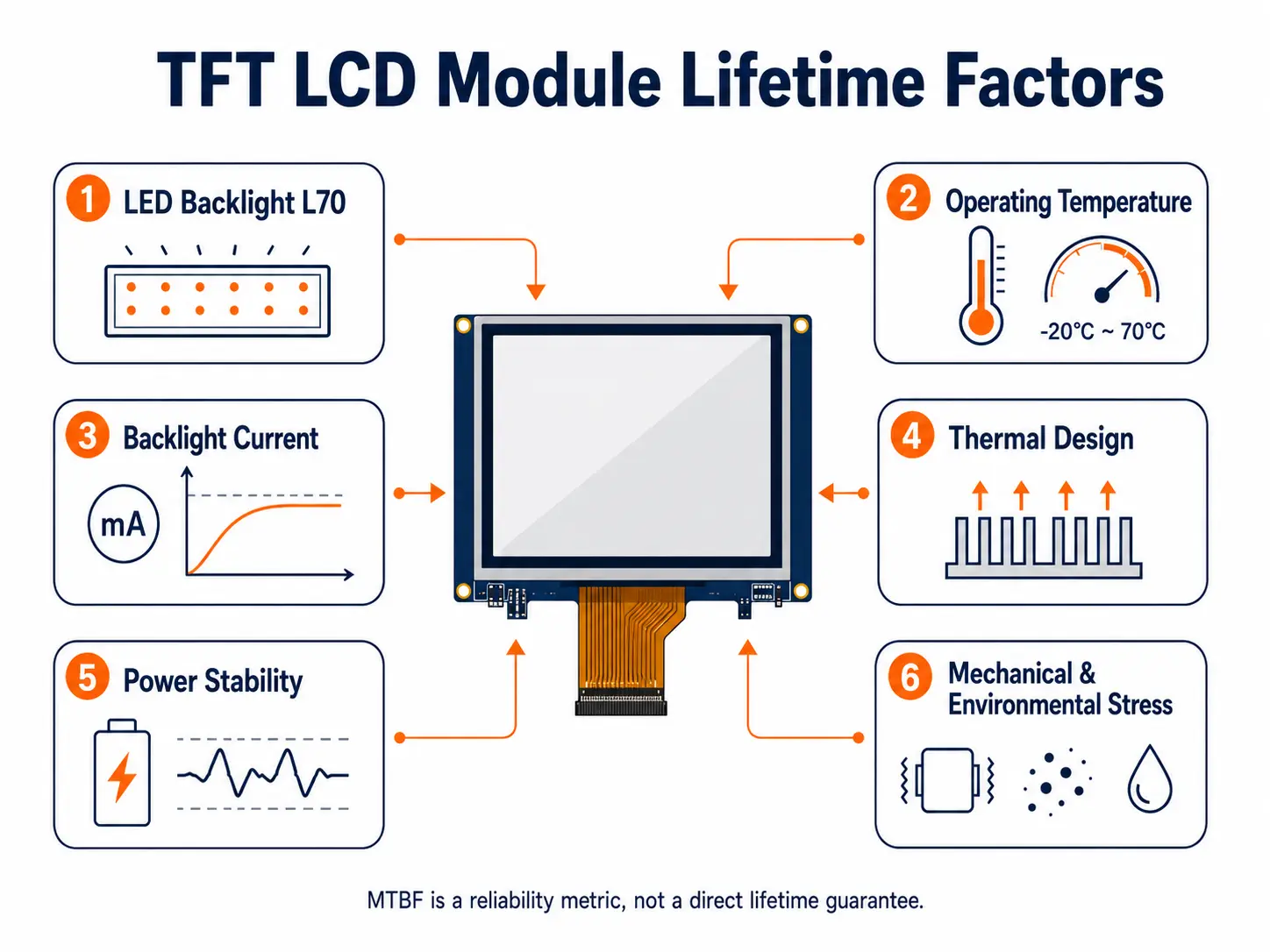
What Does TFT LCD Module Lifetime Mean?
TFT LCD module lifetime usually refers to the practical usable period during which the module can continue to meet application requirements. This may include acceptable brightness, stable image performance, normal electrical operation, reliable touch function, and mechanical integrity.
In real applications, LCD module lifetime depends on many factors, including:
- LED backlight degradation
- Operating temperature
- Backlight current setting
- Thermal management
- Power supply stability
- Humidity and condensation exposure
- Vibration or mechanical stress
- Display duty cycle
- Touch panel structure
- Optical bonding or cover glass design
- Driver IC and FPC reliability
Because of these variables, LCD module lifetime should be evaluated under the intended operating conditions, not only by reading a single number in a datasheet.
MTBF Is Not the Same as Service Life
MTBF stands for Mean Time Between Failures. It is a statistical reliability metric commonly used for repairable systems or assemblies. It estimates the average operating time between failures across a population of products under defined conditions.
MTBF should not be interpreted as the guaranteed life of one individual LCD module. For example, an MTBF value of 50,000 hours does not mean that every display will operate continuously for exactly 50,000 hours. It also does not mean that the module must be replaced immediately after that time.
Instead, MTBF is used to compare reliability expectations, plan maintenance intervals, estimate failure rates, and support system-level reliability calculations. A higher MTBF generally indicates lower expected failure frequency, but it is not the same as warranty period, service life, or LED backlight lumen maintenance.
This distinction is especially important for TFT LCD modules because a module contains multiple functional parts: LCD panel, LED backlight, driver IC, flexible printed circuit, connector, touch panel, cover glass, optical films, and sometimes a controller board. Each part may have a different reliability profile.
LED Backlight Lifetime and L70
Most modern transmissive TFT LCD modules use LED backlights. The backlight is one of the most important lifetime-related components because LEDs gradually lose brightness over time.
LED backlight lifetime is often described using L70, which means the time at which the light output has decreased to 70% of its initial value. L70 is not the point of complete failure. It is a lumen maintenance benchmark used to define useful light output. A display can still operate after reaching L70, but it may no longer meet the brightness requirement of the application.
For example, if a display starts at 1000 nits and its backlight reaches L70, the brightness may have declined to approximately 700 nits under the relevant test conditions. Whether this is acceptable depends on the application. A 700-nit display may still be usable indoors, but it may no longer be sufficient for a sunlight-readable outdoor kiosk.
Why Backlight Lifetime Depends on Operating Conditions
LED backlight lifetime is highly dependent on temperature and current. Higher LED current can increase brightness, but it also increases heat. Higher operating temperature accelerates LED lumen depreciation and may reduce the lifetime of optical films, adhesives, and electronic components.
Important factors include:
- LED junction temperature
- Ambient temperature
- Backlight driving current
- Heat dissipation design
- Display enclosure ventilation
- Duty cycle and dimming strategy
- Optical film aging
- Power supply ripple and surge protection
For high-brightness LCD modules, thermal design is especially important. A display configured for 1500 nits or 2500 nits may require stronger LEDs and better heat management than a standard 300–500 nit module. Without proper thermal control, brightness decay may occur faster than expected.
LCD Panel Lifetime vs Backlight Lifetime
The LCD cell itself and the LED backlight do not age in exactly the same way. The LCD panel includes glass substrates, liquid crystal material, alignment layers, polarizers, color filters, transparent electrodes, and TFT arrays. The LED backlight includes LEDs, light guide plate, diffuser films, prism films, reflector, and sometimes a metal frame for thermal dissipation.
In many practical TFT LCD modules, the backlight is the dominant lifetime-limiting factor because brightness gradually decreases with use. However, other parts can also affect lifetime:
- Polarizer degradation under heat and UV exposure
- Yellowing or aging of optical films
- FPC fatigue from bending or vibration
- Connector oxidation or poor contact
- Touch panel delamination
- Cover glass adhesive aging
- Driver IC or power circuit failure
- Moisture ingress in harsh environments
Therefore, a complete lifetime evaluation should consider the whole display module, not only the LED backlight.
Operating Temperature and Reliability
Operating temperature is one of the most important reliability factors for TFT LCD modules. Standard commercial LCD modules may only support a limited temperature range, while industrial LCD modules often support wider ranges such as -20°C to 70°C or -30°C to 80°C depending on the design.
Low temperatures may increase liquid crystal viscosity, causing slower response time or image lag. High temperatures may accelerate backlight aging, polarizer degradation, adhesive aging, and electronic component stress.
For industrial and outdoor applications, engineers should check:
- Operating temperature range
- Storage temperature range
- High-temperature brightness stability
- Low-temperature response behavior
- Thermal simulation or test data
- Backlight derating recommendations
- Enclosure-level heat dissipation
A display that performs well in a laboratory may not maintain the same lifetime inside a sealed outdoor enclosure exposed to sunlight and high ambient temperature.
Brightness Setting and Lifetime Trade-Off
Backlight brightness is not free. Increasing brightness usually requires higher LED current, which increases power consumption and thermal load. This can shorten useful backlight life if the module is not properly designed.
For applications that do not require maximum brightness at all times, dimming control can improve long-term reliability. Common approaches include:
- PWM dimming
- DC dimming
- Ambient light sensor control
- Automatic day/night brightness adjustment
- Reduced brightness during standby
- Thermal derating at high temperature
For outdoor displays, a well-designed brightness control strategy can help balance sunlight readability, power consumption, heat generation, and backlight lifetime.
How to Read Lifetime Specifications Correctly
When reviewing a TFT LCD datasheet or supplier specification, buyers should avoid relying on one number alone. A more accurate review should include the following questions:
- Is the stated lifetime referring to LED backlight L70, MTBF, or module service life?
- Under what temperature and current conditions was the value measured or estimated?
- Is the backlight lifetime based on typical brightness or maximum brightness?
- Does the value include the LCD panel, backlight, driver IC, touch panel, and controller board?
- Is the display intended for indoor, outdoor, industrial, or automotive use?
- Are thermal design recommendations provided?
- Is long-term supply and replacement compatibility required?
These questions are especially important for B2B applications where the LCD module may be integrated into equipment expected to remain in production or service for many years.
Practical Lifetime Guidance for Industrial LCD Selection
For industrial display applications, engineers should evaluate lifetime at the system level. A display module should be matched with the final enclosure, power architecture, thermal environment, and user interface requirements.
For indoor control panels, moderate brightness and stable thermal conditions may allow long service life. For outdoor kiosks or transportation displays, high brightness, optical bonding, anti-glare cover glass, and thermal dissipation become more important. For medical or marine applications, reliability, documentation, supply stability, and environmental resistance may be as important as optical performance.
A well-selected TFT LCD module should provide:
- Suitable brightness for the application
- Appropriate operating temperature range
- Stable interface compatibility
- Reliable backlight design
- Mechanical structure suitable for installation
- Touch panel options if required
- Long-term supply support
- Clear datasheet specifications
Common Mistakes When Comparing LCD Lifetime
A common mistake is treating MTBF as if it were the exact operating lifetime of a single LCD module. Another mistake is assuming that LED backlight lifetime means the display will fail completely at the stated hour rating. In reality, LED backlight life usually refers to lumen maintenance, while MTBF refers to statistical reliability.
Another frequent mistake is comparing lifetime values without checking test conditions. A backlight lifetime measured at room temperature and moderate current may not apply to a high-brightness display installed in a sealed outdoor enclosure.
It is also important to distinguish between consumer display usage and industrial display usage. Consumer devices may be replaced after a few years, while industrial systems may need stable operation, spare part availability, and consistent optical performance over a much longer product cycle.
Conclusion
TFT LCD module lifetime should be understood as a combination of backlight lumen maintenance, panel reliability, electronic component durability, mechanical design, and actual operating conditions. MTBF, service life, and LED backlight L70 lifetime are related but not interchangeable.
For engineering evaluation, MTBF should be treated as a statistical reliability metric, while LED backlight lifetime should be interpreted through lumen maintenance and operating conditions. The most reliable display selection process considers the complete module, the final application environment, and the required brightness, temperature, interface, and mechanical constraints.
Technical Notes
MTBF, service life, and LED backlight lifetime are often used together in display specifications, but they describe different aspects of reliability. MTBF is a statistical reliability metric, while LED backlight lifetime is commonly associated with lumen maintenance such as L70. Actual TFT LCD module lifetime depends on operating temperature, brightness setting, current, thermal design, duty cycle, and the final application environment.