Freya Yang
+86 18318948097
+852 62667476
3.7 Inch Epaper E-Ink Status Display Panel for Embedded Devices
Model P/N
Size
Resolution
Brightness
Viewing Angle
Connector Type
Operating Temp
Overall(mm)
huisoar
HS0325EK-1
Brand
Panel Size (inch)
Model P/N
Resolution
Viewing Angle
Response Time
Overall (mm)
Active Area (mm)
Refresh Rate
Display Colors
Panel Type
Connector Type
Operating Temp
Touchscreen Type
Storage Temp
Work Mode
Weight (g)
Designed For
3.7 Inch Epaper E-Ink Status Display Panel for Embedded Devices
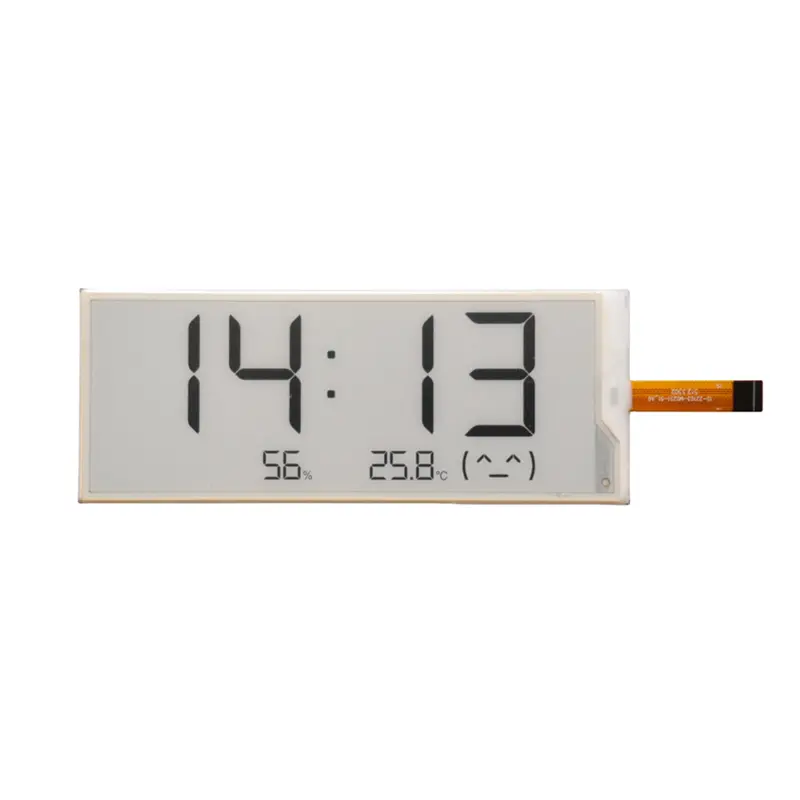
A slim black-and-white electronic-paper panel for narrow embedded status windows, using 3-wire SPI and a 10-pin FPC.
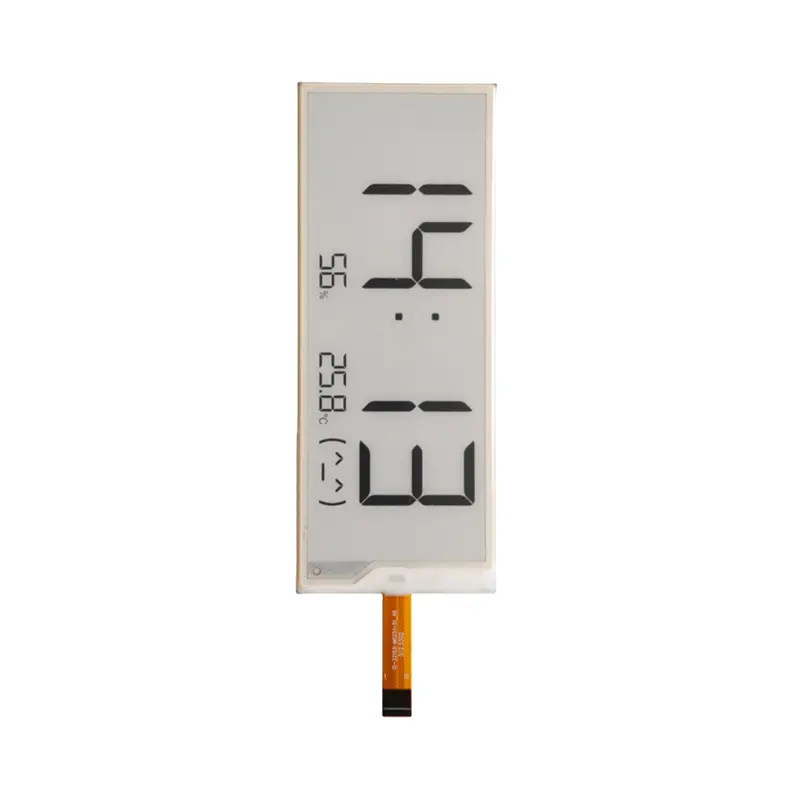
An Epaper E-Ink Status Display Panel is a practical choice when an embedded product needs to present time, measurements, identifiers, settings, or other information that changes periodically rather than continuously. This 3.7-inch black-and-white panel combines a 29.74 × 76.93 mm active area with a 38.0 × 97.1 × 0.98 mm outline, a 5.22 ± 0.5 g module weight, and a 3-wire SPI interface. Its long, slim geometry suits status windows and compact information surfaces where a conventional wide display would consume unnecessary front-panel space.
Product Summary
The module uses compact mechanics and a serial host connection. A 10-pin FPC with a 0.5 mm pitch provides the physical connection, while 3-wire SPI defines the confirmed communication interface. The standard display version is black and white.
The native pixel or segment map, controller IC, drive voltage, waveform package, refresh time, and partial-refresh capability are not confirmed. These items should be locked before firmware, PCB layout, or artwork is released.
Key Specifications at a Glance
| Parameter | Confirmed value |
|---|---|
| Display size | 3.7 inches |
| Display technology | E-paper / E-Ink |
| Display color | Black and white |
| Active area | 29.74 × 76.93 mm |
| Module outline | 38.0 × 97.1 × 0.98 mm |
| Module weight | 5.22 ± 0.5 g |
| Interface | 3-wire SPI |
| Connector | 10-pin FPC |
| FPC pitch | 0.5 mm |
Narrow Mechanical Format for Embedded Status Windows
Active Area and Module Outline Serve Different Design Tasks
The 29.74 × 76.93 mm active area defines the usable information region, while the 38.0 × 97.1 × 0.98 mm outline defines the full module envelope. Enclosure engineers should keep those dimensions separate when planning the front opening, border allowance, retention structure, and cable exit.
Thin and Lightweight Construction Supports Compact Packaging
At 0.98 mm thick and 5.22 ± 0.5 g, the panel fits products where front-panel depth and mass need to remain low. The slim format also leaves room for the host PCB, battery, sensors, or enclosure features behind the display.
Thin construction does not establish a qualified bend radius. Curved installation requires a confirmed bend condition, support structure, and mechanical limit for the ordered revision.
3-Wire SPI Interface and Host Qualification
A 10-Pin Connector Match Is Only the Starting Point
The confirmed interface is 3-wire SPI through a 10-pin, 0.5 mm-pitch FPC. A host board should not be approved only because another module uses the same pin count or pitch. The complete pin assignment, contact side, cable orientation, SPI mode, clock limits, reset behavior, busy signaling, and logic levels still need to match the production panel.
A 10-pin FPC match alone does not establish SPI pin mapping, voltage, timing, or waveform compatibility.
Native Addressing Must Be Locked Before UI Conversion
The display artwork and firmware buffer should be built around the approved native pixel or segment map. Because the available product material contains conflicting resolution wording, the approved production drawing and controller documentation should control release.
The native pixel or segment map must be confirmed before firmware and artwork are released.
Integrating the Epaper E-Ink Status Display Panel
Controller and Waveform Data Are Part of the Display Design
Electronic-paper updating requires more than moving image data across SPI. Controller definition, waveform or LUT resources, busy-state behavior, and the correct full-refresh procedure can affect update quality. Partial refresh should not be assumed simply because the panel is black and white.
Request the current controller and waveform package before adapting code from another e-paper module.
Voltage and Power Data Must Match the Ordered Revision
No exact panel input-voltage or refresh-power value is confirmed for this module. The host power architecture should remain open until the electrical specification is approved.
No panel input-voltage or refresh-time figure is confirmed for this module.
When Electronic Paper Fits Better Than a Conventional LCD
Electronic paper is best aligned with static or relatively low-update content. This makes the module a stronger fit for clocks, measurements, identifiers, equipment state, menu values, and status summaries than for video or rapid animation. The project should treat it as an E-paper/E-Ink component rather than a conventional LCD throughout electrical, optical, and content planning.
Application Direction for Compact Embedded Devices
The Epaper E-Ink Status Display Panel can support environmental and measurement indicators, handheld-equipment readouts, smart-device status windows, controller front panels, and other low-update embedded information interfaces. Its 29.74 × 76.93 mm active area provides a long presentation zone, while the 38.0 × 97.1 × 0.98 mm outline keeps the assembly mechanically narrow.
Final application approval should consider update frequency, operating environment, front-window design, host interface, and power architecture. No outdoor, medical, automotive, waterproof, touch, or front-light qualification should be inferred from the panel format alone.
Customization and Integration Boundaries
Project review can cover FPC geometry and orientation, connector definition, complete SPI pin mapping, controller and waveform support, front-window design, enclosure adaptation, branding, and packaging.
Custom configurations are generally reviewed from 500 pieces, subject to tooling requirements, material availability, and the requested specification. Sample and standard-module quantities are confirmed separately.
Procurement Checklist
Before prototype or production approval, confirm the 3.7-inch product revision, black-and-white version, native pixel or segment map, exact resolution, complete 10-pin assignment, 0.5 mm FPC pitch and contact side, 3-wire SPI mode and timing, logic and display-drive voltages, controller IC, waveform or LUT package, full-refresh behavior, partial-refresh support if required, refresh time, update and sleep power, 29.74 × 76.93 mm active area, 38.0 × 97.1 × 0.98 mm outline, 5.22 ± 0.5 g module weight, operating and storage limits, touch or front-light requirements, sample quantity, and annual demand.

FAQ
About 3.7 Inch Epaper E-Ink Status Display Panel
What must be checked before connecting the 10-pin SPI FPC?
How should the display resolution be handled before firmware is finalized?
What refresh information is needed before choosing an update strategy?
Can the 0.98 mm panel be used in a curved enclosure?
When should this panel be selected instead of a conventional LCD?
Freya Yang
+86 18318948097