
~
~
~
~
~
~
P550HVN06.7 2500-Nit Outdoor AMVA3 Signage Panel AUO

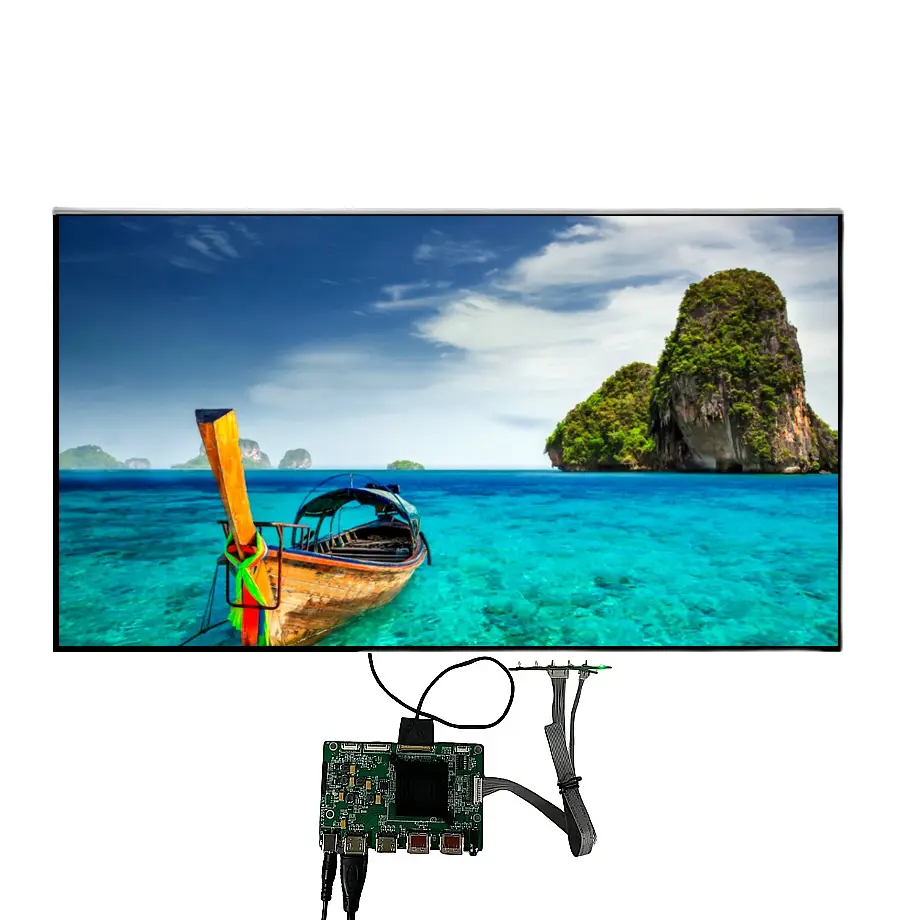
Model P/N
Size
Resolution
Brightness
Viewing Angle
Connector Type
Operating Temp
Overall(mm)
auo
P550HVN06.7
Brand
Panel Size (inch)
Model P/N
Resolution
Brightness (nits)
Viewing Angle
Contrast Ratio
Response Time
Overall (mm)
Active Area (mm)
Refresh Rate
Display Colors
Panel Type
Connector Type
Surface Treatment
Operating Temp
Touchscreen Type
Storage Temp
Work Mode
Pixel Format
Input Voltage (V)
Vibration Resistance
Weight (g)
Designed For
Product Details
P550HVN06.7 2500-Nit Outdoor AMVA3 Signage Panel is a 55-inch AUO a-Si TFT-LCD module specified for digital signage and outdoor high-brightness use. Its 2500 cd/m² typical luminance, 6000:1 typical contrast, low-reflection antiglare surface and 55-inch FHD format create a component profile for bright public-information displays. The module can be evaluated in landscape or portrait orientation, but outdoor use remains a property of the complete enclosure and optical stack—not of panel luminance alone.
Large high-brightness signage has three coupled design problems: optical efficiency through the front window, heat generated at sustained brightness, and mechanical support of a heavy panel. The production review should connect those disciplines early. A sign that looks bright on a bench can lose contrast behind reflective cover glass or exceed thermal limits after solar loading in a sealed cabinet.
Three buyer value propositions
2500-nit component baseline for high-ambient signage
The exact module is specified at 2500 cd/m² typical luminance and is explicitly positioned for outdoor high-brightness digital signage. This gives integrators a documented starting point for bright public displays without having to infer outdoor intent from luminance alone. The finished sign still needs cover-glass, reflection, solar-load and dimming validation before any system-level sunlight-readability claim.
6000:1 AMVA3 contrast with low-reflection antiglare surface
The 6000:1 typical contrast ratio is paired with an antiglare Haze 2.5% surface, 3H hard coat and 2.0% maximum reflection wording. Those parameters are relevant when viewing conditions include strong ambient light or polarized sunglasses. They should be verified through the actual front window because protective glass and optical gaps can materially change final reflection performance.
Landscape or portrait signage orientation with integrated LED driver
The exact-model evidence supports landscape/portrait signage positioning and a WLED system with an integrated driver and 50,000-hour rating. That can simplify system architecture for large-format public information displays while keeping orientation and service planning explicit. Mechanical support and cooling still need to be qualified for the 15 kg panel in the chosen orientation.
Key Specifications at a Glance
Use this exact-model baseline when evaluating P550HVN06.7 2500-Nit Outdoor AMVA3 Signage Panel for a signage enclosure.
| Brand | AUO |
|---|---|
| Model P/N | P550HVN06.7 |
| Size | 55 inch |
| Resolution | 1920(RGB)×1080, FHD, 16:9 |
| Active Area | 1209.6×680.4 mm (H×V) |
| Overall | 1235.6×706.4×58.2 mm |
| Brightness | 2500 cd/m² (Typ.) |
| Viewing Angle | 89/89/89/89 (Typ.)(CR≥10) |
| Display Colors | 16.7M/1.07B, 72% NTSC |
| Weight | 15.0 kg (Typ.) |
| Refresh Rate | 60 Hz |
| Connector / Native Interface | LVDS (2 ch, 10-bit), 51 pins 0.5 mm connector |
| Input Voltage | 12.0 V (Typ.) |
| Maximum Power | 233.2 W (Typ.) |
| Operating Temperature | -20 ~ 60 °C |
| Storage Temperature | -20 ~ 60 °C |
| Vibration | 1.0G (9.8 m/s²) |
| Panel Type | a-Si TFT-LCD, LCM |
| Pixel Format | RGB Vertical Stripe |
| Surface Treatment | Antiglare (Haze 2.5%), Hard coating (3H), Reflection 2.0% (Max.) |
| Contrast Ratio | 6000:1 (Typ.) |
| Response Time | 8 ms (Typ.)(G to G) |
| Work Mode | AMVA3, Normally Black, Transmissive |
| Backlight / Emission | 50,000 hours (WLED, integrated LED driver) |
| Designed For | Digital signage; outdoor high-brightness signage; landscape or portrait installations subject to full-system environmental qualification |
| Touchscreen Type | Without touch screen |
Outdoor optical stack: budget light in both directions
Start with the panel's 2500 cd/m² typical luminance, then account for every layer placed in front of it. Cover-glass transmission, protective coatings, bonding or air gaps and surface reflection all affect emitted light. At the same time, those surfaces send ambient light back toward the viewer. Measure the assembled sign in representative sunlight or high-ambient conditions rather than extrapolating finished readability from the bare-panel luminance value.
The panel surface is specified with 2.5% haze, 3H hard coating and 2.0% maximum reflection wording. Those values are valuable inputs when choosing front-window treatments, but they do not survive unchanged once a new optical surface is added. If polarized sunglasses are part of the usage scenario, validate the actual landscape or portrait optical stack at the viewing angles expected in the field.
Turn 233.2 W into a cabinet thermal model
P550HVN06.7 2500-Nit Outdoor AMVA3 Signage Panel has 233.2 W typical total panel power in the supplied parameters. Use that figure to build a heat-load budget alongside the scaler/controller, media player, network hardware, fans and any heaters. A sealed or filtered enclosure can reach temperatures far above ambient, especially under solar load. Place sensors near the panel and power electronics during chamber or field simulation so the -20 to 60 °C operating boundary is evaluated at the component, not only outside the cabinet.
The WLED backlight includes its LED driver and is rated at 50,000 hours. Service planning can use that documented component rating, but real field life depends on brightness duty cycle, temperature and system conditions. If ambient-light dimming is used, document the control range and fail-safe behavior rather than assuming the display operates continuously at maximum output.
12 V distribution for a high-power panel
The display input is 12.0 V typical. At this power level, internal harness resistance, connector current capacity and distribution topology can matter. Measure voltage at the panel connector at startup and sustained maximum-brightness operation. Keep panel power separate from the controller or auxiliary loads where the system architecture requires independent protection, and verify recovery after brownout or source switching.
Panel-facing LVDS is not the same as the player input
The native panel interface is dual-channel 10-bit LVDS through a 51-pin 0.5 mm connector. A media player may output HDMI or DisplayPort to a scaler, but the scaler's panel side still must match AUO timing, bit depth, pin assignment and voltage behavior. Test the production cable for clock/data integrity, grounding and connector retention. Long-duration playback and repeated power cycling are appropriate first-article cases for a digital-signage product.
Landscape versus portrait mechanics
The module outline is 1235.6×706.4×58.2 mm and the typical mass is 15 kg. Rotation changes the direction of gravity relative to the frame, cable and convection path. Review rear mounting points, chassis stiffness, bezel contact and service access separately for the chosen orientation. A portrait sign should not simply reuse a landscape mounting assumption without checking localized stress and the manufacturer's exact drawing.
What the high-temperature liquid-crystal note does and does not prove
The supporting exact-model description references high-Tni liquid crystal. That is relevant to thermal robustness of the panel technology, but it does not replace the stated -20 to 60 °C operating range and does not certify the complete enclosure for direct-sun exposure. System qualification should remain bounded by the approved component limits and actual measured cabinet temperatures.
Signage release dossier
Approve P550HVN06.7 2500-Nit Outdoor AMVA3 Signage Panel with a record containing the exact AUO model, 51-pin LVDS cable, controller timing, 12 V distribution, enclosure orientation, optical-stack materials, thermal test results and brightness-control policy. That dossier allows later service or sourcing decisions to distinguish a genuinely compatible high-brightness replacement from an ordinary 55-inch FHD panel.
Recommended: Same Size
(55")
Applications & Value of LCD Panel

- Fast sourcing with in-stock panels & cross-reference alternatives
- Stable supply chain with long-term availability
- Engineering-level support from panel to integration
- Custom solutions: cable, touch & optical bonding
- Strict quality control with IQC / OQC / aging test
- Full traceability system for quality assurance
- Complete technical documentation & drawings
- Compliance support: RoHS & certification files
