
~
~
~
~
~
~
TM043NDHG22-00 WQVGA Portable Navigation LCD 4.3 Inch Tianma
Model P/N
Size
Resolution
Brightness
Viewing Angle
Connector Type
Operating Temp
Overall(mm)
tianma
TM043NDHG22-00
Brand
Panel Size (inch)
Model P/N
Resolution
Brightness (nits)
Viewing Angle
Contrast Ratio
Response Time
Overall (mm)
Active Area (mm)
Refresh Rate
Display Colors
Panel Type
Connector Type
Operating Temp
Touchscreen Type
Storage Temp
Work Mode
Pixel Format
Designed For
Product Details
Product Overview
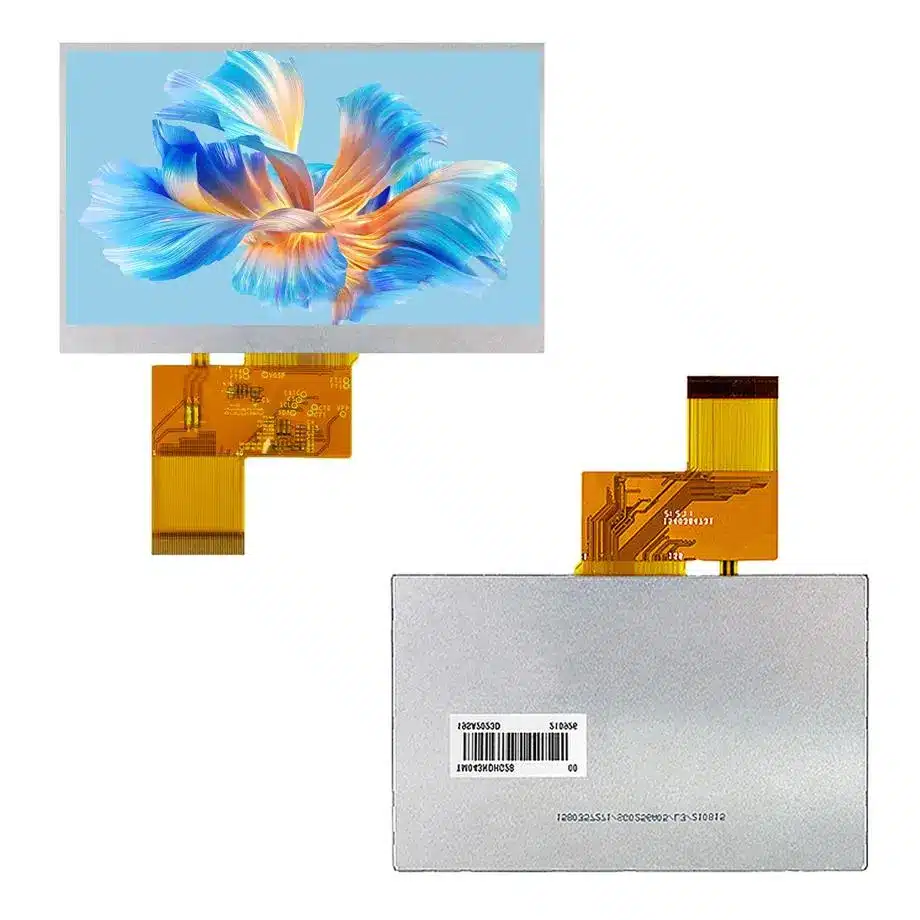
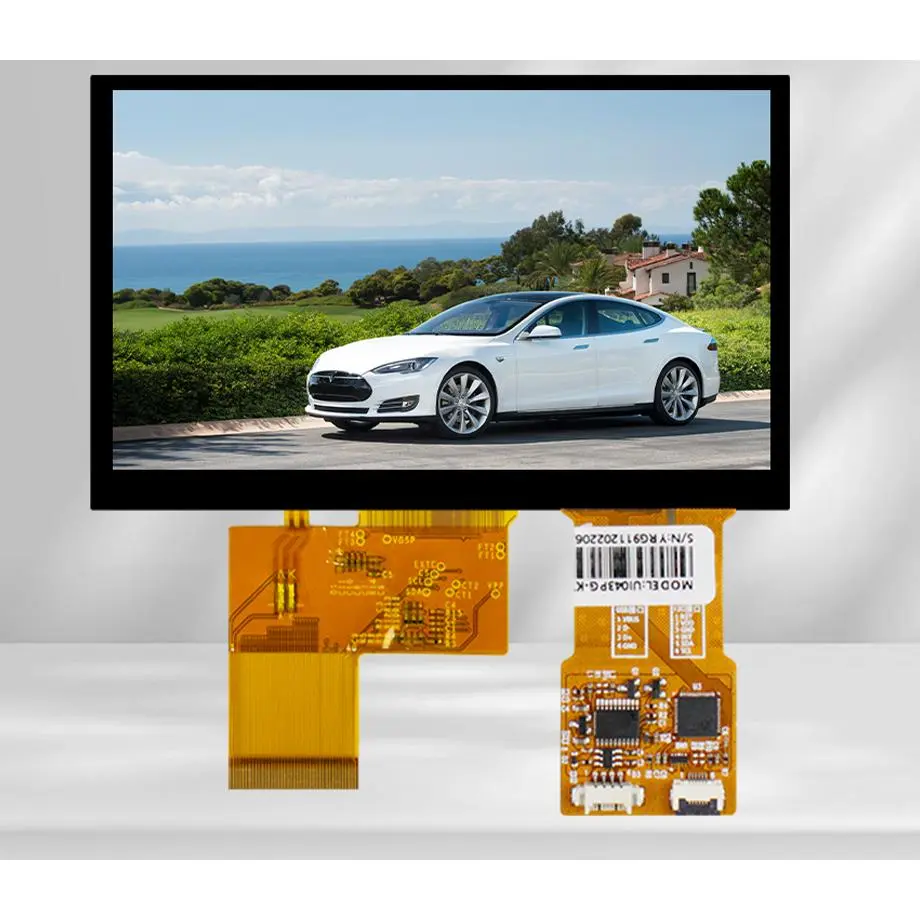
The TM043NDHG22-00 WQVGA Portable Navigation LCD is a 4.3-inch Tianma a-Si TFT-LCD module built around a native 480(RGB)×272 WQVGA image in a 16:9 format. The active image area is 95.04 × 53.856 mm, using an RGB vertical-stripe pixel arrangement. The display operates in TN normally-white transmissive mode, supports 16.7 million colors and is specified for a 60 Hz refresh rate. Its listed contrast ratio is 900:1 typical, with a 20 ms typical Tr+Td response time.
This module includes a WLED backlight but no backlight driver, and it is supplied without touch. The documented application direction is Handheld & PDA / Portable Navigation. The model also carries an operating range of -20 to 70 °C and a storage range of -30 to 80 °C. Several integration details are not defined in the available model specifications, including finished outline dimensions, luminance, viewing-angle values, panel supply voltage and the exact display protocol behind the FPC connection. Those items should be confirmed from current Tianma documentation before a cable, controller or housing is released.
Three Core Buyer Value Propositions
WQVGA geometry gives a compact 16:9 baseline for portable interfaces
The 480×272 raster and 95.04 × 53.856 mm active area provide a clearly defined image window for compact navigation, handheld and portable-device interfaces. That helps mechanical and UI teams establish aspect ratio, visible area and pixel budget early in the project. The engineering boundary is equally important: an active-area match does not prove that the module will fit an existing enclosure, because the overall outline, connector position, mounting details and tolerances still require the exact drawing.
Wide storage and operating ranges support portable thermal screening
The -20 to 70 °C operating range and -30 to 80 °C storage range give designers a concrete component-level thermal envelope. For portable navigation or field equipment, this is useful for cold-start and elevated-enclosure screening. It is not an automotive, outdoor or rugged certification. Display temperature can differ from ambient because of processor heat, enclosure solar loading, backlight power and local airflow, so qualification should measure the assembled product rather than relying on chamber set-point alone.
Separate backlight driving keeps the illumination architecture under system control
The integrated WLED light source is specified without a driver. That lets the equipment designer choose the driver architecture and brightness-control method that fit the host power tree, but it also means the module cannot be treated as a complete plug-in display. LED string voltage, current, dimming method, startup behavior and any backlight enable signals must come from model-specific documentation. None of those electrical values should be inferred from the words “WLED, No Driver.”
Key Specifications at a Glance
| Parameter | Specification |
|---|---|
| Manufacturer / model | Tianma TM043NDHG22-00 |
| Size / type | 4.3 inch a-Si TFT-LCD, LCM |
| Resolution | 480(RGB)×272 WQVGA, 16:9 |
| Active area | 95.04 × 53.856 mm |
| Overall dimensions | Not specified; confirm from current drawing |
| Brightness / viewing angle | Not specified |
| Contrast / response | 900:1 typical / 20 ms typical Tr+Td |
| Display mode / colors | TN normally white transmissive / 16.7M colors |
| Pixel arrangement | RGB vertical stripe |
| Refresh rate | 60 Hz |
| Connection | FPC; signal protocol and pin count not specified |
| Panel supply | Not specified |
| Backlight | WLED, without backlight driver |
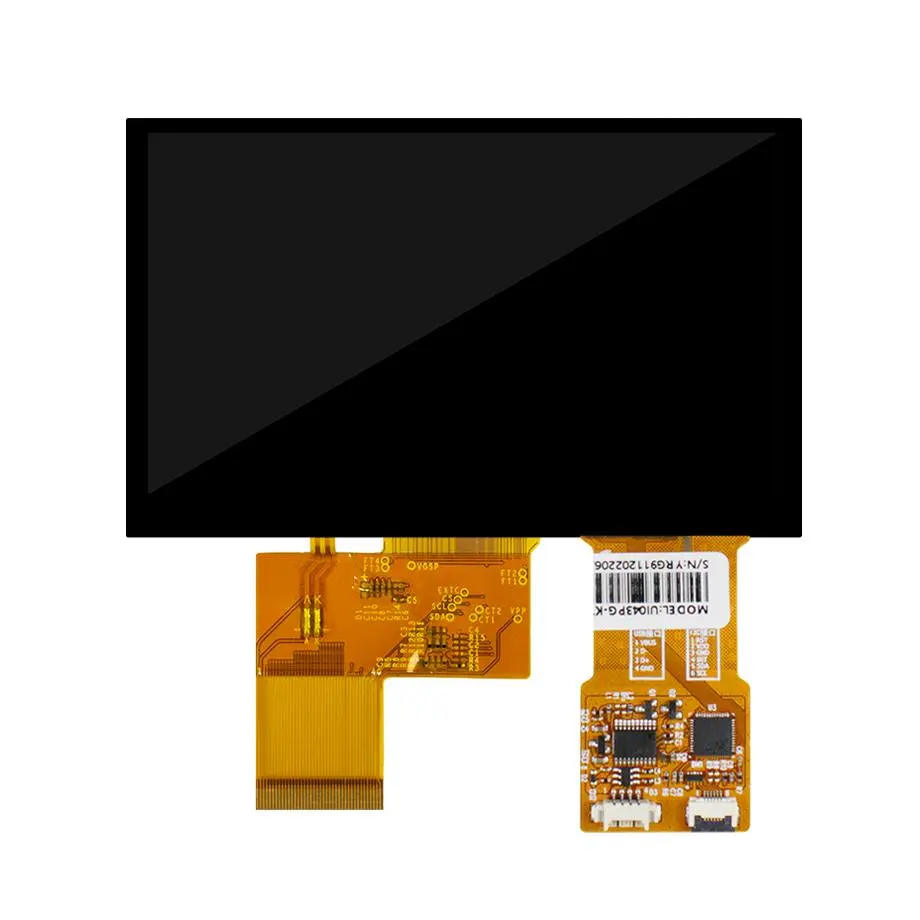
| Touch | Without touch screen |
| Temperature | Operating -20 to 70 °C; storage -30 to 80 °C |
| Designed for | Handheld & PDA / Portable Navigation |
What must be confirmed before connecting the FPC?
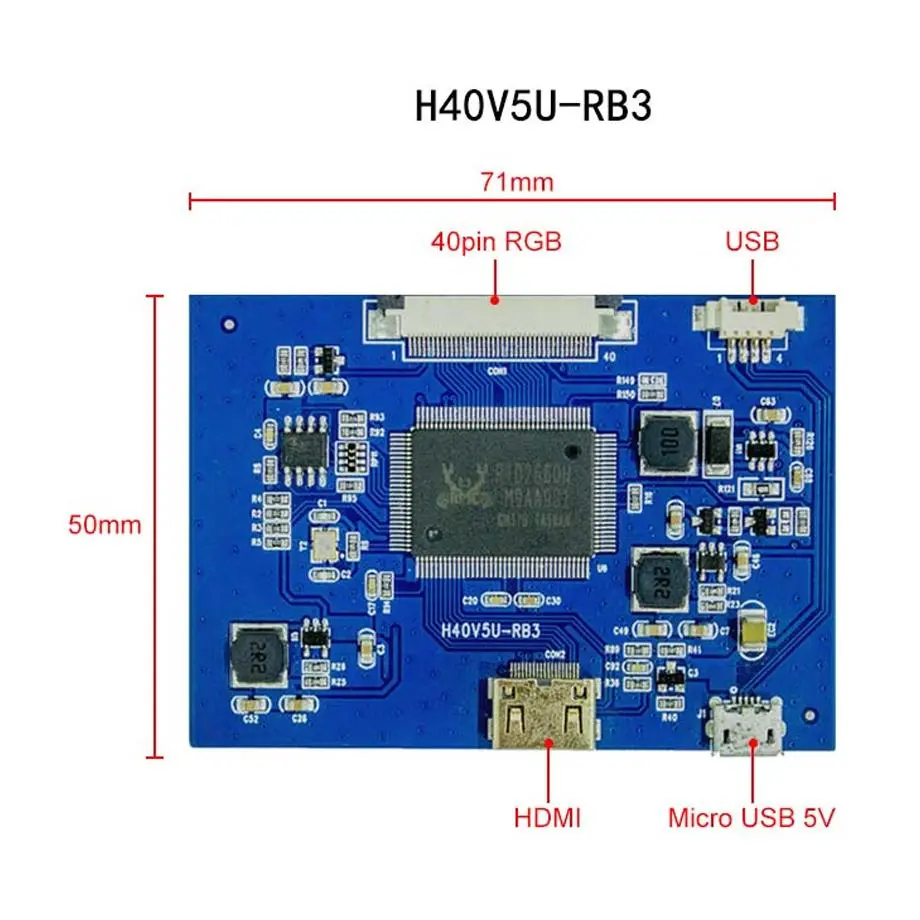
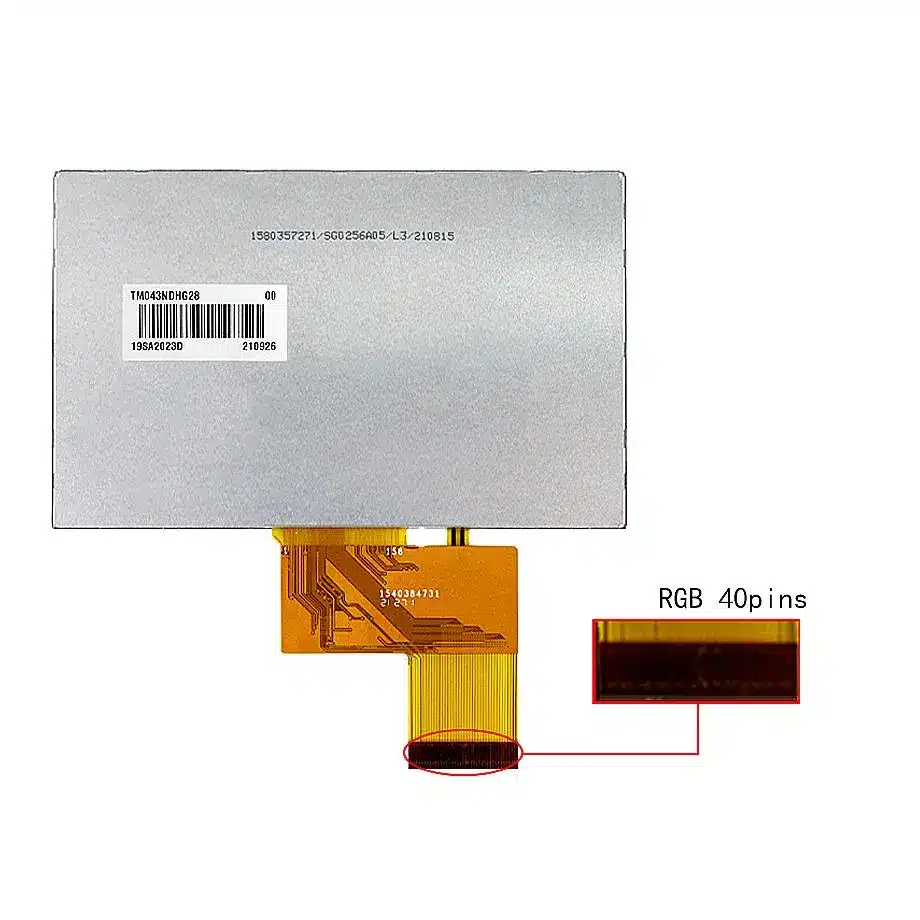
The TM043NDHG22-00 WQVGA Portable Navigation LCD is listed with an FPC connection, but an FPC is a mechanical interconnect format rather than a complete statement of display protocol. The exact signal family, pin count, contact orientation, pixel-data mapping, clocking, control lines and power contacts are not established by the available model data. A visually similar flexible cable can still be electrically incompatible. The correct engineering step is to obtain the current Tianma interface drawing and timing specification before selecting a controller board or ordering a production cable.
Tianma’s current product portfolio includes 4.3-inch WQVGA TFT modules and describes industrial and portable-device use cases across its display families (Tianma industrial displays). That provides useful manufacturer context, but family-level interface examples must not be copied into this exact model. In particular, do not assume that a nearby 4.3-inch Tianma module using RGB or another interface proves that TM043NDHG22-00 uses the same protocol.
Controller qualification should start with the exact timing table
Once the model-specific interface is confirmed, validate the released controller, cable and firmware as one system. Check the native 480×272 timing, color mapping, frame rate, startup sequence, reset behavior and image stability over repeated power cycles. If the equipment supports multiple display modes, make sure the controller does not silently fall back to a non-native timing that appears functional on a bench but creates long-term margin or image-quality problems.
How should the no-driver WLED backlight be integrated?
The module contains the WLED light source but not the driver electronics. Therefore, the host design needs a dedicated backlight-driver solution that matches the exact LED electrical requirements. The available specifications do not establish LED-string topology, forward voltage, current, dimming input or expected luminance. A generic small-panel LED driver should not be selected solely from screen size. Confirm the driver’s output range, current regulation and protection behavior against the current Tianma electrical data.
Brightness is a system result when the model luminance is not documented
Because a luminance value is not stated for this model, no finished-display brightness claim should be created from another 4.3-inch module. Driver current, diffuser design, optical films, cover-window transmission and temperature all affect the assembled result. If the application has a minimum readability requirement, define it as a system-level acceptance criterion and measure the production optical stack at representative ambient-light and thermal conditions.
Is the temperature range enough for portable navigation use?
The documented -20 to 70 °C operating range is a useful screening limit for portable navigation and handheld hardware, but it does not by itself establish suitability for a specific vehicle installation, outdoor exposure or rugged-use standard. Tianma’s public material describes portable navigation among its rugged and mobile display application areas (Tianma display applications), yet qualification remains model- and system-specific.
For a navigation device, test cold power-up, direct-sun enclosure heating where applicable, long-duration backlight operation and repeated sleep/wake cycles. If the product is mounted in a vehicle, keep the distinction between “portable navigation application” and “automotive-qualified component.” No vibration, EMC, UV, functional-safety or vehicle qualification is established for this model by the supplied specifications. Those requirements must be separately defined and verified if the target program needs them.
How does 4.3-inch WQVGA affect UI and mechanical design?
The 16:9 480×272 raster favors compact status views, menus, maps and navigation prompts rather than dense desktop-style interfaces. UI teams should confirm text size, icon legibility and map-label density on the real 4.3-inch image area rather than only in a desktop simulator. The active area of 95.04 × 53.856 mm is known, but the full module outline is not, so the bezel opening and chassis recess cannot be finalized from the active area alone.
Mechanical design should wait for the current drawing to establish module width, height, thickness, FPC exit, bend radius, mounting features and keep-out zones. If the device has a front lens or touch overlay added by the system integrator, treat that as a separate stack. The standard module is explicitly non-touch, and no cover-glass, bonding or protective-window performance is documented for the base part.
Replacement and procurement controls
For replacement work, compare the TM043NDHG22-00 WQVGA Portable Navigation LCD rather than looking only for any 4.3-inch 480×272 display. Matching criteria should include active-area position, TN normally-white behavior, color format, response characteristics, connector mechanics, signal protocol, power rails, backlight electrical requirements and temperature range. The missing interface and outline details make a current manufacturer drawing especially important before approving a substitute.
A third-party sourcing reference currently lists the model as in production, but that is only a sourcing signal and not a Tianma lifecycle commitment. Before a volume order, ask Tianma or an authorized channel to confirm the offered revision, current production status, traceability and any applicable PCN/EOL information. Distributor or marketplace stock counts should not be treated as HS-LCD inventory or as proof of a guaranteed support horizon.
Engineering Answers in Brief
TM043NDHG22-00 is a 4.3-inch Tianma WQVGA LCM with a 480×272 raster, TN normally-white transmissive mode and 60 Hz refresh rate.
The module includes WLED backlighting without a driver, so LED current, voltage and dimming remain host-design responsibilities that require exact model documentation.
The FPC connection does not identify the native display protocol by itself; the current pinout and timing specification are required before controller or cable approval.
The -20 to 70 °C operating range supports portable thermal screening but does not establish automotive, outdoor or rugged qualification.
Procurement Checklist
- Specify Tianma TM043NDHG22-00 exactly, including the full suffix.
- Request the current interface timing, FPC pin assignment, panel power requirements and startup sequence.
- Confirm the complete mechanical drawing before releasing a bezel, housing or production cable.
- Design the external WLED driver from model-specific LED voltage, current and dimming requirements.
- Validate native 480×272 operation at 60 Hz using the intended controller, cable and firmware.
- Test readability with the finished optical stack because model luminance is not documented.
- Keep vehicle, outdoor, vibration, EMC and rugged requirements as separate qualification items.
- Reconfirm revision, lifecycle status, traceability and PCN/EOL expectations before volume purchasing.
The TM043NDHG22-00 WQVGA Portable Navigation LCD provides a compact Tianma display platform with a defined active area, WQVGA geometry, broad component temperature range and separate backlight-driving requirement. A reliable production design depends on closing the still-unknown interface, power, luminance and mechanical details from current model-specific documentation before hardware release.
Recommended: Same Size
(4.3")
Applications & Value of LCD Panel

- Fast sourcing with in-stock panels & cross-reference alternatives
- Stable supply chain with long-term availability
- Engineering-level support from panel to integration
- Custom solutions: cable, touch & optical bonding
- Strict quality control with IQC / OQC / aging test
- Full traceability system for quality assurance
- Complete technical documentation & drawings
- Compliance support: RoHS & certification files
