Freya Yang
+86 18318948097
+852 62667476
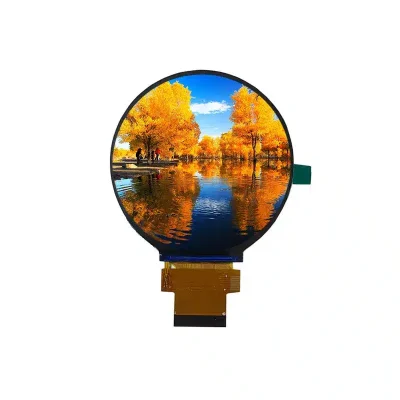
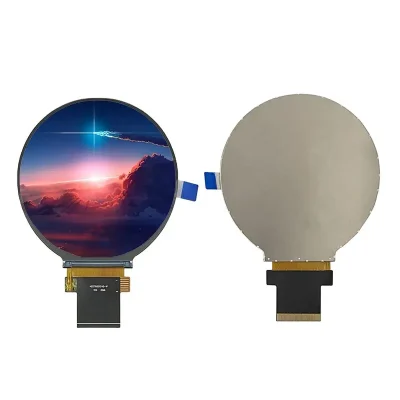
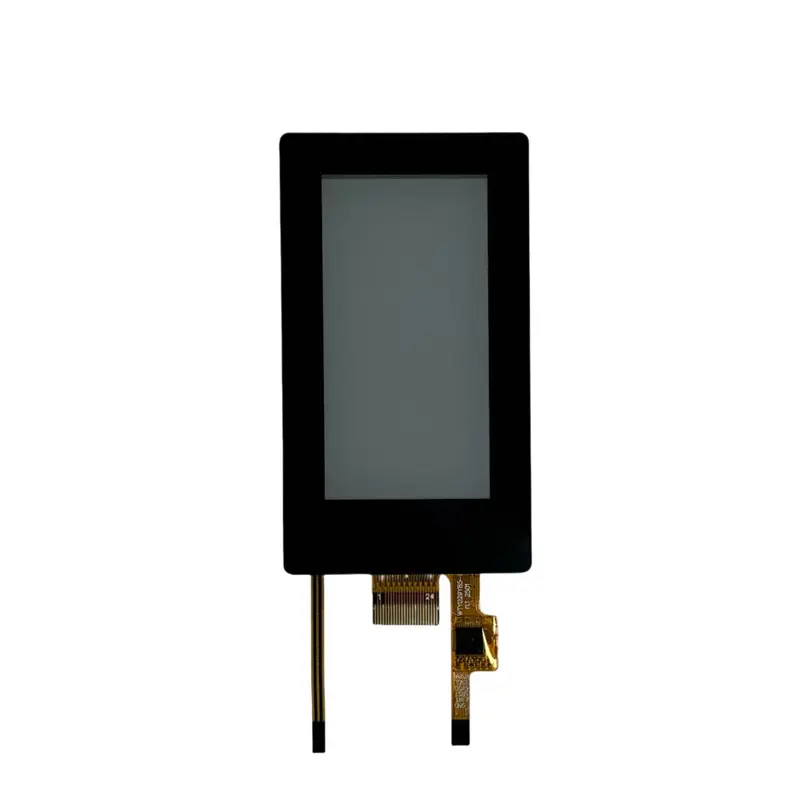
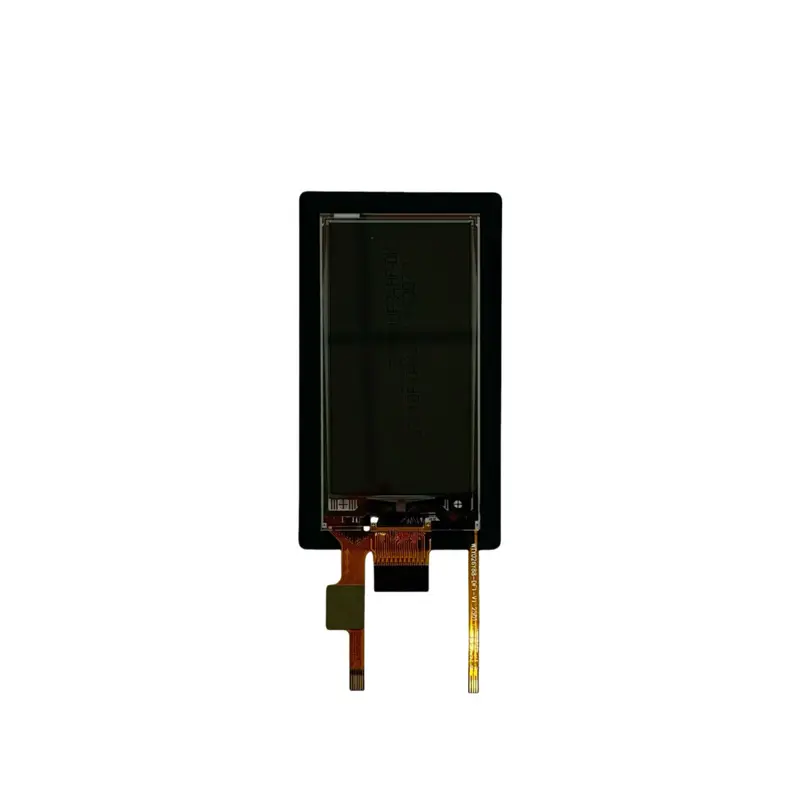
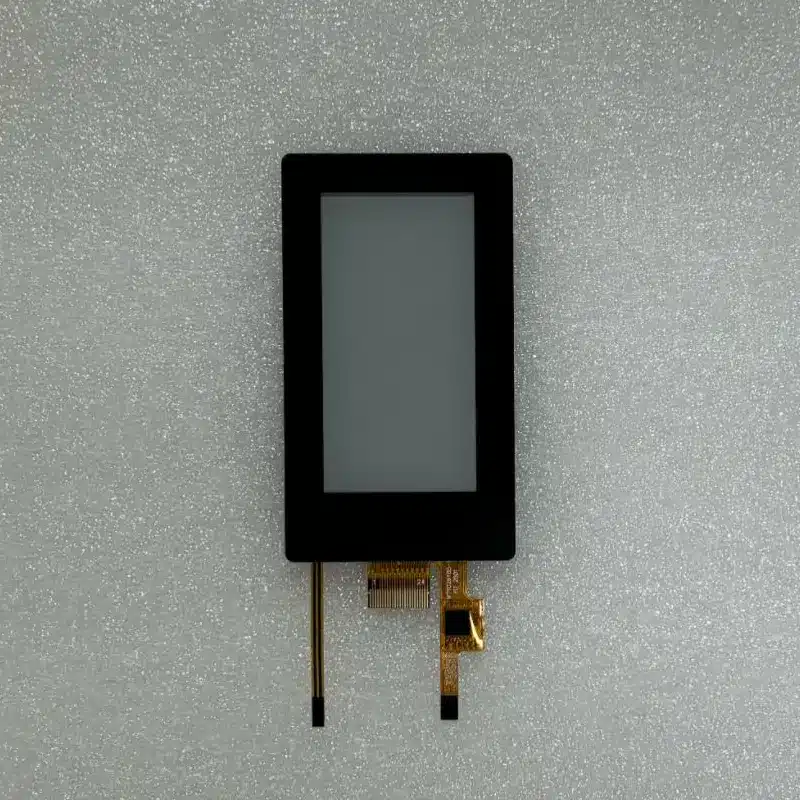
2.8 Inch High Resolution Portrait TFT Display Module for Handhelds
Model P/N
Size
Resolution
Brightness
Viewing Angle
Connector Type
Operating Temp
Overall(mm)
huisoar
HS028VGFPD047
Brand
Panel Size (inch)
Model P/N
Resolution
Brightness (nits)
Viewing Angle
Contrast Ratio
Response Time
Overall (mm)
Active Area (mm)
Refresh Rate
Display Colors
Panel Type
Connector Type
Surface Treatment
Operating Temp
Touchscreen Type
Storage Temp
Work Mode
Pixel Format
Input Voltage (V)
Operating Environment
Designed For
2.8 Inch High Resolution Portrait TFT Display Module for Handhelds
A compact 480×640 LTPS IPS module using 3-wire SPI control and parallel RGB pixel data for handheld instruments and portable terminals.
Product Summary
The High Resolution Portrait TFT Display Module is a 2.8-inch color display component for compact devices that need a tall 480×640 interface, wide-angle viewing, and a slim envelope. The standard configuration combines a transmissive, normally black LTPS TFT panel with 670 cd/m² luminance, an 800:1 listed contrast ratio, a 45-pin FPC, and a 3.3 V logic supply.
The ordered SPI+RGB configuration is not the same as the separately listed MIPI model. The standard module is non-touch; capacitive touch is a separate C026A configuration requiring its own drawing and controller-interface approval.
A 45-pin connector and an ST7701S name do not establish compatibility without the approved pin assignment, RGB timing, SPI command package, power sequence, and FPC orientation.
Key Specifications at a Glance
| Parameter | Confirmed value |
|---|---|
| Display size | 2.8 inches |
| Resolution | 480 × 640 pixels |
| Orientation | 3:4 portrait |
| Panel technology | LTPS TFT, IPS/all-view |
| Operating mode | Transmissive, normally black |
| Luminance | 670 cd/m² |
| Contrast ratio | 800:1 listed |
| Interface | 3-wire SPI + 16/18/24-bit parallel RGB |
| Connection | 45-pin FPC, 0.5 mm pitch, plugging type |
| Active area | 43.2 × 57.6 mm |
| Base-module outline | 47 × 66.25 × 1.83 mm |
| Pixel pitch | 0.09 × 0.09 mm |
| Logic input | 3.3 V |
| Backlight | 8 white LEDs in series; 24 V / 20 mA listed |
| Touch | No touch standard; optional capacitive-touch variant |
| Operating temperature | −20°C to +70°C |
| Storage temperature | −30°C to +80°C |
Native 480×640 Portrait UI Planning
High-Density 3:4 Canvas
The 480×640 raster supports menus, readings, status graphics, camera controls, and vertically stacked information. Design assets at the native resolution rather than scaling a 240×320 layout. Confirm scan direction, pixel order, rotation behavior, and the visible opening before software release.
The 43.2 × 57.6 mm active area gives a consistent 0.09 × 0.09 mm pixel pitch. Check small text and icons at the intended viewing distance and through the final cover.
IPS and All-View Qualification
IPS and all-view wording supports flexible viewing positions, but directional angle values are not confirmed. Validate color shift, black level, brightness uniformity, and contrast from the installed angles.
A transmissive LCD requires its backlight for readable output, and cover reflections can reduce perceived contrast.
High Resolution Portrait TFT Display Module Integration
SPI Control and RGB Pixel Data
This configuration combines 3-wire SPI with a 16-, 18-, or 24-bit parallel RGB path. SPI handles control and configuration, while the RGB bus carries real-time pixel data. Do not assume that three SPI wires alone can deliver the complete 480×640 image stream.
The host must provide the approved pixel clock, data-enable or synchronization timing, RGB mapping, reset behavior, and command sequence. Select the color format only after the ordered pin map and initialization package are confirmed. This interface-role separation is standard for combined 3-wire SPI and parallel RGB TFT architectures.
45-Pin Host Qualification
Confirm all 45 FPC positions, including logic supply, grounds, SPI control, RGB data, timing, reset, and backlight connections. The 0.5 mm pitch, contact side, insertion direction, cable length, and connector height must match the PCB and enclosure.
Another 45-pin display may use a different signal order, voltage domain, RGB width, or FPC orientation.
ST7701S Documentation Boundary
ST7701S identifies the driver family but does not prove that generic code will operate the ordered panel. Use the approved command list, timing table, gamma settings, and power sequence for the exact revision.
670 cd/m² Optical Performance
Brightness Behind the Final Cover
For the High Resolution Portrait TFT Display Module, 670 cd/m² provides useful headroom for bright indoor equipment and protected portable devices. It does not by itself establish direct-sun readability.
Cover glass, capacitive touch, adhesive, air gaps, printing, and reflections can reduce front-of-screen brightness and contrast. Evaluate the complete optical stack under the intended lighting.
Contrast and Color-Depth Validation
The detailed module description lists an 800:1 contrast ratio. Color-depth information varies between marketplace options and the capacitive-touch variant, so confirm the ordered RGB mode before firmware and artwork are frozen.
Backlight and Power Design
Separate Logic and LED Requirements
The panel logic is listed at 3.3 V. The backlight is separately described as eight white LEDs in series with a 24 V / 20 mA reference. Treat these as distinct electrical domains.
Confirm voltage tolerance, current regulation, startup behavior, enable logic, dimming, ripple, and protection requirements.
Lifetime and Thermal Conditions
A 50,000-hour LED-life value is listed for the related C026A configuration, but lifetime depends on current, temperature, duty cycle, and the luminance-decay criterion. Confirm the applicable grade for the ordered base module.
Mechanical Fit and Optional Capacitive Touch
Base-Module Envelope
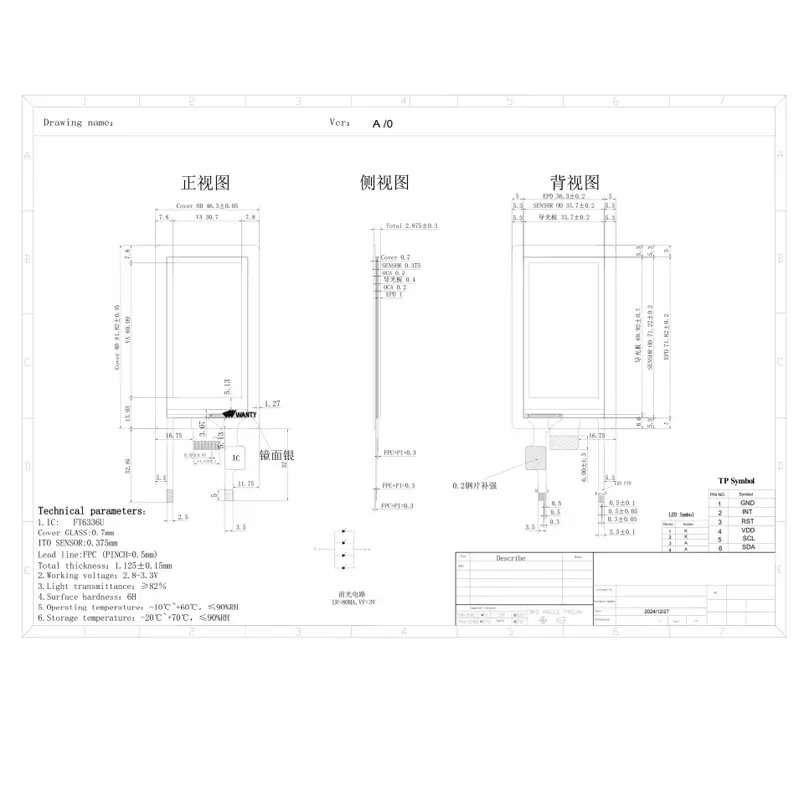
The base display outline is 47 × 66.25 × 1.83 mm, while the active area is 43.2 × 57.6 mm. Use the active area for the visible opening and the full outline for cavity, support, connector, and tolerance planning.
Provide clearance for the bottom FPC and bend radius. Avoid point loading or pressure on the active area.
CTP Variant Is a Separate Assembly
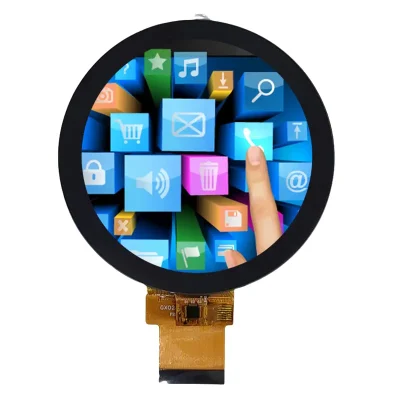
The standard configuration has no touch panel. The optional C026A version is described with a G+G projected-capacitive structure, five touch points, an FT5436 controller, and an I²C interface through an 8-pin, 0.5 mm-pitch connection.
Touch changes dimensions, optical transmission, reflection, controller wiring, and enclosure opening. Approve the CTP drawing separately rather than applying its mechanical values to the non-touch module.
Environmental and Application Fit
The module is listed for −20°C to +70°C operation and −30°C to +80°C storage. These limits do not establish humidity, condensation, vibration, ultraviolet, waterproof, medical, or automotive qualification.
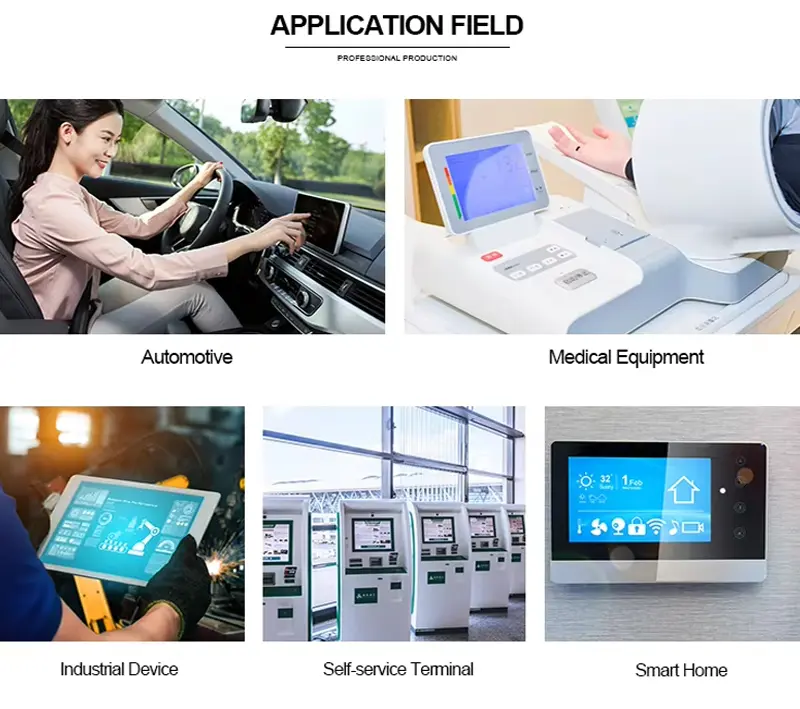
The High Resolution Portrait TFT Display Module can be evaluated for handheld instruments, portable data terminals, compact industrial controllers, inspection tools, smart-appliance interfaces, and small equipment status panels. Each project still requires electrical, optical, mechanical, thermal, and software qualification.
Customization and Procurement
FPC routing, pin definition, brightness, cover lens, capacitive touch, optical bonding, interface configuration, branding, and packaging may be reviewed by project.
Custom FPC, CTP, and cover-glass configurations are shown from 1,000 pieces. Sample and standard-module quantities, tooling, materials, and schedules are confirmed separately.
Procurement Checklist
Confirm before sample approval:
- Assigned model HS028VGFPD047 and supplier model KD028VGFPD047.
- The SPI+RGB version rather than the separate MIPI model.
- Native 480×640 orientation, scan direction, pixel order, and rotation.
- Complete 45-pin assignment, 0.5 mm pitch, contact side, and FPC orientation.
- 3-wire SPI mode and exact ST7701S command package.
- RGB16/RGB18/RGB24 selection, pixel clock, sync or DE timing, and mapping.
- 3.3 V logic requirements and complete power sequence.
- Eight-LED backlight topology, 24 V / 20 mA reference, dimming, and thermal limits.
- 43.2 × 57.6 mm active area and 47 × 66.25 × 1.83 mm fit.
- 670 cd/m² target behind the final cover stack.
- Standard non-touch or separately approved C026A touch assembly.
- Operating environment, sample criteria, quantity, and annual demand.
FAQ
About 2.8 Inch High Resolution Portrait TFT Display Module
What must be checked before connecting this display to an SPI+RGB host?
Can the SPI interface carry the complete image stream by itself?
Is 670 cd/m² sufficient behind a protective cover?
What changes when the optional capacitive-touch version is selected?
Which dimensions should control enclosure release?
Freya Yang
+86 18318948097