Freya Yang
+86 18318948097
+852 62667476
6.67 Inch Bendable Rollable OLED Screen Module for Prototypes

Model P/N
Size
Resolution
Brightness
Viewing Angle
Connector Type
Operating Temp
Overall(mm)
huisoar
HS0667OLED
Brand
Panel Size (inch)
Model P/N
Resolution
Brightness (nits)
Viewing Angle
Contrast Ratio
Response Time
Overall (mm)
Active Area (mm)
Refresh Rate
Display Colors
Panel Type
Connector Type
Operating Temp
Touchscreen Type
Storage Temp
Work Mode
Operating Environment
Motherboard Type
I/O Interface
Designed For
6.67 Inch Bendable Rollable OLED Screen Module for Prototypes
This 6.67-inch flexible AMOLED module combines a 2400 × 1080 image area, MIPI integration and 500 cd/m² luminance for mechanically qualified curved-device development.
The Bendable Rollable OLED Screen Module gives product developers a 6.67-inch flexible visual platform for custom hardware that cannot rely on a conventional rigid rectangular display. Its 2400 × 1080 resolution, 394 PPI listing and compact 156 × 71.5 mm outline support detailed user interfaces while leaving the final curvature, enclosure and FPC arrangement to the mechanical design.
The product is positioned for flexible and rollable concepts, but those terms should be separated from formal flex-life specifications. Minimum bend radius, repeated-roll endurance and dynamic-flex cycling require project-level confirmation.
Product Summary
The module uses flexible AMOLED/OLED display technology with a MIPI interface. Luminance is listed at 500 cd/m², while the contrast ratio is listed at 100000:1.
The active image area measures 154.56 × 69.552 mm inside a 156 × 71.5 mm overall screen outline. Operating temperature is −10°C to +60°C, with storage from −20°C to +70°C.
Key Specifications
| Parameter | Confirmed value |
|---|---|
| Screen size | 6.67 inches |
| Display technology | Flexible AMOLED / OLED |
| Resolution | 2400 × 1080 pixels |
| Pixel density | 394 PPI listed |
| Luminance | 500 cd/m² |
| Contrast | 100000:1 listed |
| Color statements | 10-bit wording; 16.7M-color wording |
| Viewing | Full viewing angle |
| Active area | 154.56 × 69.552 mm |
| Module outline | 156 × 71.5 mm |
| Interface | MIPI |
| Operating temperature | −10°C to +60°C |
| Storage temperature | −20°C to +70°C |
What Bendable and Rollable Mean for Mechanical Qualification
Bendable Form Does Not Define a Minimum Radius
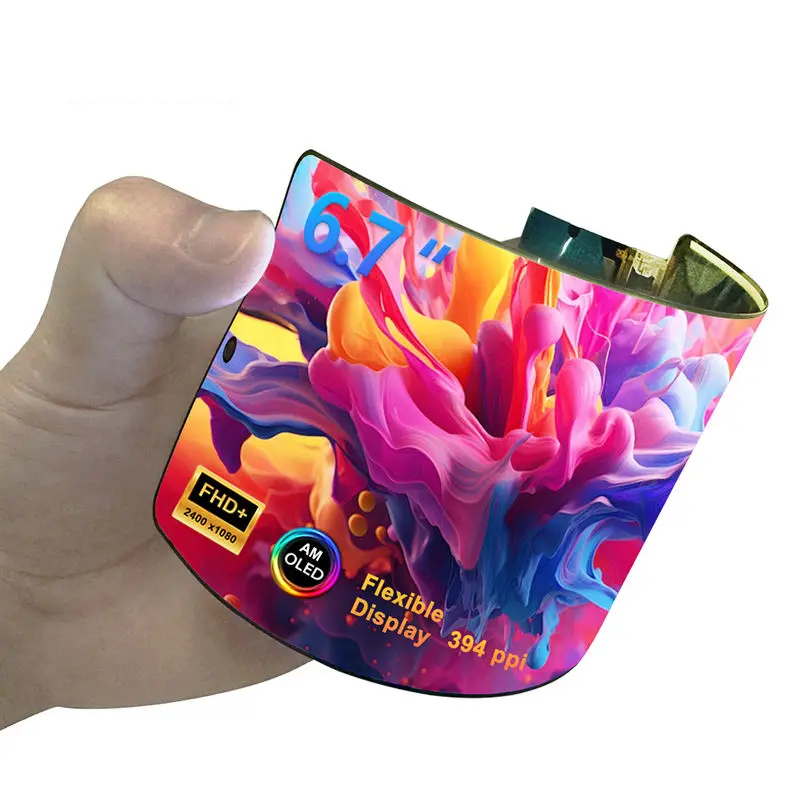
A flexible AMOLED structure makes curved integration possible, but a product image showing the screen bent does not establish the minimum permitted curvature.
Bendable product wording does not define a minimum bend radius.
The approved radius should be based on the final direction of curvature, enclosure structure, FPC position and whether the display is intended to remain in a fixed curve or move repeatedly.
Rollable Marketing Does Not Define Cycle Life
Rollable is useful buyer language for identifying this display category, but it should not be translated into an unlimited dynamic-flex claim.
A prototype that is curved once during assembly has a different mechanical requirement from a device expected to roll and unroll thousands of times.
Repeated rolling requires a separate cycle-life qualification.
MIPI Integration Requires Host-Level Verification
The MIPI Name Alone Does Not Prove Compatibility
The native display interface is identified as MIPI. However, the available product data does not confirm lane count, connector pin count, timing mode, voltage rails or final pin assignment.
A processor or mainboard should therefore not be approved solely because it also has a MIPI-labeled connector.
A matching MIPI label does not prove electrical or timing compatibility.
Before PCB release, engineering should confirm the host processor, display timing, FPC pin map, connector orientation and required voltage definitions.
Evaluation Hardware Is a Separate Integration Path
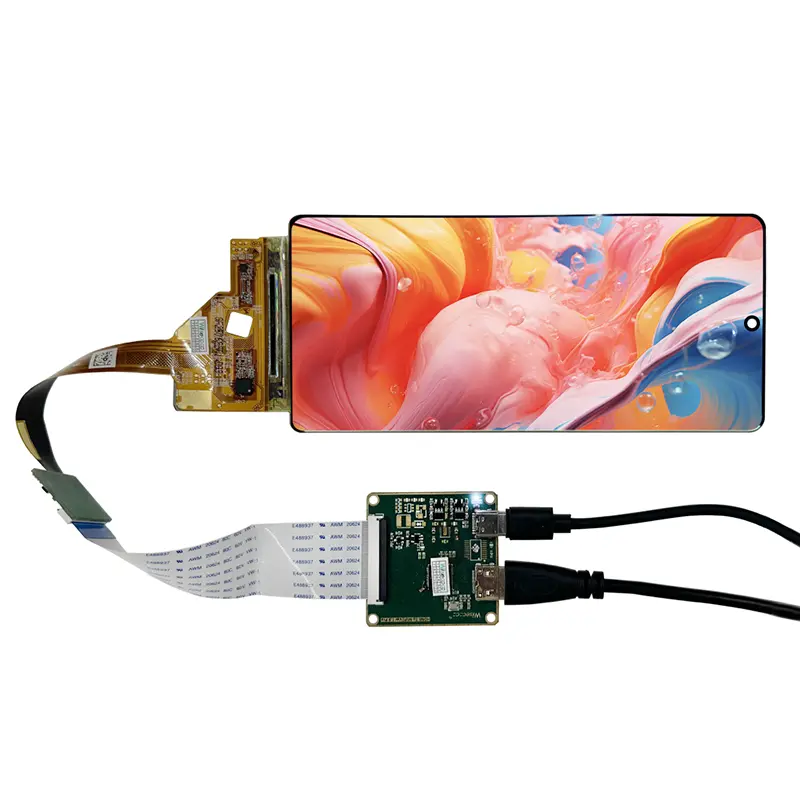
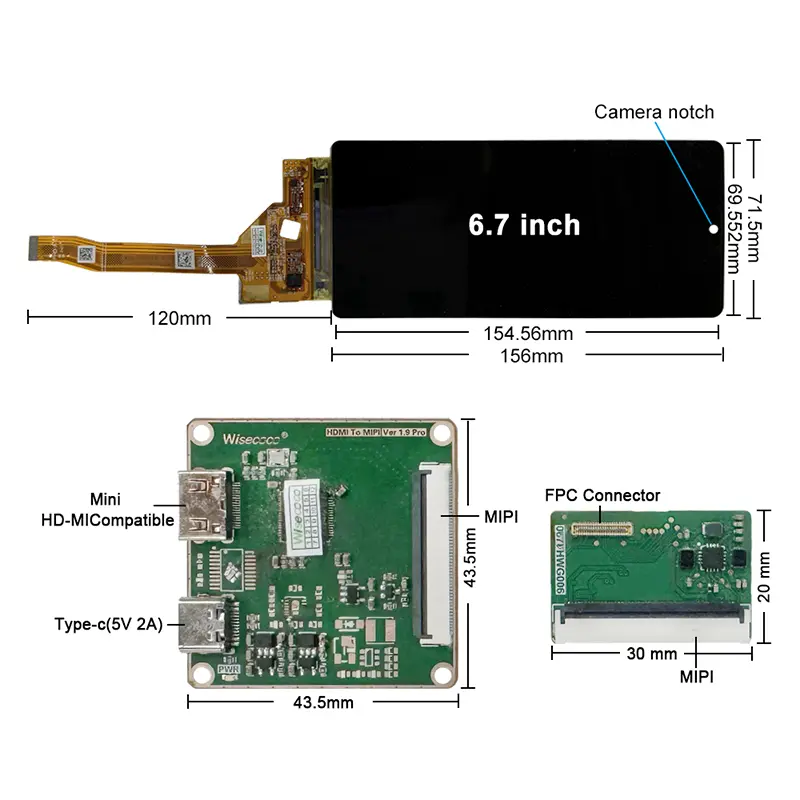
The product imagery shows an HDMI-to-MIPI evaluation-board arrangement. One board image identifies Mini HDMI-compatible input, a MIPI connection and USB-C power marked at 5 V / 2 A.
That hardware can provide a useful evaluation route, but it should not be treated as part of the bare module until the ordered configuration is confirmed.
Mechanical Planning for the Bendable Rollable OLED Screen Module
Active Area and Outline Are Different Boundaries
The active image area is 154.56 × 69.552 mm. The outer display dimensions are 156 × 71.5 mm.
The active area and module outline are separate mechanical design boundaries.
The first value controls the usable image region. The second controls the space that must be reserved for the physical screen.
This difference matters when designing narrow bezels or curved housings because enclosure pressure should not be transferred through the visible display area.
Camera Notch and FPC Clearance
The mechanical illustration shows a camera-notch feature near one edge of the screen. It also indicates a long FPC section extending from the display assembly, with an approximately 120 mm illustrated length reference.
The final enclosure drawing should therefore define the notch location, FPC bend direction, connector position and available cable-routing space before tooling approval.
Optical Performance for Detailed Interfaces
2400 × 1080 and 394 PPI
The 2400 × 1080 pixel format provides a dense interface area for a 6.67-inch screen. A 394 PPI value is also listed.
That combination is useful for compact graphical interfaces where small icons, text and visual detail matter more than the lower-resolution layouts common in traditional industrial LCDs.
500 cd/m² Is Not an Outdoor Readability Rating
Luminance is specified at 500 cd/m².
That figure can be evaluated for indoor and controlled-light applications, but it does not by itself establish direct-sunlight visibility.
The 500 cd/m² rating should not be converted into a sunlight-readable or outdoor qualification.
If the finished product uses a cover lens or reflective curved housing, final optical performance should be tested in the actual assembly.
Keep 10-Bit and 16.7M Statements Separate
The product information provides both 10-bit and 16.7M Color descriptions.
They should remain separate stated characteristics until the exact pixel encoding, processing path and native color-depth definition are confirmed. A larger color-count specification should not be calculated from the 10-bit wording alone.
Environmental Boundaries
The operating temperature range is −10°C to +60°C, while storage is listed from −20°C to +70°C.
These limits support evaluation in a wider range of custom embedded projects, but they do not establish waterproofing, humidity resistance, automotive qualification or another environmental certification.
Any project exposed to moisture, repeated mechanical flexing or elevated enclosure temperatures should define those qualification requirements separately.
Application Direction
The module is suitable for evaluation in curved smart-device prototypes, industrial concept hardware, custom visual terminals and creative electronic products where a flexible display contributes directly to the mechanical design.
A Bendable Rollable OLED Screen Module is especially relevant when a rigid display would force an unwanted flat surface into the enclosure.
Selection should still depend on MIPI compatibility, mechanical curvature, notch position, FPC routing, operating temperature and final optical environment.
Customization and Engineering Scope
Project-specific requirements can include mechanical outline review, FPC definition, interface adaptation, touch integration and evaluation-board configuration.
Custom configurations are generally reviewed from 500 pieces, subject to tooling requirements, material availability and the requested specification. Sample and standard-module quantities are confirmed separately.
Branding, packaging and graphic customization shown at the original supplier level should not be treated as HuiSoar standard MOQ policy.
Procurement Checklist
Before sample approval, confirm the exact production revision; 6.67-inch size; 2400 × 1080 native orientation and timing; 500 cd/m² luminance tolerance; 100000:1 contrast definition; 10-bit versus 16.7M color wording; 394 PPI listing; 154.56 × 69.552 mm active area; 156 × 71.5 mm outline; camera-notch position; FPC geometry; MIPI lane count, timing, pin mapping and voltage rails; required bend direction and minimum radius; static or dynamic flex use; expected roll-cycle target; touch requirement; evaluation-board scope; operating environment; sample quantity; and annual demand.
FAQ
About 6.67 Inch Bendable Rollable OLED Screen Module
What bend-radius information is required before enclosure design?
Does the rollable description mean the screen can be rolled repeatedly?
What information is needed to verify the MIPI connection?
Should the HDMI-to-MIPI board be assumed to ship with the screen?
What dimensions should control a custom front enclosure?
Freya Yang
+86 18318948097