Freya Yang
+86 18318948097
+852 62667476
6.67 Inch Custom Flexible AMOLED Bendable OLED Display for Prototypes

Model P/N
Size
Resolution
Brightness
Viewing Angle
Connector Type
Operating Temp
Overall(mm)
huisoar
HS06.67OLED
Brand
Panel Size (inch)
Model P/N
Resolution
Brightness (nits)
Viewing Angle
Contrast Ratio
Response Time
Overall (mm)
Active Area (mm)
Refresh Rate
Display Colors
Panel Type
Connector Type
Operating Temp
Touchscreen Type
Storage Temp
Work Mode
Operating Environment
Motherboard Type
Designed For
6.67 Inch Custom Flexible AMOLED Bendable OLED Display for Prototypes
A 6.67-inch flexible AMOLED panel combines 1080 × 2400 resolution, 500 cd/m² luminance and MIPI DSI for curved smart-device and industrial prototypes.
The Custom Flexible AMOLED Bendable OLED Display gives product teams a compact way to develop interfaces that do not have to remain completely flat. Its 6.67-inch AMOLED structure combines a 1080 × 2400 image, 500 cd/m² luminance and 100000:1 contrast with a MIPI display connection. The 154.56 × 69.552 mm active area sits inside a 156 × 71.5 mm module envelope, helping engineers evaluate both visual coverage and mechanical fit early in a curved-product program.
Product Summary
This flexible AMOLED is intended for industrial applications, intelligent products and creative prototype development. It is particularly relevant where the display itself contributes to the product form rather than sitting behind a conventional rigid rectangular window.
Its electrical architecture remains a component-level MIPI display path. Host timing, lane configuration, pin assignment and power requirements must therefore be qualified against the final processor platform rather than assumed from the MIPI label alone. MIPI DSI is specifically designed as a high-speed interface between host processors and display modules.
Key Specifications at a Glance
| Parameter | Confirmed value |
|---|---|
| Size | 6.67 inches |
| Display technology | Flexible AMOLED / OLED |
| Resolution | 1080 × 2400 pixels |
| Brightness | 500 cd/m² |
| Contrast ratio | 100000:1 |
| Color-depth wording | 10-bit |
| Display-color wording | 16.7M colors |
| Pixel density | 394 ppi |
| Viewing | Full viewing-angle wording |
| Active area | 154.56 × 69.552 mm |
| Module outline | 156 × 71.5 mm |
| Interface | MIPI DSI |
| Operating temperature | −10°C to +60°C |
| Storage temperature | −20°C to +70°C |
Flexible AMOLED Design for Curved Product Concepts
Bendable Structure Is Not a Bend-Radius Specification
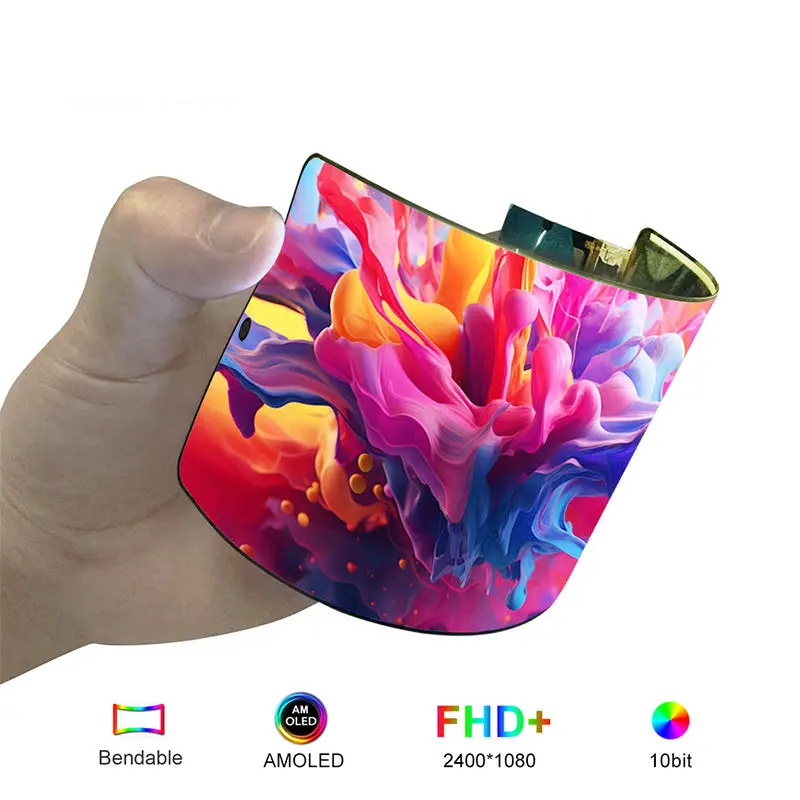
The module can physically form a curved display surface, opening design options for wraparound controls, compact smart terminals and visually differentiated prototypes.
A flexible-product image, however, does not define the minimum static bend radius, permitted bending direction or number of repeated bend cycles. Those values affect mechanical support, adhesive selection, FPC routing and long-term reliability and therefore need explicit project qualification.
Bendable product construction does not establish a minimum bend radius or repeated bend-cycle lifetime.
1080 × 2400 Resolution for Compact High-Density Interfaces
The portrait-oriented 1080 × 2400 canvas provides substantially more interface density than basic embedded displays. Product teams can allocate space to detailed icons, status information, graphics and multimedia without increasing the screen diagonal into tablet territory.
The module is also identified at 394 ppi, which supports fine UI elements and close-viewing applications.
MIPI DSI Integration
Direct MIPI Host Qualification
MIPI DSI is well suited to high-resolution embedded displays, but the interface name by itself is not a compatibility certificate. The host must match the required physical layer, data-lane arrangement, timing, operating mode, FPC pin assignment and electrical rails. MIPI Alliance describes DSI as a host-to-display high-speed serial interface designed for embedded and mobile-influenced devices.
A matching MIPI label does not by itself confirm lane configuration, timing, pin mapping or direct host compatibility.
Before controller-PCB release, obtain the complete panel timing, pin and power documentation for the selected production revision.
HDMI-to-MIPI Evaluation Path
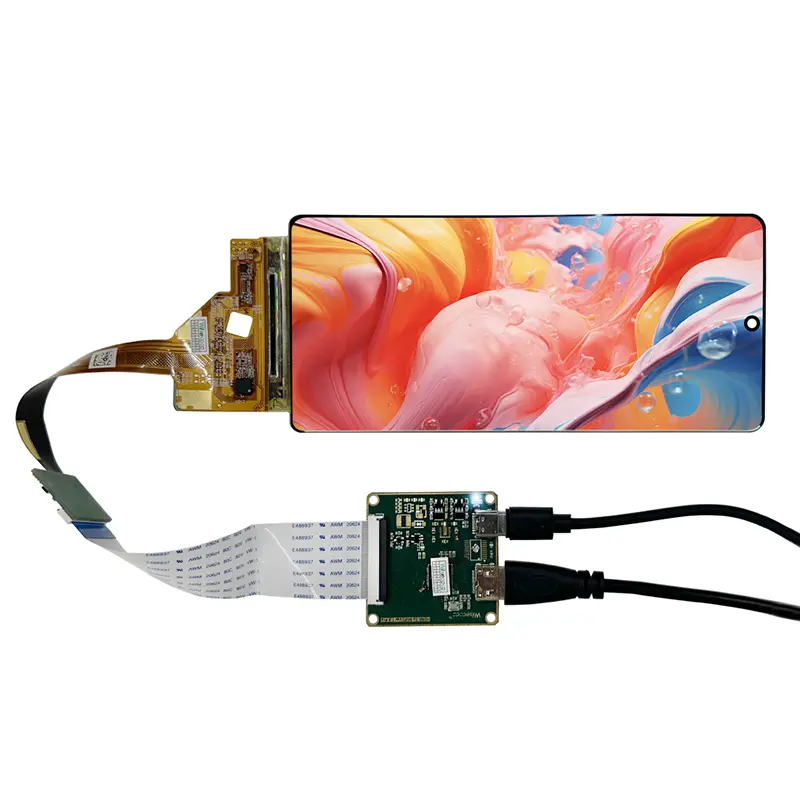
An HDMI-to-MIPI board is illustrated as a development path, including a Mini HDMI input and USB Type-C board-power connection marked 5 V / 2 A.
That board should be treated separately from the bare panel. Confirm whether it is part of the ordered evaluation kit, an optional accessory or only a development reference before planning the prototype bill of materials.
Custom Flexible AMOLED Bendable OLED Display Mechanical Planning
Active Area Versus Module Outline
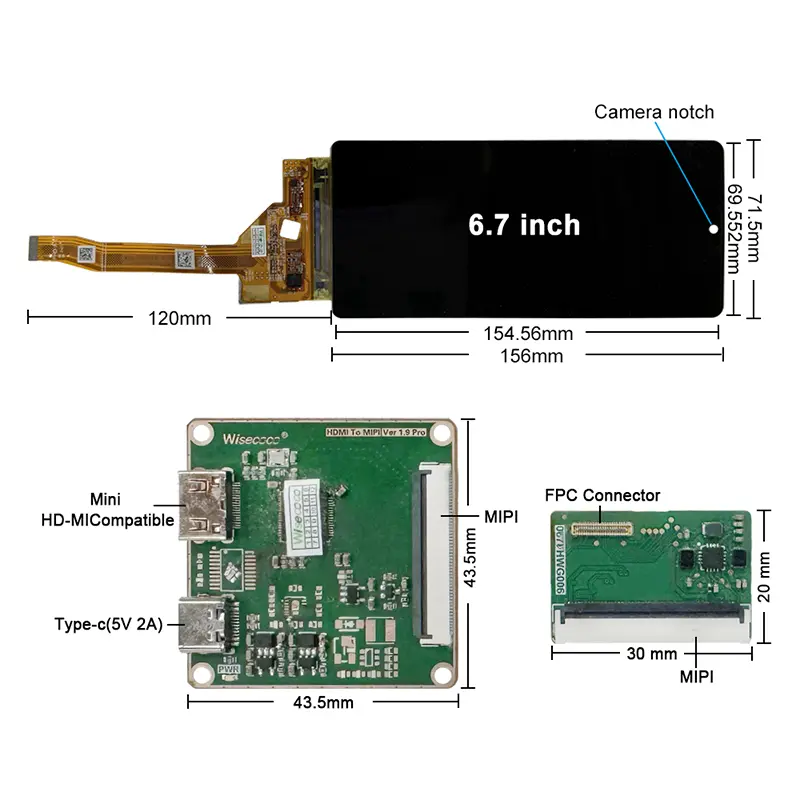
The active image area is 154.56 × 69.552 mm, while the outer panel dimensions are 156 × 71.5 mm. Those values serve different design functions: the active area controls visible-content coverage, while the module outline controls mechanical clearance.
The 154.56 × 69.552 mm active area and 156 × 71.5 mm outline are different mechanical boundaries.
The available manufacturer specification independently confirms this dimensional relationship.
Camera Notch and FPC Clearance
The mechanical illustration shows a camera-notch feature and an extended flexible cable. Final housing design should therefore include the approved notch location, FPC bend direction, connector position and cable keep-out region.
A flexible screen should not be clamped or sharply folded at an unspecified FPC transition zone simply because the active display portion can bend.
Optical Performance and Color
500 cd/m² and 100000:1 Contrast
The display is specified at 500 cd/m² and 100000:1 contrast. That combination is appropriate for visually strong interfaces in controlled or well-lit environments, while it does not establish a sunlight-readable or outdoor-system rating.
The 500 cd/m² specification does not establish a sunlight-readable or outdoor qualification.
Keep 10-Bit and 16.7M Wording Separate
Technical data identifies both 10-bit color depth and 16.7M display colors. Those statements should remain separate until the production datasheet resolves the exact color pipeline.
Do not automatically convert the 10-bit wording into a 1.07-billion-color claim when the same configuration also identifies 16.7M colors.
Environmental and Application Boundaries
The module is specified for operation from −10°C to +60°C and storage from −20°C to +70°C. These are component-level temperature ranges and do not establish waterproofing, condensation tolerance, humidity grade or finished-device certification.
The Custom Flexible AMOLED Bendable OLED Display fits intelligent products, industrial visual interfaces, curved smart-device concepts and creative prototype systems where screen geometry matters to the industrial design.
Automotive, medical, wearable-skin-contact and exposed-outdoor deployment require separate system-level qualification.
Customization and Project Qualification
Projects may evaluate FPC/interface definition, bend geometry, mechanical outline, optical targets, touch integration and development-board packaging according to the required production architecture.
Custom configurations are generally reviewed from 500 pieces, subject to tooling requirements, material availability and the requested specification. Sample and standard-module quantities are confirmed separately.
Touch functionality should be treated as a separate requirement because it is not defined for the standard display configuration.
Procurement Checklist
Confirm the production revision; native 1080 × 2400 timing; 500 cd/m² luminance and tolerance; 100000:1 contrast definition; 10-bit versus 16.7M color interpretation; 154.56 × 69.552 mm active area; 156 × 71.5 mm outline; camera-notch position; FPC orientation; MIPI lane count and operating mode; complete pin assignment; voltage rails; bend direction; minimum static bend radius; dynamic-bend requirement and cycle target; touch requirement; evaluation-board requirement; −10°C to +60°C operation; −20°C to +70°C storage; humidity/reliability documents; sample criteria; quantity; and annual demand.
FAQ
About 6.67 Inch Custom Flexible AMOLED Bendable OLED Display
What bend-radius information is required before releasing the enclosure?
What must be checked before connecting this display directly to a MIPI DSI host?
Is the HDMI-to-MIPI board included with the standard display?
Is touch included with the 6.67-inch flexible AMOLED?
Which dimensions should control the mechanical design?
Freya Yang
+86 18318948097