
~
~
~
~
~
~
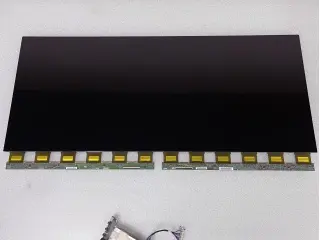
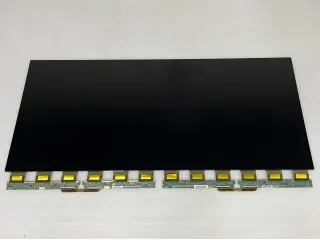
M340QVR02.0 CELL R1500 180Hz Curved VA Open Cell AUO
Model P/N
Size
Resolution
Brightness
Viewing Angle
Connector Type
Operating Temp
Overall(mm)
auo
M340QVR02.0 CELL
Brand
Panel Size (inch)
Model P/N
Resolution
Viewing Angle
Contrast Ratio
Response Time
Overall (mm)
Active Area (mm)
Refresh Rate
Display Colors
Panel Type
Connector Type
Surface Treatment
Operating Temp
Touchscreen Type
Storage Temp
Work Mode
Pixel Format
Input Voltage (V)
Weight (g)
Designed For
Product Details
M340QVR02.0 CELL R1500 180Hz Curved VA Open Cell is the controlled component identity for engineering, sourcing and replacement review of this 34-inch curved open-cell monitor configuration.
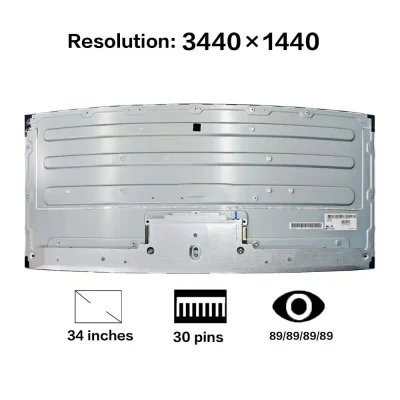
M340QVR02.0 CELL is a 34-inch AUO a-Si TFT-LCD, CELL (FOB) with 3440(RGB)×1440, UWQHD, 21:9, 180 Hz refresh and eDP (8 Lanes), HBR2 (5.4G/lane), 51 pins 0.5 mm connector. The current-run parameters establish the exact electrical, optical and mechanical baseline. System behavior still has to be demonstrated in the target product.
Three buyer value propositions
R1500 curved open-cell geometry for custom monitor stacks
The exact CELL configuration is a curved R1500 open-cell product with a 1.17 mm outline depth. That lets integrators design the backlight, frame and optical stack around the cell rather than assuming LCM-level mechanical behavior.
180 Hz native target with eight-lane HBR2 input
A 3440×1440 180 Hz target over eight HBR2 eDP lanes creates a specific controller and signal-integrity requirement. The approved scaler, cable and power sequence should be validated together at the native mode.
4000:1 VA contrast for a backlight-defined final monitor
The panel cell is specified at 4000:1 typical transmissive contrast and 4.3% typical transmittance with polarizer. Final brightness and black-level behavior still depend strongly on the backlight and optical cavity selected by the monitor manufacturer.
M340QVR02.0 CELL R1500 180Hz Curved VA Open Cell should be qualified as one exact configuration rather than approved from family-level assumptions.
Key Specifications at a Glance
| Brand | AUO |
|---|---|
| Model P/N | M340QVR02.0 CELL |
| Size | 34 inch |
| Resolution | 3440(RGB)×1440, UWQHD, 21:9 |
| Active Area | 797.22×333.72 mm (H×V) |
| Overall | 810.02×347.82×1.17 mm |
| Brightness | 0 cd/m² (CELL, no backlight) |
| Viewing Angle | 89/89/89/89 (Typ.)(CR≥10) |
| Display Colors | 16.7M |
| Weight | 750 g (Typ.) |
| Refresh Rate | 180 Hz |
| Connector / Native Interface | eDP (8 Lanes), HBR2 (5.4G/lane), 51 pins 0.5 mm connector |
| Input Voltage | 12 V (Typ.) |
| Operating Temperature | 0 ~ 50 °C |
| Storage Temperature | -20 ~ 60 °C |
| Panel Type | a-Si TFT-LCD, CELL (FOB) |
| Pixel Format | RGB Vertical Stripe |
| Surface Treatment | Antiglare (Haze 25%), Hard coating (3H) |
| Contrast Ratio | 4000:1 (Typ.) |
| Response Time | 8 ms (Typ.)(G to G) |
| Work Mode | VA, Normally Black, Transmissive |
| Transmissivity | 4.3% (Typ.)(with Polarizer) |
| Designed For | Desktop monitor and gaming monitor integration; 180 Hz curved open-cell platforms |
| Touchscreen Type | Without touch screen |
Open-cell integration scope
This is a CELL (FOB), not a finished backlit LCM. Mechanical, thermal and optical engineering must therefore include the custom backlight unit, diffuser stack, frame, grounding and protection scheme used by the final monitor.
R1500 mechanical control
Use the exact 810.02×347.82×1.17 mm cell envelope and R1500 curvature when defining support points. The thin glass stack is not tolerant of arbitrary point loading, so the housing should distribute force along approved support regions.
Backlight design ownership
Because the component has no backlight, the 0 cd/m² storage value is correct for the CELL itself and should not be replaced by an assumed monitor luminance. Brightness, dimming and thermal targets belong to the backlight system that will be designed around it.
Controller and eDP validation
The eight-lane HBR2, 51-pin interface and 12 V supply define the electrical baseline. Verify pin mapping, AUX behavior, link training and the native 180 Hz timing with the production controller rather than a generic development adapter.
High-refresh motion review
The 8 ms G-to-G response figure should be evaluated at representative refresh points, including the maximum 180 Hz mode. Check visible smear, overshoot behavior from any system-level overdrive and recovery after mode changes.
VA optical stack
The 4000:1 typical contrast is a cell-level transmissive measurement. Final monitor contrast, uniformity and viewing performance can shift with the chosen backlight, diffuser films, bezel design and factory calibration.
Transmittance budget
The 4.3% typical transmittance with polarizer is directly relevant to backlight power planning. Use measured prototype efficiency to size LEDs and thermal capacity rather than converting transmittance into an unsupported finished brightness claim.
Curved gaming qualification
The current-run evidence supports desktop monitor and gaming use. Test high-refresh game content, desktop text, dark scenes and rapid mode changes while the cell is installed in the actual curved mechanical stack.
Sourcing comparison
Future substitutes should be screened on R1500 curvature, cell depth, active area, 51-pin eDP definition, eight-lane HBR2 transport, 180 Hz timing, contrast and transmittance. An LCM or a differently curved CELL is not automatically equivalent.
Controlled engineering record
Preserve the cell drawing, approved backlight design, optical films, controller configuration, power sequence and high-refresh results. This record is the functional definition of the released display stack for procurement and service.
R1500 cell support and handling
The R1500 CELL is a thin glass component rather than a self-supporting monitor module. Handling fixtures, vacuum pickup and assembly support should be designed around the 1.17 mm outline depth and curved profile. Avoid local bending that tries to flatten or further curve the cell. Prototype inspection should include edge chips, polarizer condition and image uniformity after the cell has been clamped into the backlight frame. A housing that looks dimensionally correct can still create stress if its radius or support distribution differs from the released mechanical design.
Backlight cavity design from transmittance
The 4.3% typical transmittance with polarizer is one of the most useful open-cell design inputs because it directly influences the optical efficiency budget. LED count, diffuser stack, reflector design and drive current should be selected from measured prototype performance rather than by copying a backlight from another 34-inch panel. Thermal measurements should be made at the brightness levels intended for production. Because the CELL has no light source, final luminance is a property of the completed optical stack, not a hidden specification that should be filled into the component record.
Twelve source-chip integration context
The exact same-model data identifies twelve built-in source chips. That detail is relevant to the cell electronics and can affect flex routing, edge construction and service handling. It does not mean the monitor designer directly controls those chips individually; the engineering requirement is to preserve the specified panel interface and power environment. Mechanical fixtures should avoid stressing the COF regions, and inspection should pay particular attention to edge bonding condition. Any alternate with a different source-driver arrangement should be treated as a new cell architecture for mechanical review.
180 Hz curved-gaming validation
The supplied application evidence includes desktop monitor and gaming use at 180 Hz. Test native 3440×1440 motion with the actual controller, including high-contrast scrolling, variable frame delivery and repeated changes between desktop and gaming modes. The 8 ms G-to-G response figure should be interpreted together with system-level overdrive behavior, if any. Do not publish an unsupported faster response number. The objective is to verify visible motion and stable transport on the released monitor rather than to extrapolate from refresh rate alone.
VA contrast and black-level engineering
A 4000:1 typical transmissive contrast ratio is a strong VA cell characteristic, but the final black level also depends on backlight leakage, bezel pressure, diffuser construction and image processing. Evaluate dark-room performance with the real backlight cavity and mechanical frame. Curved assemblies can show edge or corner behavior that a loose-cell optical measurement does not capture. If the product specification includes black-uniformity limits, define them on the completed monitor and retain representative measurement maps with the engineering release.
Open-cell sourcing controls
Open-cell procurement needs tighter configuration control than a finished LCM because the buyer owns more of the final display stack. Keep the exact cell drawing, curvature, optical-film stack, backlight BOM, controller timing and assembly process linked to the approved part number. A substitute can match 34-inch UWQHD and still differ in transmittance, curvature, driver-edge geometry or connector mapping. Those differences can force changes to LEDs, frame tooling or electronics, so they must be identified before a commercial replacement decision.
Cell-to-monitor conversion gate
Before this AUO open cell is released into a monitor BOM, the program should document how the bare CELL becomes a protected, illuminated and serviceable display assembly. That record should identify the R1500 support frame, approved optical films, backlight construction, LED thermal path, controller board, 51-pin interface and grounding method. First articles should be inspected before and after enclosure closure to catch pressure-induced mura or edge damage. Optical measurements should be repeated after the backlight and bezel are installed because the open-cell contrast and transmittance values are only part of the final result. If the backlight supplier, diffuser set or frame tooling changes, treat that as a display-stack revision and rerun the affected brightness, uniformity, temperature and stress checks. The controlled object for procurement is therefore the exact cell plus its approved integration stack, not merely the cell model in isolation.
M340QVR02.0 CELL R1500 180Hz Curved VA Open Cell belongs in the released sourcing dossier together with the exact drawing, production interface hardware and test evidence used to approve the target system.
Engineering and sourcing review
Before release, provide the target host or controller, mechanical drawing, production cable, power design and acceptance criteria. Qualification should verify native timing, interface behavior, optical performance and mechanical fit for the exact M340QVR02.0 CELL configuration.
M340QVR02.0 CELL R1500 180Hz Curved VA Open Cell should remain the reference term for this approved component package so future lots and substitutes can be evaluated against the same evidence.
Recommended: Same Size
(34")
Applications & Value of LCD Panel

- Fast sourcing with in-stock panels & cross-reference alternatives
- Stable supply chain with long-term availability
- Engineering-level support from panel to integration
- Custom solutions: cable, touch & optical bonding
- Strict quality control with IQC / OQC / aging test
- Full traceability system for quality assurance
- Complete technical documentation & drawings
- Compliance support: RoHS & certification files
