
~
~
~
~
~
~
M340QAR01.1 120Hz HDR Curved AHVA Ultrawide Module AUO
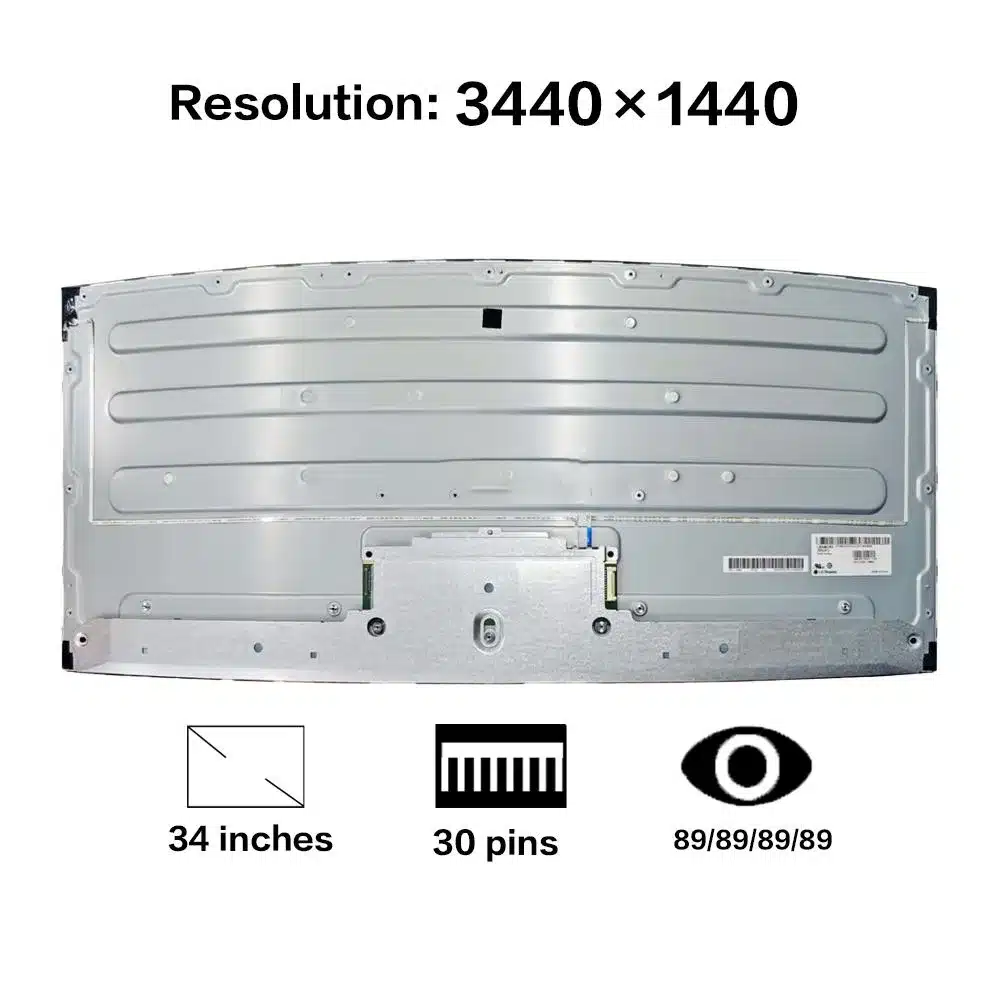
Model P/N
Size
Resolution
Brightness
Viewing Angle
Connector Type
Operating Temp
Overall(mm)
auo
M340QAR01.1
Brand
Panel Size (inch)
Model P/N
Resolution
Brightness (nits)
Viewing Angle
Contrast Ratio
Response Time
Overall (mm)
Active Area (mm)
Refresh Rate
Display Colors
Panel Type
Connector Type
Surface Treatment
Operating Temp
Touchscreen Type
Storage Temp
Work Mode
Pixel Format
Input Voltage (V)
Vibration Resistance
Weight (g)
Designed For
Product Details
M340QAR01.1 120Hz HDR Curved AHVA Ultrawide Module is the controlled component identity for engineering, sourcing and replacement review of this 34-inch curved ultrawide monitor configuration.
M340QAR01.1 is a 34-inch AUO a-Si TFT-LCD, LCM with 3440(RGB)×1440, UWQHD, 21:9, 120 Hz refresh and eDP (8 Lanes), HBR2 (5.4G/lane). The current-run parameters establish the exact electrical, optical and mechanical baseline. System behavior still has to be demonstrated in the target product.
Three buyer value propositions
1900R ultrawide geometry for a defined curved-monitor platform
The same-model record identifies a curved 1900R form factor around a 3440×1440, 21:9 active image. That gives mechanical engineering a concrete curvature and viewing geometry to validate instead of treating the panel as a flat 34-inch module.
Eight-lane HBR2 transport for 120 Hz native operation
The component uses an eight-lane HBR2 eDP path at a 120 Hz native refresh target. Cable layout, controller output, connector implementation and timing must therefore be qualified as a high-bandwidth display chain rather than inferred from resolution alone.
HDR400 and 98% DCI-P3 wording with bounded optical claims
The supplied facts include 300 cd/m² typical luminance, HDR400 wording and 98% DCI-P3. These are useful component-level targets, but final HDR behavior, calibration accuracy and system certification still depend on the completed monitor electronics and optical stack.
M340QAR01.1 120Hz HDR Curved AHVA Ultrawide Module should be qualified as one exact configuration rather than approved from family-level assumptions.
Key Specifications at a Glance
| Brand | AUO |
|---|---|
| Model P/N | M340QAR01.1 |
| Size | 34 inch |
| Resolution | 3440(RGB)×1440, UWQHD, 21:9 |
| Active Area | 799.8×334.8 mm (H×V) |
| Overall | 809.55×354.7×16.7 mm |
| Brightness | 300 cd/m² (Typ.), HDR400 |
| Viewing Angle | 89/89/89/89 (Typ.)(CR≥10) |
| Display Colors | 1.07B, 98% DCI-P3, Low Blue Light |
| Weight | 4.36 kg (Typ.) |
| Refresh Rate | 120 Hz |
| Connector / Native Interface | eDP (8 Lanes), HBR2 (5.4G/lane) |
| Input Voltage | 10.0 V (Typ.) |
| Operating Temperature | 0 ~ 50 °C |
| Storage Temperature | -20 ~ 60 °C |
| Vibration | 1.5G (14.7 m/s²) |
| Panel Type | a-Si TFT-LCD, LCM |
| Pixel Format | RGB Vertical Stripe |
| Surface Treatment | Antiglare (Haze 25%), Hard coating (3H) |
| Contrast Ratio | 1000:1 (Typ.) |
| Response Time | 14 ms (Typ.)(G to G) |
| Work Mode | AHVA, Normally Black, Transmissive |
| Backlight / Emission | 30,000 hours (WLED, no integrated driver, 8 zones) |
| Designed For | Desktop monitor integration; 120 Hz ultrawide curved-monitor platforms |
| Touchscreen Type | Without touch screen |
Curved chassis release
Use the exact 809.55×354.7×16.7 mm module envelope together with the 1900R curvature when releasing the rear housing, bezel and stand structure. Curved modules need continuous support without local pressure points, and a nominal diagonal match does not establish mechanical interchangeability.
Eight-lane signal-integrity plan
Validate the HBR2 route with the production controller board and cable assembly at the native 3440×1440/120 Hz mode. Repeated cold starts, warm restarts, source changes and long-duration patterns are more informative than a single static image-on test.
Backlight-driver responsibility
The WLED system is documented without an integrated driver, so the monitor electronics must provide the correct external backlight-drive function. Keep LED electrical requirements, dimming implementation and protection design tied to the exact panel release package.
Eight-zone HDR evaluation
The same-model description references eight backlight zones. Treat that as a component architecture fact, not as proof of a finished monitor HDR certification. Test local brightness transitions, halo behavior and thermal loading with the intended monitor firmware.
Color and low-blue-light validation
The 1.07B color depth, 98% DCI-P3 wording and Low Blue Light feature give a defined panel baseline. The finished product still needs its own white-point, gamma, gamut and low-blue-light-mode verification through the final electronics and any cover materials.
Ultrawide controller timing
The 21:9 3440×1440 timing should be stored as part of the approved controller configuration. Do not assume that another 34-inch ultrawide timing table is equivalent; blanking, link training and scaler behavior can differ between panel models.
Incoming inspection
Incoming inspection should verify the exact model marking, curved glass condition, connector area, edge integrity and any agreed cosmetic limits. A sample functional check at native refresh helps detect configuration drift before a lot enters assembly.
Replacement screening
A proposed alternate should be compared on curvature, outline, HBR2 lane architecture, backlight-driver responsibility, 120 Hz timing, optical targets and connector implementation. Shared diagonal and resolution are only the starting point.
Evidence boundaries
Procurement documents can state the confirmed component facts, including 120 Hz, 300 cd/m², 98% DCI-P3, curved 1900R geometry and HDR400 wording. They should not add unsupported claims about factory calibration, universal source compatibility, stock, lifecycle or finished-system certification.
Engineering handoff
The release package should retain the exact drawing, controller timing, eight-lane link settings, backlight-driver design, HDR-zone test result and approved mechanical support scheme. This gives sourcing and service teams a reproducible baseline for later lot or alternate review.
1900R support geometry and curved-glass loading
A 1900R display is mechanically different from a flat panel even when the diagonal class is familiar. The rear structure should follow the module curvature without forcing the glass into the chassis radius. During prototype builds, inspect edge seating, center support, screw torque and any foam or tape used to control vibration. Uneven loading can introduce mura or permanent stress that is not visible in an unloaded bench test. The module outline and curvature should therefore be released together as one mechanical datum set, and any housing change that alters support pressure should trigger a focused display review.
Eight-zone backlight behavior
The exact-model description references eight zones in the WLED system while the module requires an external backlight driver. Engineering should separate zone architecture from the driver implementation: the zones are a display-side feature, whereas current regulation, dimming commands and protection behavior are functions of the selected monitor electronics. Test dark scenes with small bright objects, full-field white, mixed desktop content and rapid brightness changes. Observe visible halo transitions and thermal response. Do not infer a more granular local-dimming architecture or a certified HDR result beyond the supported eight-zone and HDR400 wording.
External LED-driver electrical design
Because the backlight driver is not integrated, LED power design belongs to the monitor mainboard or dedicated driver board. Confirm the panel connector definition, string arrangement, operating current and dimming method from the exact engineering package before PCB release. Protection for open strings, short conditions and abnormal startup should be validated with the actual module. Brightness control should also be checked at the lowest user settings where regulation can behave differently. A later driver-board substitution should not be treated as transparent merely because the connector still fits.
Ultrawide desktop timing qualification
The 3440×1440 21:9 canvas changes scaler, source and firmware requirements compared with ordinary 16:9 QHD. Validate EDID, preferred timing, source detection and recovery across the intended input set. Include common desktop refresh points as well as the native 120 Hz path, and verify that aspect-ratio handling does not introduce unintended scaling. If the monitor supports picture-by-picture or other multi-source modes, those are separate system functions and need their own testing rather than being inferred from the panel's ultrawide geometry.
Color-management boundary
The supplied 98% DCI-P3 and 1.07B color wording indicate a wide-gamut panel baseline. A shipping monitor still requires a defined color-management policy: native gamut, sRGB clamp, factory calibration or user-selectable modes can produce very different results from the same panel. Measure the finished product through its actual signal path and brightness settings. Low Blue Light behavior should likewise be tied to the implemented mode. Keep panel capability separate from claims about Delta-E, white-point precision or certification unless those are supported by finished-monitor test data.
Curved-monitor sourcing package
For recurring procurement, preserve a golden sample with the exact AUO model marking, curvature, controller firmware, backlight-driver board, cable assembly and approved mechanical stack. The most likely sourcing mistakes are not simple size errors; they are substitution of another 34-inch ultrawide with a different curvature, connector implementation, backlight architecture or timing envelope. A controlled comparison sheet should flag those differences before samples are ordered. This reduces the chance that availability pressure creates an unplanned mechanical or electrical redesign.
Curvature, zone and interface release gate
A release review for this AUO ultrawide should close three risks together: the 1900R mechanical stack, the eight-zone backlight implementation and the eight-lane HBR2 transport. Mechanical engineering should confirm that the production chassis follows the panel radius and does not twist the module during assembly. Electronics should record the controller timing and external LED-driver revision, then verify maximum refresh after the complete unit has warmed. Optical review should use representative dark and bright content so the eight-zone behavior is visible in the same assembly that will ship. If any one of those subsystems changes later, repeat the focused tests affected by that change rather than assuming the unchanged panel part number guarantees identical system behavior. This cross-functional gate is especially important for curved monitors because mechanical pressure, backlight geometry and high-speed electronics can interact in ways that are not apparent from an isolated panel bench test.
M340QAR01.1 120Hz HDR Curved AHVA Ultrawide Module belongs in the released sourcing dossier together with the exact drawing, production interface hardware and test evidence used to approve the target system.
Engineering and sourcing review
Before release, provide the target host or controller, mechanical drawing, production cable, power design and acceptance criteria. Qualification should verify native timing, interface behavior, optical performance and mechanical fit for the exact M340QAR01.1 configuration.
M340QAR01.1 120Hz HDR Curved AHVA Ultrawide Module should remain the reference term for this approved component package so future lots and substitutes can be evaluated against the same evidence.
Recommended: Same Size
(34")
Applications & Value of LCD Panel

- Fast sourcing with in-stock panels & cross-reference alternatives
- Stable supply chain with long-term availability
- Engineering-level support from panel to integration
- Custom solutions: cable, touch & optical bonding
- Strict quality control with IQC / OQC / aging test
- Full traceability system for quality assurance
- Complete technical documentation & drawings
- Compliance support: RoHS & certification files
