
~
~
~
~
~
~
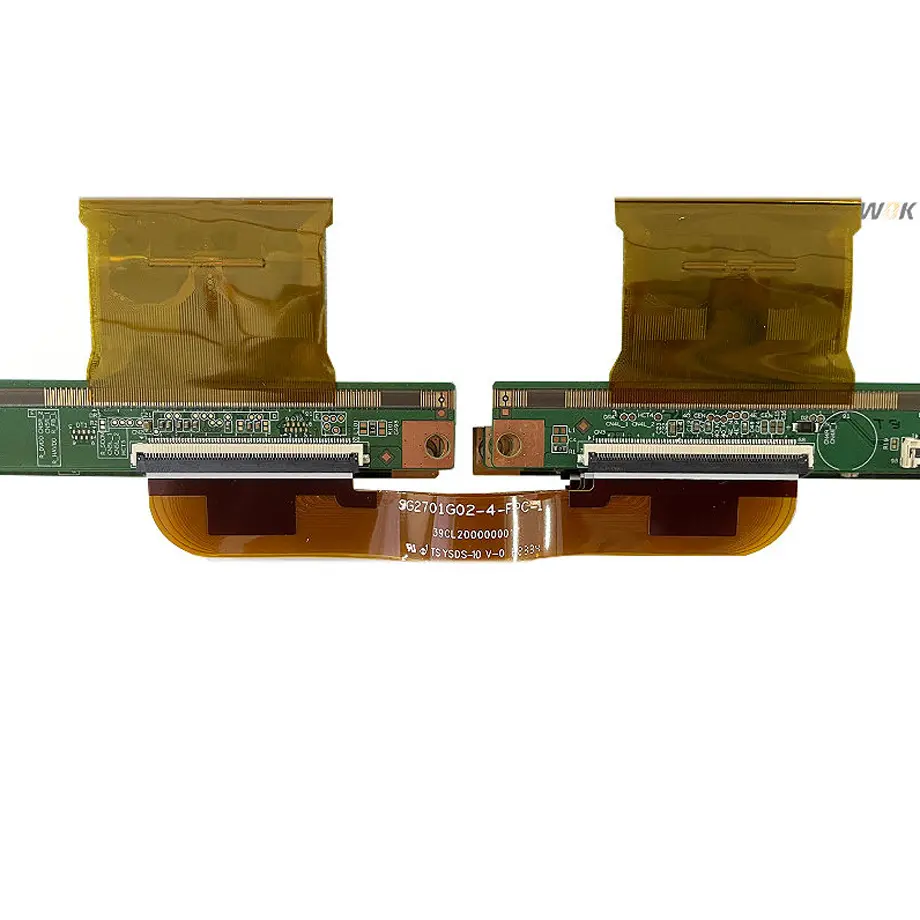
SG3151G02-6 QHD HVA Gaming Glass Cell 32 Inch Curved CSOT
Model P/N
Size
Resolution
Brightness
Viewing Angle
Connector Type
Operating Temp
Overall(mm)
csot
SG3151G02-6
Brand
Panel Size (inch)
Model P/N
Resolution
Viewing Angle
Contrast Ratio
Response Time
Overall (mm)
Active Area (mm)
Refresh Rate
Display Colors
Panel Type
Connector Type
Surface Treatment
Operating Temp
Touchscreen Type
Storage Temp
Work Mode
Pixel Format
Input Voltage (V)
Weight (g)
Designed For
Product Details
Product Overview
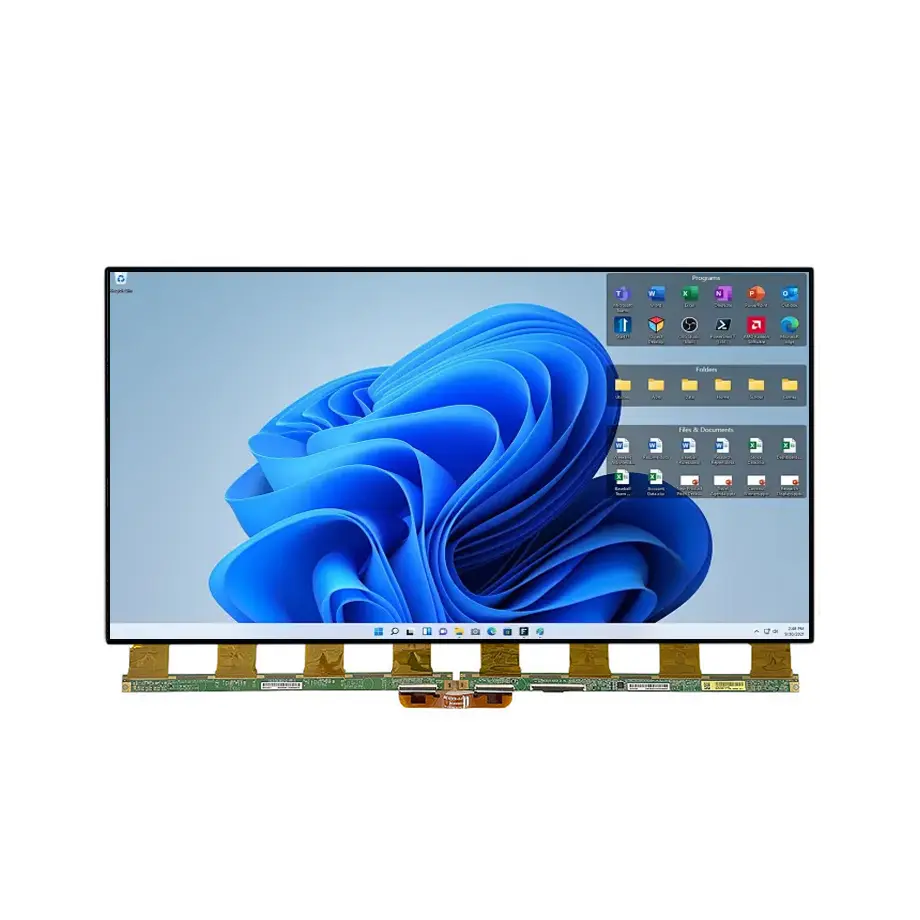
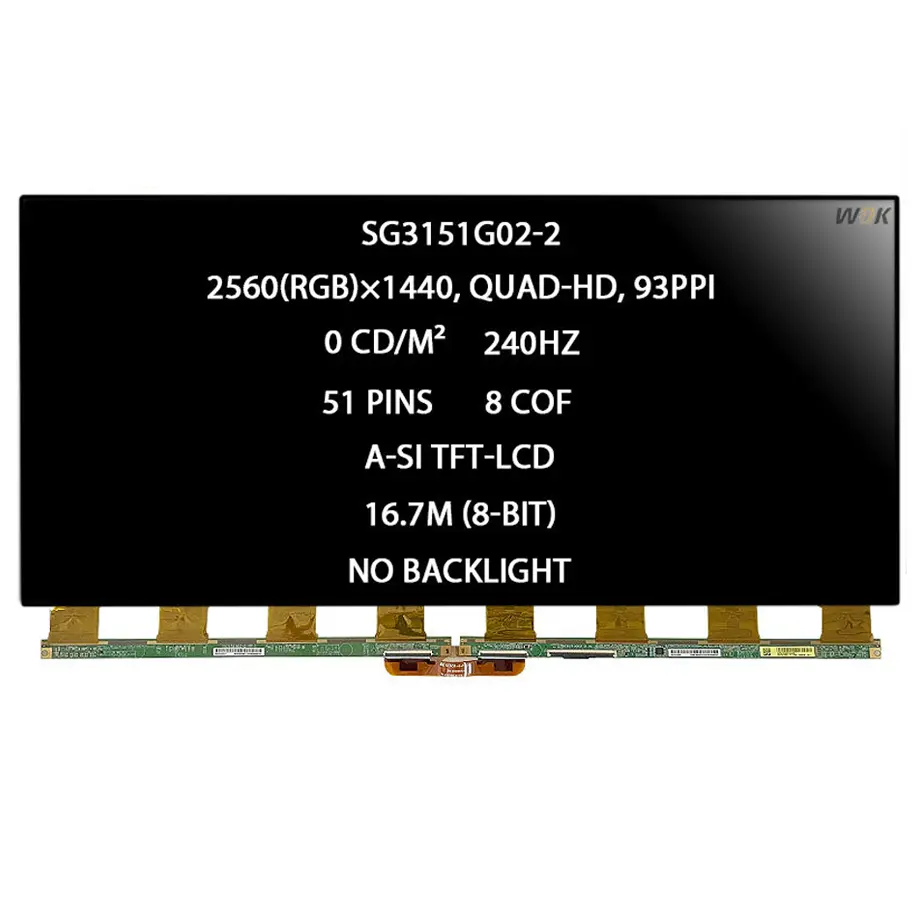
SG3151G02-6 QHD HVA Gaming Glass Cell is a 32.0-inch CSOT a-Si TFT-LCD CELL built around a 2560(RGB)×1440 Quad-HD image format and a 165 Hz refresh rate. It uses HVA normally-black transmissive operation, a 3500:1 typical contrast ratio, 16.7M colors with 100% sRGB coverage, and an eDP four-lane HBR2 panel interface. The product is supplied without a backlight, without a backlight driver and without touch, so it belongs inside an OEM monitor architecture rather than functioning as a complete screen assembly.
The active image area is 697.344 × 392.256 mm. The cell outline is 708.844 × 405.681 × 1.07 mm and the typical glass weight is 736 g. Surface treatment is antiglare with 25% haze and 2H hard coating. These dimensions and optical details matter because a 32-inch QHD gaming monitor must combine the glass with a separately engineered backlight, optical film stack, frame, scaler/TCON path and enclosure.
CSOT identifies gaming monitors among its product directions on the TCL CSOT corporate site. For the native panel interface, VESA's Embedded DisplayPort material provides system-level context for eDP link design. Those references support engineering context; the exact product values remain the confirmed values for this model.
Three Core Buyer Value Propositions
1. 165 Hz QHD timing for high-refresh desktop platforms
The combination of 2560×1440 resolution and 165 Hz refresh gives a monitor designer a dense 32-inch desktop image with a high frame-rate target. That is useful for gaming, simulation, visualization and fast-moving UI content where a 60 Hz panel would impose a lower temporal ceiling. The cell alone does not determine input lag, adaptive-sync behavior, overdrive tuning or frame pacing; those are complete-monitor design outcomes that must be qualified with the selected controller and firmware.
2. HVA normally-black optics with a 3500:1 contrast reference
The HVA mode and 3500:1 typical contrast ratio provide a strong native contrast starting point for darker game scenes, dashboards and mixed-content displays. Symmetric 89/89/89/89 typical viewing at CR≥10 supports off-axis viewing around a large desktop screen. Final black level, reflection and perceived contrast still depend on the backlight, cover treatment, ambient illumination and assembly pressure, so finished-monitor optical testing remains necessary.
3. Thin cell construction for custom curved or slim monitor stacks
The 1.07 mm cell depth is far thinner than a finished LCD module, allowing the OEM to control backlight geometry, chassis depth and industrial design. Same-model public information also describes three-side-borderless and curved-display use. That does not specify a required curvature radius or finished housing; mechanical tooling must follow the exact drawing and the intended stack so glass stress and optical uniformity remain within qualification limits.
Key Specifications at a Glance
| Parameter | Confirmed value |
|---|---|
| Manufacturer / model | CSOT SG3151G02-6 |
| Display size | 32.0 inch |
| Composition | a-Si TFT-LCD CELL, no backlight |
| Resolution | 2560(RGB)×1440, 16:9, Quad-HD |
| Active area | 697.344 × 392.256 mm |
| Outline | 708.844 × 405.681 × 1.07 mm |
| Refresh rate | 165 Hz |
| Contrast ratio | 3500:1 typical |
| Viewing angle | 89/89/89/89 typical at CR≥10 |
| Color | 16.7M, 100% sRGB |
| Response time | 5 ms typical G-to-G |
| Native interface | eDP, 4 lanes, HBR2 5.4 Gbit/s per lane, 51-pin connector |
| Panel supply | 12 V typical |
| Surface | Antiglare, 25% haze, 2H hard coating |
| Transmissivity | 3.5% typical with polarizer |
| Operating / storage temperature | 0 to 50 °C / -20 to 60 °C |
| Touch | Without touch screen |
Why Is the CELL Composition Important for a 32-Inch Gaming Monitor?
A CELL is the liquid-crystal image-forming layer rather than a complete illuminated module. The confirmed brightness value is therefore 0 cd/m² because SG3151G02-6 has no integrated backlight. The finished monitor needs an LED backlight, light guide or direct-light architecture, optical films, reflector, mechanical support and thermal path. These choices determine final brightness, uniformity, color point and power consumption.
For a high-refresh product, the backlight system also interacts with motion perception. LED drive, scanning or strobing techniques, if used, are system features and are not implied by the cell specification. Start qualification with continuous backlight operation, then validate any motion-enhancement mode separately. A backlight that reaches a target luminance at room temperature may still shift in color or efficiency after thermal stabilization.
Optical stack qualification
SG3151G02-6 QHD HVA Gaming Glass Cell has 3.5% typical transmissivity with polarizer, so backlight efficiency matters directly to the finished power budget. Engineers should measure luminance and uniformity with the production diffuser and prism stack, not with a laboratory light source that differs from the intended design. Evaluate pressure sensitivity around the 708.844 × 405.681 mm outline and inspect for mura after the bezel and rear chassis are fully assembled.
How Should the Four-Lane HBR2 eDP Link Be Integrated?
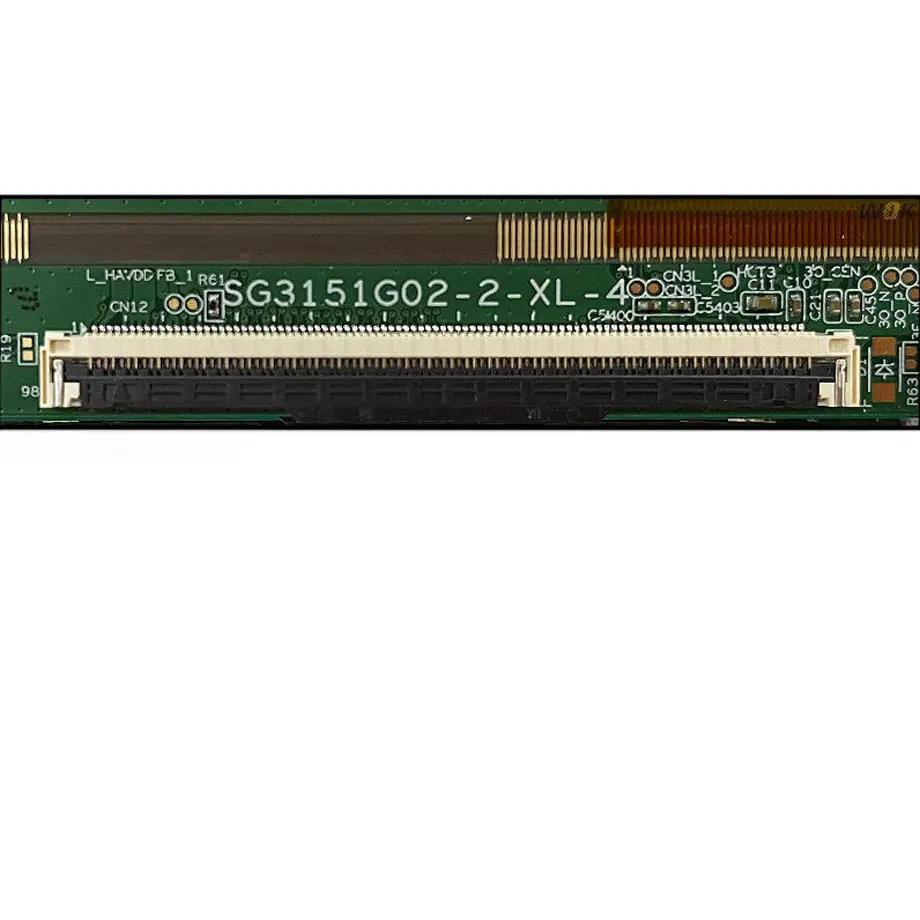
The panel-side interface is eDP with four lanes at HBR2 5.4 Gbit/s per lane through a 51-pin connector. This describes the native cell connection. It does not mean that any motherboard with DisplayPort or USB-C will connect directly. The system still needs an eDP-capable source path with the exact timing, lane count, voltage levels, AUX behavior, connector pinout and power sequence required by the cell.
The 12 V typical input is the panel supply. Controller-board or complete-monitor input power can be different and should remain a separate design item. When selecting a scaler, confirm that the board can deliver 2560×1440 at 165 Hz over the required eDP configuration without relying on an undocumented reduced-refresh fallback. Link stability should be tested at cold start, after thermal soak and across repeated resolution or power-state changes.
Signal-integrity checks
At HBR2 rates, route length, impedance control, connector quality and electromagnetic coupling become important. Keep differential pairs matched and follow the controller and connector layout requirements. A development cable that works on an open bench may lose margin in the final enclosure if routing changes or if the cable is folded near switching power circuits. Treat the final cable and connector set as part of the qualified display path.
What Does 165 Hz Change for Motion and Response-Time Evaluation?
At 165 Hz, a frame interval is about 6.1 ms. The specified 5 ms typical gray-to-gray response time is therefore relevant to motion behavior, but it is not equivalent to an input-lag figure and should not be interpreted as a guarantee that every pixel transition completes within one frame. Different gray transitions can have different response characteristics, and the monitor's overdrive algorithm can change both speed and overshoot.
Qualification should include moving test patterns, dark transitions, text scrolling and real game content at the intended refresh modes. If variable refresh is planned, test the full operating range and transitions between frame rates. The cell data supports a 165 Hz target; adaptive-sync support, low-framerate compensation or esports marketing claims require controller and system evidence that is separate from the panel fact set.
The 3500:1 typical contrast ratio and HVA normally-black mode are valuable for dark-scene differentiation, while 100% sRGB coverage supports mainstream desktop color targets. Neither figure proves calibrated creator-monitor performance. If the product will be sold for color-sensitive work, define the finished monitor's calibration process, white point, gamma and tolerance independently.
Which Mechanical Details Matter Before a Curved or Borderless Build?
The active area of 697.344 × 392.256 mm should be separated from the 708.844 × 405.681 mm cell outline in CAD. The active area defines the visible image opening; the glass outline defines structural clearance and edge support. The 1.07 mm depth describes the cell, not the final stack with optical films, LEDs and rear metalwork.
Same-model application information mentions a curved display and a three-side-borderless concept. Those descriptors can guide application planning but do not prove a particular bend radius, bezel width or mechanical fixture. Obtain the exact mechanical drawing and any handling specification before creating tooling. Curved-glass integration should control stress distribution and avoid forcing the cell into a radius that is not documented for the exact configuration.
Temperature and handling
The operating range is 0 to 50 °C and storage is -20 to 60 °C. These are component limits. A 32-inch gaming monitor can create localized heat around the backlight driver, power supply and scaler, so internal cabinet temperature should be measured after sustained high-refresh operation. The 736 g cell also needs appropriate glass handling during assembly even though the finished monitor will be much heavier.
Where Does SG3151G02-6 Fit in the Market?
The supported applications are desktop monitor and gaming. SG3151G02-6 QHD HVA Gaming Glass Cell is particularly relevant to OEM projects that want QHD resolution and a 165 Hz panel path while retaining control over the backlight, enclosure and electronics. It can also suit simulation or visualization terminals that value high refresh and wide symmetric viewing, provided the equipment environment fits the confirmed temperature range and the project does not infer unsupported industrial qualification.
Because the product has no backlight, no touch and no complete monitor I/O, it should not be positioned as a finished gaming display. HDMI, DisplayPort, USB hub, speakers, RGB lighting and firmware features all belong to the system design. The safest product page makes this boundary explicit so procurement teams do not compare a bare cell with an assembled retail monitor as if they were equivalent products.
What Should Procurement Verify Before Design Freeze?
Confirm the exact SG3151G02-6 identity, current production status and the latest revision documentation. Request the current electrical timing, eDP pin assignment and mechanical drawing. Match the 51-pin connector and HBR2 link to the controller path, and verify that the selected board supports the required QHD 165 Hz mode rather than only lower refresh rates.
For the optical stack, define the target finished brightness, uniformity, color point and power consumption before sourcing the backlight. The cell's 100% sRGB figure is useful, but the finished result depends on the LED spectrum and optical films. If a curved or borderless enclosure is planned, include the actual frame and backlight in the engineering sample so pressure and uniformity are validated in the intended geometry.
Finally, separate current stock from lifecycle planning. Supplier inventory can support sample timing, but it does not establish a supply horizon. For products expected to ship for several years, request current lifecycle and change information before tooling is committed.
Procurement Checklist
- Confirm SG3151G02-6 model identity and current specification revision.
- Validate 2560×1440 at 165 Hz through the four-lane HBR2 eDP path.
- Verify the 51-pin connector pinout and 12 V panel supply requirements.
- Design a separate backlight and qualify brightness, uniformity and thermal performance.
- Check the 708.844 × 405.681 × 1.07 mm cell outline in the final chassis.
- Test motion behavior and overdrive at the actual refresh modes.
- Treat curved or borderless styling as a mechanical project requiring exact drawing validation.
- Confirm production, revision and change status before volume purchase.
For a custom 32-inch QHD platform, SG3151G02-6 QHD HVA Gaming Glass Cell combines a 165 Hz target, HVA contrast behavior and an eDP HBR2 interface in a thin cell format. The finished product still depends on disciplined backlight, signal, mechanical and thermal engineering.
Recommended: Same Size
(32")
Applications & Value of LCD Panel

- Fast sourcing with in-stock panels & cross-reference alternatives
- Stable supply chain with long-term availability
- Engineering-level support from panel to integration
- Custom solutions: cable, touch & optical bonding
- Strict quality control with IQC / OQC / aging test
- Full traceability system for quality assurance
- Complete technical documentation & drawings
- Compliance support: RoHS & certification files
