Freya Yang
+86 18318948097
+852 62667476
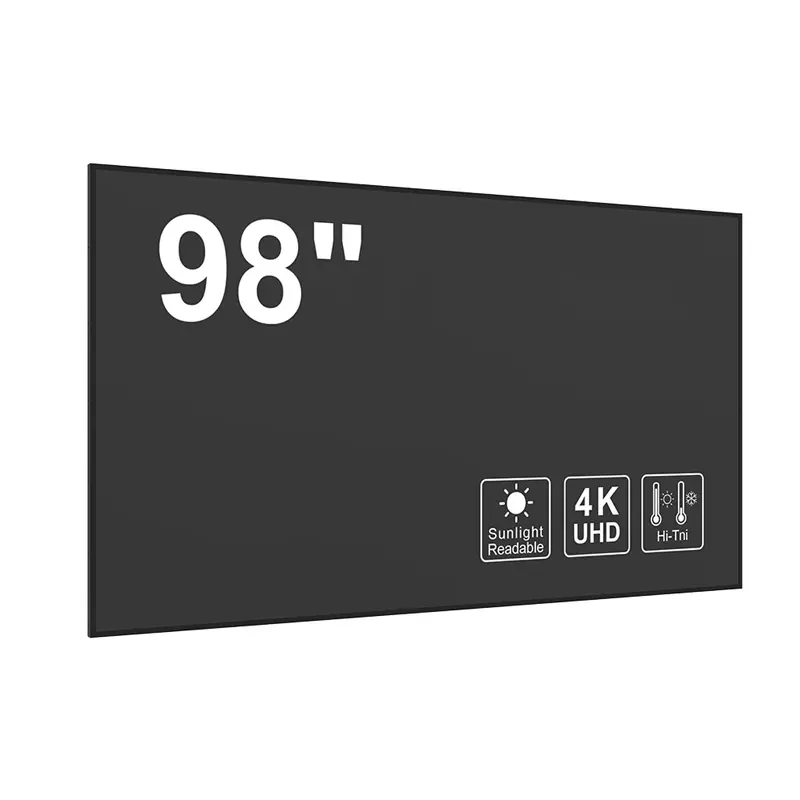
98 Inch Daylight Readable Display Module for Public Signage
Model P/N
Size
Resolution
Brightness
Viewing Angle
Connector Type
Operating Temp
Overall(mm)
huisoar
HS980ENT-ND50
Brand
Panel Size (inch)
Model P/N
Resolution
Brightness (nits)
Viewing Angle
Contrast Ratio
Response Time
Overall (mm)
Active Area (mm)
Refresh Rate
Display Colors
Panel Type
Connector Type
Surface Treatment
Operating Temp
Touchscreen Type
Storage Temp
Work Mode
Pixel Format
Input Voltage (V)
Control Type
Weight (g)
Product Weight
Operating Environment
I/O Interface
Designed For
98 Inch Daylight Readable Display Module for Public Signage
A 98-inch 4K ADS display module for large public-signage systems, with high-brightness family options, V-by-One integration and wide-temperature operation.
Product Summary
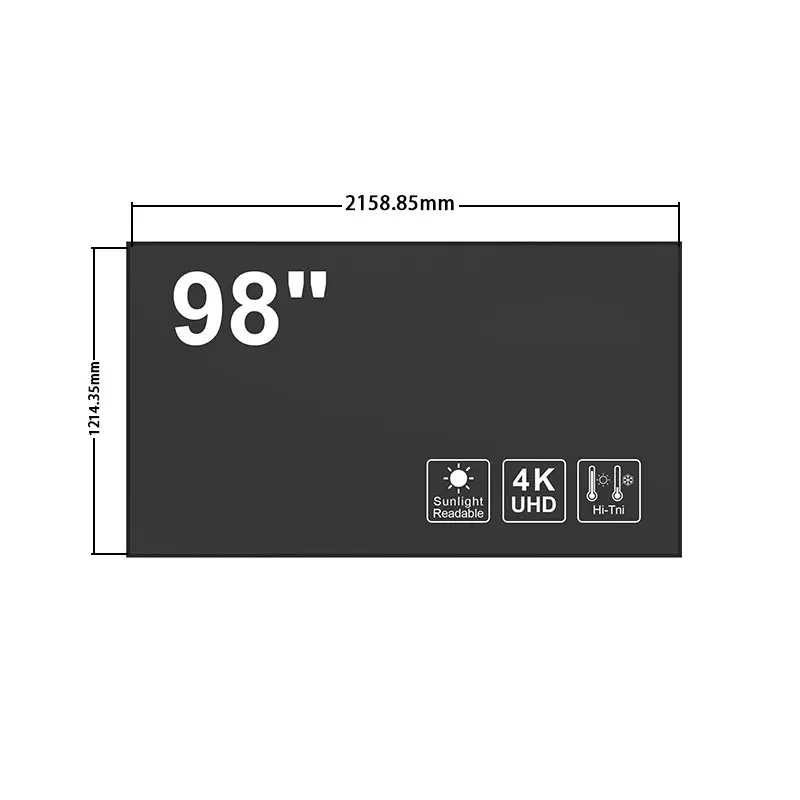
The Daylight Readable Display Module provides a 98-inch visual platform for public signage, transportation information, window-facing promotion, command displays and other large-format systems. Its 3840 × 2160 native resolution supports detailed text, video, schedules and multi-zone information across a 2158.85 × 1214.35 mm active image area.
The module uses ADS normally black technology with a 1200:1 typical contrast ratio, 1.07 billion colors and a 74% NTSC color-gamut reference. An anti-glare matte surface with 25% haze helps manage reflections at the panel level, while the wide viewing geometry supports large public spaces where viewers approach from different positions.
Key Specifications
| Parameter | Confirmed value |
|---|---|
| Screen size | 98 inches |
| Resolution | 3840 × 2160 pixels |
| Pixel density | 45 PPI |
| Active area | 2158.85 × 1214.35 mm |
| Display mode | ADS, normally black, transmissive |
| Brightness family | 2000–5000 cd/m² |
| Contrast ratio | 1200:1 typical |
| Viewing angle | 89/89/89/89° L/R/T/B |
| Response time | 8 ms typical, gray-to-gray |
| Color depth | 1.07 billion colors, 74% NTSC |
| Surface treatment | Anti-glare matte, haze 25% |
| Native frequency | 60 Hz |
| Signal interface | 51-pin, eight-lane V-by-One |
| Panel input | 12.0 V typical |
| Backlight | WLED with LED driver |
| Weight | 61.0 kg typical |
| Operating temperature | −20°C to +70°C |
| Storage temperature | −30°C to +80°C |
Native 4K Content for a 98-Inch Image Area
Prepare Assets at 3840 × 2160
Content should be authored at the native 3840 × 2160 raster. Scaling lower-resolution material can soften route text, pricing, schedules and other high-value details across such a large image area.
The layout should reserve adequate margins for the eventual bezel and cover structure. Critical text should not be placed at the extreme edges until the visible opening and final enclosure drawing are approved.
Match Text Scale to Viewing Distance
A 98-inch display may be viewed from several meters away in a transport hub, mall or public-information environment. Text size, line spacing, contrast and information density should be tested at the actual installation distance.
Large image area does not automatically make dense content readable. Schedules, directional information and emergency notices should receive higher visual priority than secondary promotional content.
Optical Planning for the Daylight Readable Display Module
Resolve the ND50 Brightness Version
The product family covers 2000–5000 cd/m², and the ND50 series row identifies a 5000 cd/m² version. The ordered luminance must nevertheless be fixed in the approved specification because a separate product description associates the same designation with 2000 nits.
The approved luminance sheet must resolve the ND50 brightness conflict before procurement.
The selection should be based on ambient illumination, screen orientation, installation setback, viewing distance, cover-glass transmittance and thermal capacity rather than the highest available number alone.
Control Reflection and Solar Loading
High panel luminance does not guarantee equivalent finished-system visibility. Cover-glass reflection, tint, surface contamination, air gaps and direct sun can materially change perceived contrast.
Optical bonding and low-reflection treatments are commonly used to reduce internal reflections and improve transmitted image contrast, but they must be evaluated with the final cover material and thermal design.
V-by-One Controller and Signal Qualification
Confirm the Complete 51-Pin Definition
The module uses an eight-lane, 51-pin V-by-One interface. A controller should not be approved from interface name and connector count alone.
A 51-pin V-by-One connector does not prove controller compatibility without timing, lane mapping, voltage and pin-definition confirmation.
The engineering package should include native timing, data rate, lane assignment, connector orientation, control signals, panel power and backlight-driver requirements.
Separate Native Refresh from MEMC Input Modes
The confirmed panel operating frequency is 60 Hz. The MEMC statement indicates support for 120 Hz or 240 Hz input modes, but this must not be rewritten as a native 120 Hz or 240 Hz panel specification.
MEMC input support does not change the confirmed 60 Hz native operating frequency.
Confirm the accepted source formats, conversion behavior, latency and controller configuration when fast motion, scrolling schedules or live-video feeds are required.
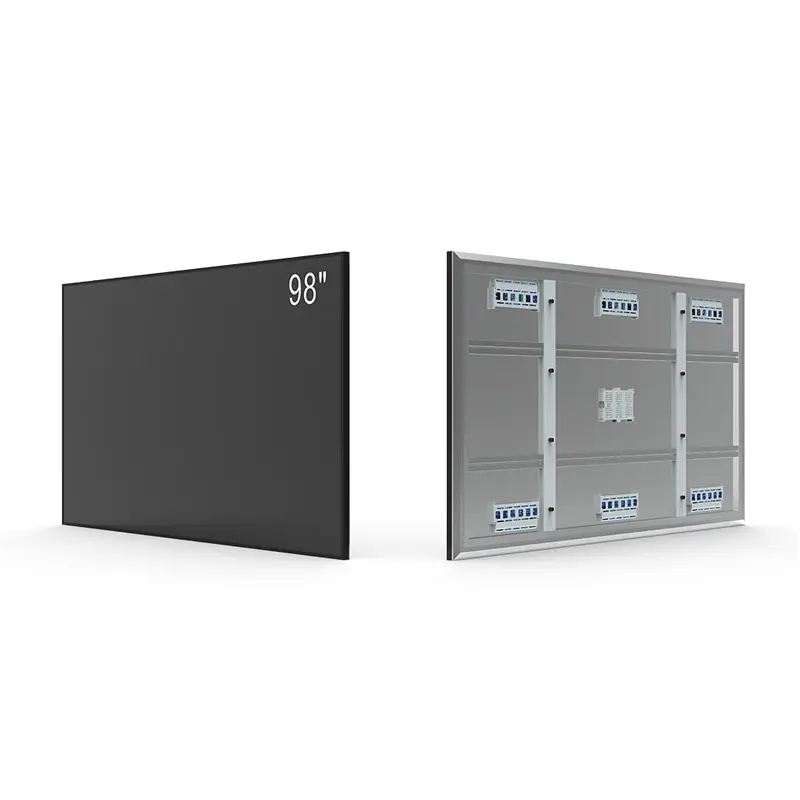
Mechanical Integration of a 61 kg LCD Module
Obtain the Complete Outline Drawing
The active area is confirmed, but the complete panel outline, thickness, mounting points and center of gravity are not supplied in the technical table. Cabinet production should not begin from the active area alone.
The approved mechanical drawing must define the outer envelope, mounting surfaces, keep-out zones, connector access and allowed support locations.
Plan Lifting, Support and Service Access
At 61.0 kg, the panel requires a documented lifting and installation method. The support frame should distribute load without twisting the glass or concentrating force at unapproved points.
The enclosure should also provide rear service access, safe cable routing and a removal path that does not require dismantling unrelated equipment.
Outdoor-System and Touch Boundaries
The standard product is an LCD module rather than a complete weatherproof digital-signage unit.
A 98-inch LCD module does not establish finished outdoor protection without enclosure, glass, sealing and thermal qualification.
The final system must address water and dust entry, drainage, condensation, solar loading, ventilation, corrosion exposure, cable glands and service panels. Any IP or impact-resistance requirement should be supported by documentation for the exact assembled configuration.
The standard panel is non-touch. Interactive use requires a separate sensor, controller, protective front and mechanical stack designed for the final application.
Application Fit
The Daylight Readable Display Module can support:
- Large public-information displays
- Airport and station signage
- Shopping-mall advertising
- Storefront and window-facing promotion
- Transportation schedules and wayfinding
- Control-room and command-center information
- Exhibition and visitor-information systems
- Interactive public displays with a separate touch overlay
Each application still requires project-specific optical, structural, thermal and environmental qualification.
Configuration Options
Project review may cover:
- ND20–ND50 brightness selection
- V-by-One controller and cable matching
- Cover glass and low-reflection treatment
- Optical bonding
- Ambient-light sensing
- Backlight and thermal design
- Enclosure and sealing
- Mounting and lifting fixtures
- Optional touch overlay
- Branding and packaging
Custom configurations are generally reviewed from 500 pieces, subject to tooling requirements, material availability and the requested specification. Sample and standard-module quantities are confirmed separately.
Procurement Checklist
Before sample approval, confirm:
- Approved ND20–ND50 brightness version
- Resolution of the ND50 2000/5000-nit conflict
- Native 3840 × 2160 timing
- Required refresh and MEMC input behavior
- V-by-One lane count, data rate and mapping
- Complete 51-pin connector definition
- 12.0 V panel power requirements
- WLED driver voltage, current and controls
- 2158.85 × 1214.35 mm active image area
- Complete outline and mounting drawing
- Support points and center of gravity
- 61.0 kg lifting and structural plan
- Cover-glass transmittance and reflectance
- Optical bonding or air-gap design
- Site orientation and ambient light
- Solar heat load and cooling
- Environmental sealing target
- Non-touch or touch-overlay requirement
- Sample criteria and annual demand

FAQ
About 98 Inch Daylight Readable Display Module
What must be checked before connecting a V-by-One controller?
Which brightness value should be used for the ND50 version?
Does the module support native 120 Hz or 240 Hz operation?
Which mechanical information is required before enclosure release?
Can the panel be installed outdoors without another enclosure?
Freya Yang
+86 18318948097