Freya Yang
+86 18318948097
+852 62667476
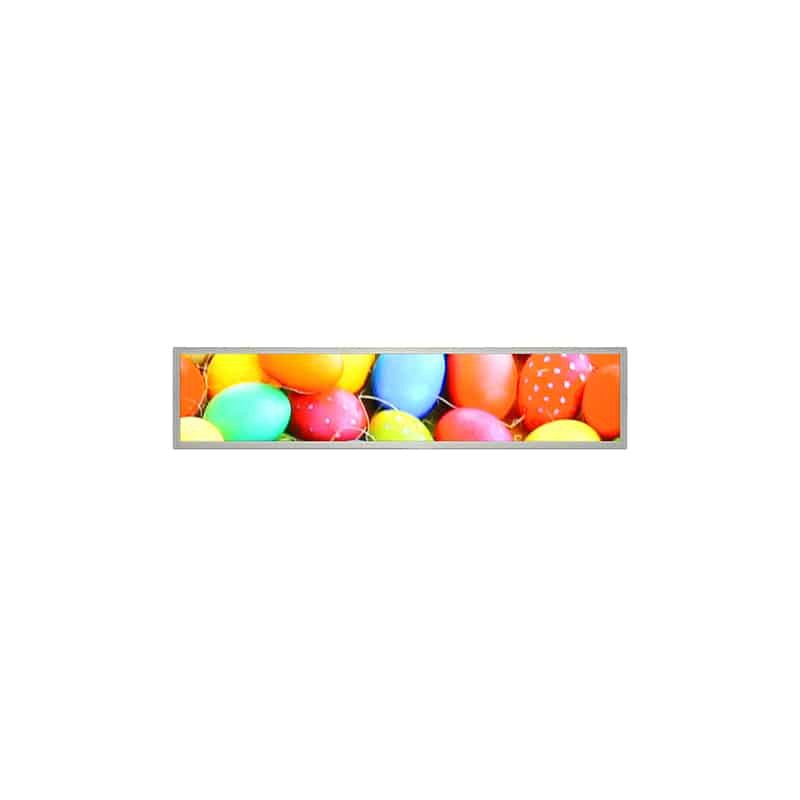
16.4 Inch Commercial Message Strip LCD Module for Retail Signs



Model P/N
Size
Resolution
Brightness
Viewing Angle
Connector Type
Operating Temp
Overall(mm)
huisoar
HS0164TB01-C070
Brand
Panel Size (inch)
Model P/N
Resolution
Brightness (nits)
Viewing Angle
Contrast Ratio
Response Time
Overall (mm)
Active Area (mm)
Refresh Rate
Display Colors
Panel Type
Connector Type
Operating Temp
Touchscreen Type
Storage Temp
Work Mode
Pixel Format
Control Type
Operating Environment
Designed For
16.4 Inch Commercial Message Strip LCD Module for Retail Signs
This narrow 16.4-inch LCD module provides a native 1366 × 230 canvas, 700 cd/m² luminance and dual-channel LVDS for compact commercial information areas.
Product Summary
The Commercial Message Strip LCD Module is designed for equipment that must present prices, short promotions, status messages or guidance information inside a long, restricted opening. Its 409.7 × 69 mm active area provides an elongated information zone without requiring the installation space of a conventional 16:9 display.
The module has a native 1366 × 230 resolution, a 1000:1 contrast ratio and a 700 cd/m² standard luminance. Image signals are carried through a two-channel, 8-bit LVDS interface. The standard configuration is non-touch and is intended for integration with a separate controller, power system, mounting structure and protective front.
The complete module measures 431.8 × 94.8 × 14.7 mm and has a 9 W product power reference. These dimensions and the elongated structure should be reviewed together when planning the enclosure, cable route and distributed mechanical support.
Key Specifications
| Specification | Value |
|---|---|
| Display size | 16.4 inches |
| Native resolution | 1366 × 230 pixels |
| Form factor | Bar-type TFT LCD module |
| Aspect ratio | 16:2.7 |
| Luminance | 700 cd/m² |
| Contrast ratio | 1000:1 |
| Interface | LVDS, 2-channel, 8-bit |
| Active area | 409.7 × 69 mm |
| Module outline | 431.8 × 94.8 × 14.7 mm |
| Power reference | 9 W |
| Backlight | WLED |
| Touch | Non-touch |
| Operating temperature | 0°C to +50°C |
Planning Content for the 1366 × 230 Canvas
Native-resolution message layouts
The 1366 × 230 pixel format should be treated as a dedicated design canvas rather than as a cropped version of a conventional widescreen asset. Scaling a 1920 × 1080 layout directly into the strip can make text too small, distort graphics or waste the available horizontal space.
A purpose-built layout can divide the canvas into clear functional zones, such as:
- Price and product name
- Promotion and expiry information
- Direction and destination
- Queue or service status
- Building and floor guidance
- Alert or operating message
- Brand and category identifier
The Commercial Message Strip LCD Module is most effective when the content hierarchy is intentionally limited. One primary message, a supporting value and one visual indicator will generally communicate more clearly than a densely packed full-screen interface.
Viewing distance and text height
Text and icon dimensions should be based on the actual viewing distance. A shelf header viewed from close range can use a denser layout than an elevator guide or queue message intended to be read several metres away.
Prototype content should be rendered at the native 1366 × 230 resolution and evaluated on a production-intent sample. The review should include character height, stroke thickness, contrast, scrolling speed and the time available for the viewer to understand each message.
LVDS Integration for the Narrow LCD Module
Dual-channel 8-bit LVDS qualification
The display is identified as a two-channel, 8-bit LVDS module. This describes the interface class but does not establish direct compatibility with every LVDS controller.
A compatible controller must be checked for:
- Native 1366 × 230 output timing
- Pixel clock and blanking parameters
- LVDS channel mapping
- Bit assignment
- Panel supply requirements
- Backlight control
- Connector pin assignment
- Cable contact orientation
- Cable length and shielding
- Power-up and power-down requirements
A dual-channel LVDS label does not prove that two panels have interchangeable cables or timing.
Controller and cable checks
The controller should generate the panel’s native format without relying on uncontrolled scaling. The cable drawing must be approved against both the panel connector and the controller-board connector.
A suitable sample review should include:
- Stable image output
- Correct color mapping
- No flicker or intermittent lines
- Cold and warm start behaviour
- Cable movement
- Backlight startup
- Long-image pattern checks
- Power measurement
- Enclosure-level electrical-noise testing
HDMI, DisplayPort or another host interface requires a suitable controller or conversion board. Those inputs are not native functions of the bare LCD module.
Mechanical Fit of the Commercial Message Strip LCD Module
Active area and module outline
The active image area is 409.7 × 69 mm, while the complete module outline is 431.8 × 94.8 × 14.7 mm. The bezel opening should therefore be planned from the active area and the approved mechanical drawing, not from the nominal 16.4-inch diagonal alone.
The design review should account for:
- Visible-area clearance
- Module edge tolerances
- Cable exit direction
- Connector access
- Backlight heat flow
- Mounting-rail position
- Protective-front thickness
- Service access
- Assembly sequence
The enclosure opening should not overlap the active image area or apply pressure to the display surface.
Support across the elongated structure
Long, narrow modules require distributed support. Mounting pressure concentrated near one edge can twist the structure, create uneven optical stress or load the connection area.
The retaining structure should keep the module flat without forcing it into an imperfect enclosure. Foam, brackets or support rails should be selected according to the approved drawing and tested through handling, transport and the intended mounting orientation.
No vibration grade is assigned to the module from the available data. Mobile or transport installations require separate vibration and shock qualification at the finished-system level.
Optical and Power Boundaries
The standard configuration is 700 cd/m². This provides useful luminance for bright indoor retail and commercial locations, but it does not by itself qualify the finished display for direct-sun exposure.
Effective visibility depends on:
- Ambient illumination
- Protective-glass reflection
- Surface treatment
- Air gap or optical bonding
- Viewing angle
- Content contrast
- Enclosure orientation
- Backlight temperature
- Dimming strategy
Brightness configurations between 500 and 2500 cd/m² may be reviewed as separate project versions. A higher-luminance configuration should not be assumed to have the same power, thermal, thickness or lifetime characteristics as the standard 700 cd/m² version.
The 9 W value is a product power reference for system planning. The final supply and thermal design should be verified with the approved sample and controller arrangement.
Commercial Signage Applications
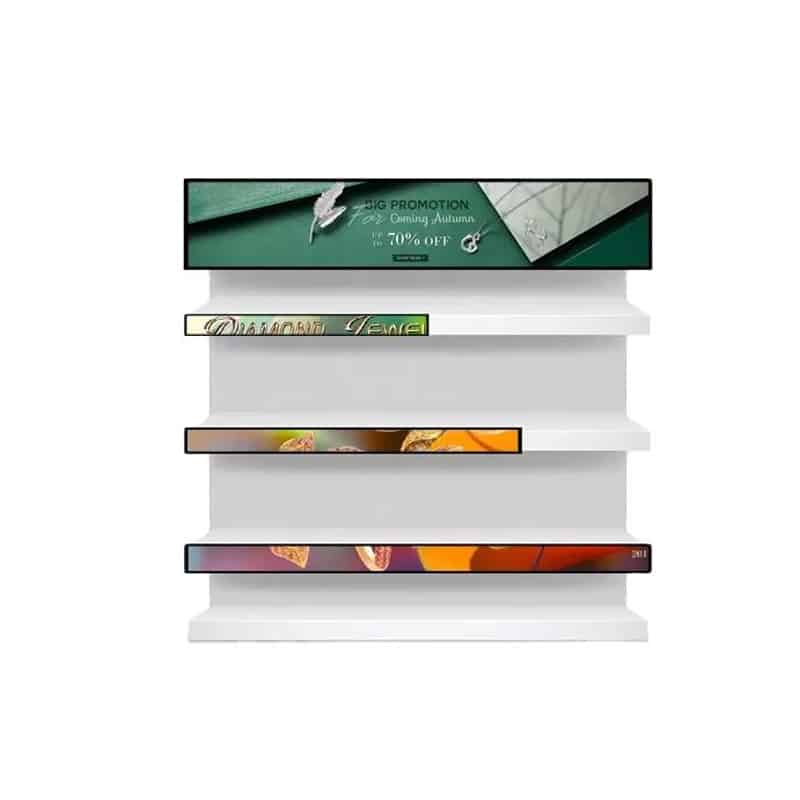
The narrow format can be evaluated for:
- Retail price and promotion strips
- Shelf and aisle headers
- Elevator guidance panels
- Queue and service notices
- Building directory strips
- Bank and reception call displays
- Narrow corridor signs
- Covered transport information areas
- Equipment status headers
- Compact commercial advertising bands
The Commercial Message Strip LCD Module is a non-touch component. Applications that require user interaction need a separately engineered touch overlay or another display configuration.
Outdoor, vehicle, railway, safety-critical or regulated projects require system-level environmental, optical, vibration and compliance review. The component specifications alone do not establish suitability for those environments.
Customization and Sample Review
Project customization may include:
- Standard-versus-custom luminance
- Cable or connector route
- Controller-board matching
- Cover-glass outline
- Decorative printing
- Surface treatment
- Mounting method
- Mechanical support
- Protective front
- Touch-overlay feasibility
Custom configurations are generally reviewed from 500 pieces, subject to tooling requirements, material availability and the requested specification. Standard-module and sample quantities are confirmed separately.
A customized version should be released only from controlled mechanical, optical and electrical documentation.
Procurement Checklist
Submit the following for engineering review:
- Controller-board model
- Native output resolution and timing
- LVDS channel and bit mapping
- Panel connector pinout
- Cable drawing and orientation
- Supply and backlight architecture
- Enclosure opening
- Mounting and support method
- Protective-front design
- Intended viewing distance
- Native content example
- Installation lighting
- Operating-temperature target
- Required compliance documents
- Sample quantity
- Forecast production quantity
- Validation criteria
Engineering review should cover controller compatibility, content mapping, cable design, mechanical support, optical conditions, power planning and sample qualification.
FAQ
About 16.4 Inch Commercial Message Strip LCD Module
What must be checked before selecting an LVDS controller?
How should standard video content be adapted to this display?
Is the 700 cd/m² configuration intended for direct sunlight?
What mechanical information is required before designing the enclosure?
When should another display configuration be selected?
Freya Yang
+86 18318948097