Freya Yang
+86 18318948097
+852 62667476
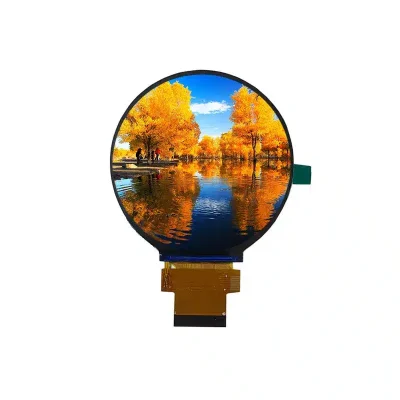
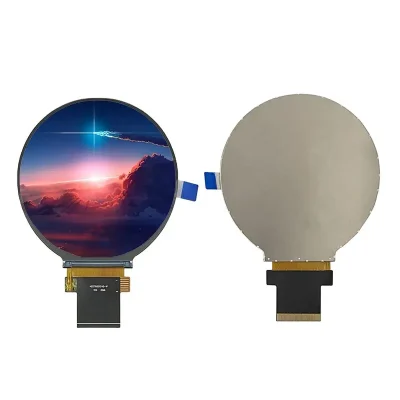
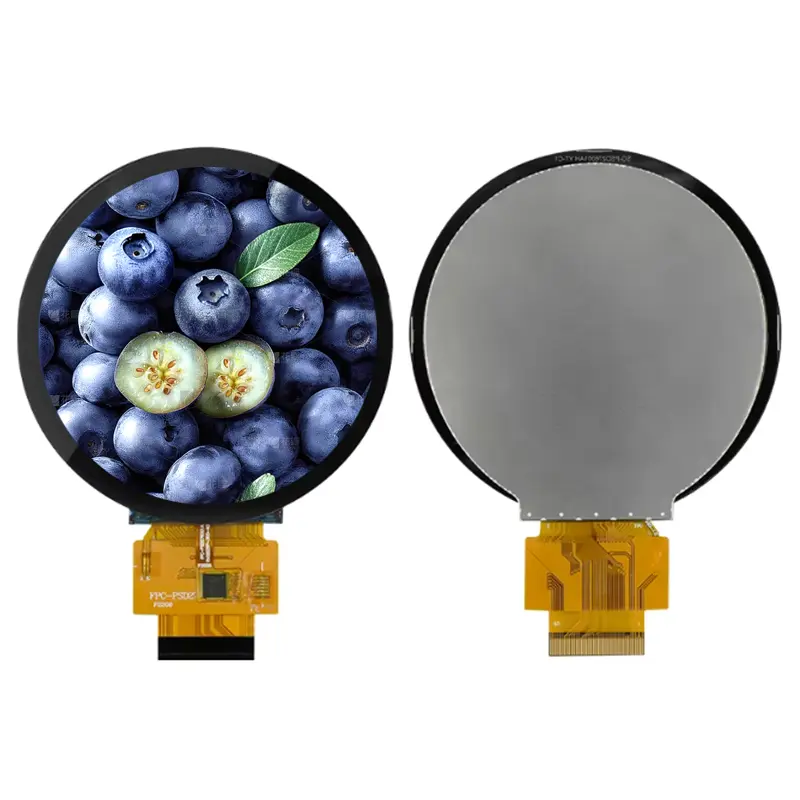
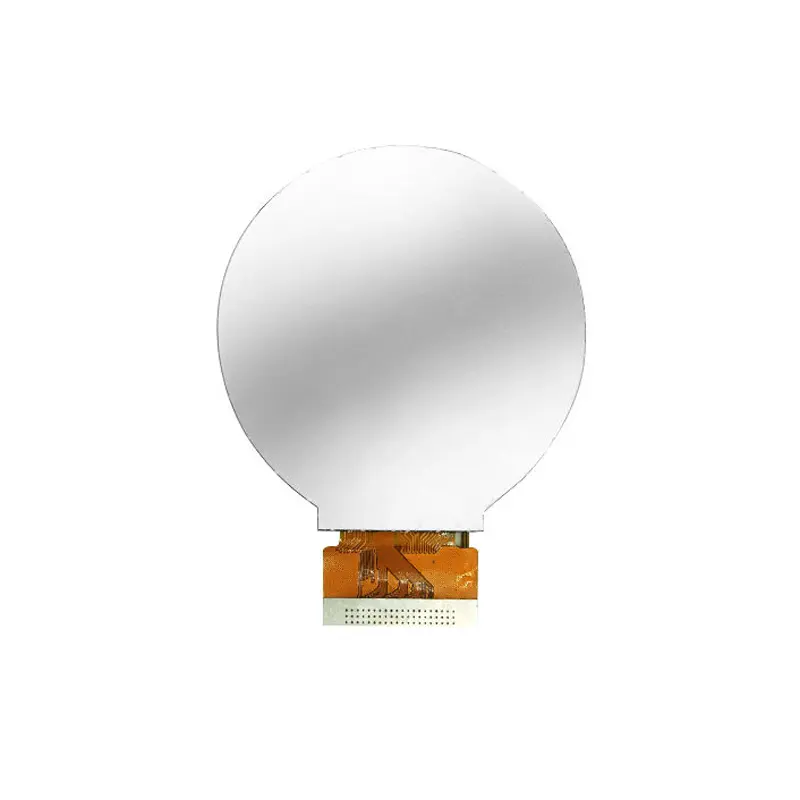
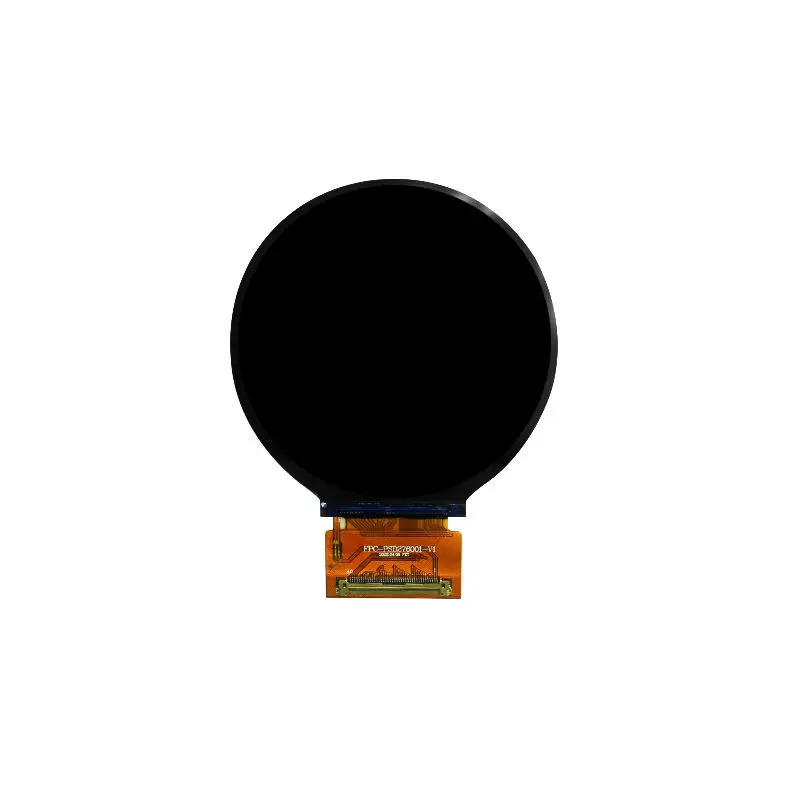
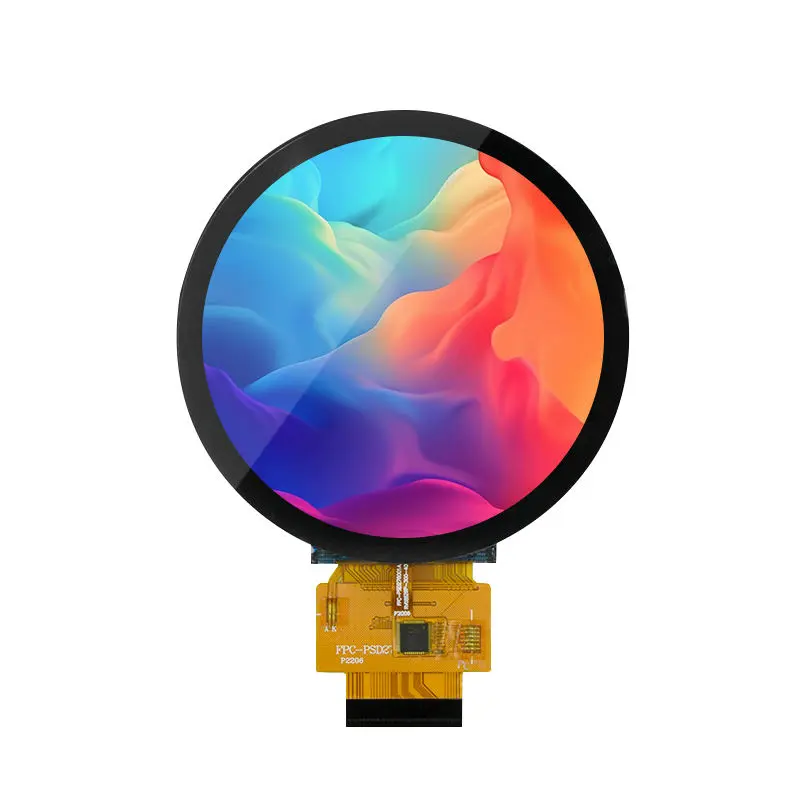
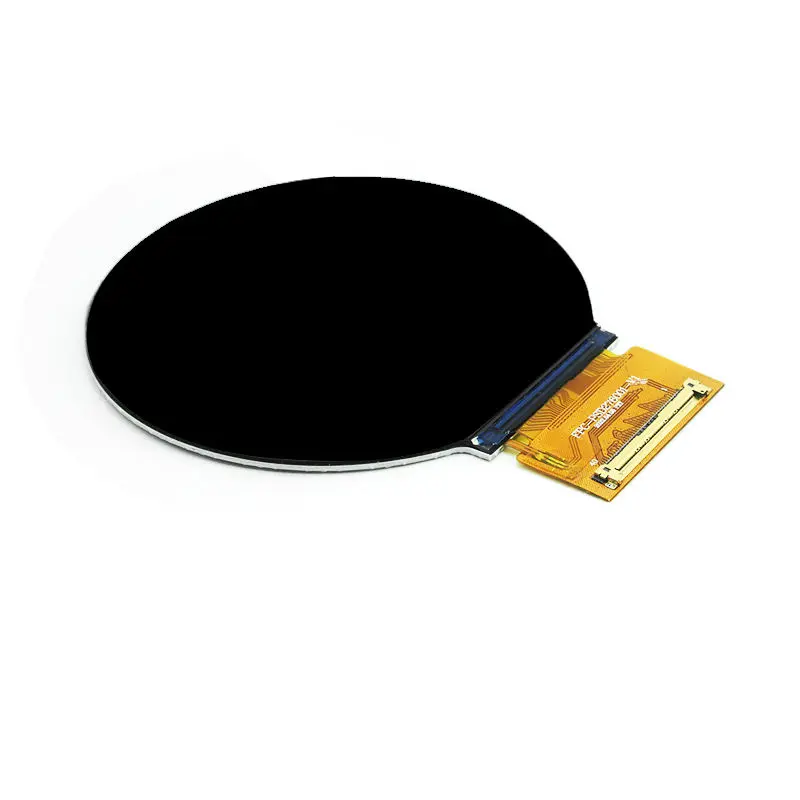
2.8 Inch Round LCD Module for Wearable Interfaces
Model P/N
Size
Resolution
Brightness
Viewing Angle
Connector Type
Operating Temp
Overall(mm)
huisoar
HS028Z6M-400-40
Brand
Panel Size (inch)
Model P/N
Resolution
Brightness (nits)
Viewing Angle
Contrast Ratio
Response Time
Overall (mm)
Active Area (mm)
Refresh Rate
Display Colors
Panel Type
Connector Type
Operating Temp
Touchscreen Type
Storage Temp
Work Mode
Pixel Format
Control Type
Operating Environment
Designed For
2.8 Inch Round LCD Module for Wearable Interfaces
A circular 480 × 480 IPS TFT display for AR/VR controls, body-worn instruments and portable smart interfaces requiring RGB + SPI integration.
Round Display Design for Wearable Interfaces
The Round LCD Module provides a circular display surface for wearable and portable smart equipment that benefits from radial menus, centered status graphics, gauges and rotary-style controls. Its 2.8-inch IPS panel uses a 480 × 480 pixel raster, providing sufficient graphical detail for icons, operating states, navigation elements and compact data visualization.
This display is particularly relevant to wearable products that are larger than conventional wristwatches. Potential integration routes include helmet-mounted controls, body-worn instruments, AR/VR auxiliary interfaces, portable sports consoles and smart equipment attached to clothing, straps or mobility systems.
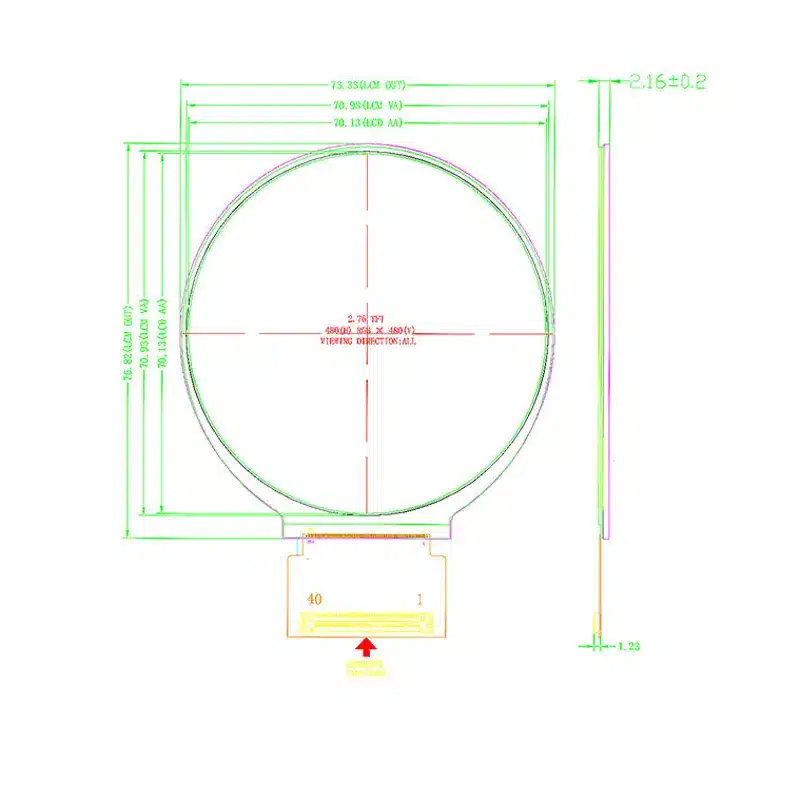
The module measures 73.33 × 76.82 × 2.20 mm. Product teams should therefore confirm available enclosure diameter, depth, weight allocation and cable space before defining it as a wrist-mounted or body-mounted component.
A 2.8-inch round display can support wearable equipment, but the complete mechanical envelope must be validated against the intended form factor.
Key Specifications for Wearable Product Planning
| Specification | Confirmed value |
|---|---|
| Display size | 2.8 inch |
| Resolution | 480 × 480 pixels |
| Viewing form | Circular |
| Panel technology | IPS TFT LCD |
| Display mode | Normally white |
| Interface | RGB + SPI |
| Driver IC reference | ST7701S |
| Active area | 70.13 × 70.13 mm |
| Module size | 73.33 × 76.82 × 2.20 mm |
| Luminance | 400 cd/m² typical |
| Contrast ratio | 800:1 |
| Display colors | 16.7M colors |
| Touch configuration | Customized CTP or RTP |
| Operating temperature | −20°C to +70°C |
| Storage temperature | −30°C to +80°C |
Circular UI Planning for Body-Worn and AR/VR Devices
Designing Within a Circular Safe Area
Although the visible display is round, the graphics system uses a square 480 × 480 coordinate space. Important content should remain within a circular safe area so that text, icons and operating controls are not hidden near the four corners.
Radial menus, compass graphics, activity rings, circular progress indicators and centered warning states fit naturally into this layout. Long text lines, wide tables and conventional rectangular menus require more careful scaling.
A Round LCD Module with a square pixel raster does not automatically crop interface content. The UI software must define which pixels remain inside the intended circular viewing boundary.
Visual Information for Wearable Operation
The 480 × 480 resolution supports interfaces requiring more detail than simple segmented indicators. A wearable or AR/VR control device can use the panel for:
- operating mode selection;
- sensor-status graphics;
- navigation direction;
- activity or equipment data;
- communication status;
- battery and connection indicators;
- radial control menus;
- graphical alerts.
The IPS panel and 16.7M-color specification support interfaces that use color to separate operating modes and information categories.
Optical Performance in Portable Equipment
The display is rated at 400 cd/m² typical luminance with an 800:1 contrast ratio. This specification is appropriate for many indoor, shaded or controlled-light wearable applications.
It does not establish outdoor or sunlight-readable performance.
The final visible luminance may be affected by:
- cover-lens transmission;
- touch-sensor layers;
- air-gap or bonding construction;
- anti-glare or surface coatings;
- enclosure shadowing;
- viewing distance;
- ambient illumination.
For helmet-mounted or body-worn use, evaluate the sample behind the proposed cover lens and under the actual lighting conditions expected during operation.
Integrating the Round LCD Module
RGB Image Data and SPI Control
The display uses an RGB + SPI architecture. RGB carries the continuous image-data path, while SPI supports control-related communication.
The host must match the required RGB clock, sync signals, data mapping, voltage levels and complete pin definition. A processor that supports only a low-bandwidth SPI display output should not be assumed to drive the full 480 × 480 image stream directly.
Wearable product teams should also evaluate whether the host processor and battery system can support the display-data bandwidth and backlight load within the intended operating time.
ST7701S Integration Boundary
ST7701S is the identified driver IC reference. The IC name does not independently prove that an existing library, initialization sequence or controller board will work with this module.
The ST7701S identifier alone does not establish firmware compatibility.
Before hardware or firmware release, obtain and verify:
- the approved initialization requirements;
- RGB timing;
- SPI control definition;
- logic-voltage requirements;
- complete FPC pinout;
- orientation settings;
- panel power conditions;
- backlight electrical requirements.
Mechanical Fit for Wearable Equipment
Module Envelope Versus Wearable Form Factor
The active image area is 70.13 × 70.13 mm, while the complete module measures 73.33 × 76.82 × 2.20 mm.
The final product envelope must also include:
- FPC bend space;
- connector clearance;
- rear mechanical support;
- touch sensor;
- cover lens;
- bonding material;
- bezel overlap;
- battery and mainboard space;
- thermal clearance.
This size is generally more suitable for larger wearable terminals, helmet or equipment-mounted controls and portable smart interfaces than for a conventional compact wristwatch enclosure.
Weight and Power Qualification
Module weight and detailed backlight electrical values are not confirmed. Both should be obtained before approving a wearable design.
For a body-worn product, engineering review should cover:
- total front-module weight;
- center of gravity;
- battery capacity;
- backlight current;
- thermal load near the user;
- cable strain;
- impact protection;
- enclosure retention;
- operating duration.
A thin LCD profile alone does not establish that the completed assembly will be lightweight or low power.
Touch Options for Wearable Interaction
Customized capacitive touch or resistive touch may be evaluated.
Capacitive Touch
CTP is relevant to finger-operated graphical interfaces and cover-lens-based wearable controls. Confirm the touch controller, interface, touch-point requirement, glove behavior and cover-lens stack.
Resistive Touch
RTP may be considered when pressure input, stylus use or non-capacitive operating tools are required. Its mechanical feel and optical stack differ from CTP and should be tested in the intended wearable enclosure.
Touch should not be treated as a standard included feature. The exact LCD, touch sensor, controller, cable and cover-lens assembly must be defined in the quotation and drawing set.
Suitable Wearable and Smart-Device Profiles
The module can be evaluated for:
- AR/VR auxiliary control displays;
- helmet-mounted equipment interfaces;
- body-worn industrial instruments;
- portable navigation or sports consoles;
- mobility-system controllers;
- smart protective-equipment displays;
- larger circular wearable terminals;
- handheld or strap-mounted smart controllers.
It can also support non-wearable circular interfaces such as smart appliance controls and industrial gauges. The selected page angle prioritizes wearable integration without excluding these valid secondary uses.
No medical, safety, automotive, outdoor or protective-equipment certification is implied.
Procurement and Sample Approval
Before approving the Round LCD Module for a wearable product, confirm both display compatibility and physical wearability.
Submit These Project Details
- wearable-device type;
- mounting position;
- enclosure diameter and depth;
- total weight target;
- battery and power budget;
- native 480 × 480 graphics capability;
- RGB timing and data mapping;
- SPI control requirements;
- full FPC pin assignment;
- panel and backlight power;
- cable orientation;
- circular UI safe area;
- CTP, RTP or display-only requirement;
- cover-lens and bonding plan;
- ambient-light target;
- operating-temperature requirement;
- sample quantity;
- annual demand.
Engineering Review Covers
Engineering review covers mechanical fit, wearable weight and power constraints, RGB timing, SPI control, connector mapping, backlight requirements, circular UI layout, touch configuration, cover-lens integration and sample qualification.

FAQ
About Round LCD Module
Is this 2.8-inch display suitable for a smartwatch?
Which wearable devices are better suited to this display size?
How should the 480 × 480 UI be adapted to the round screen?
What host functions are required for RGB + SPI?
What information is needed for a wearable touch version?
Freya Yang
+86 18318948097