Freya Yang
+86 18318948097
+852 62667476
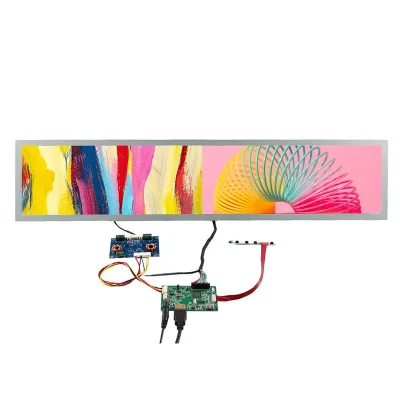
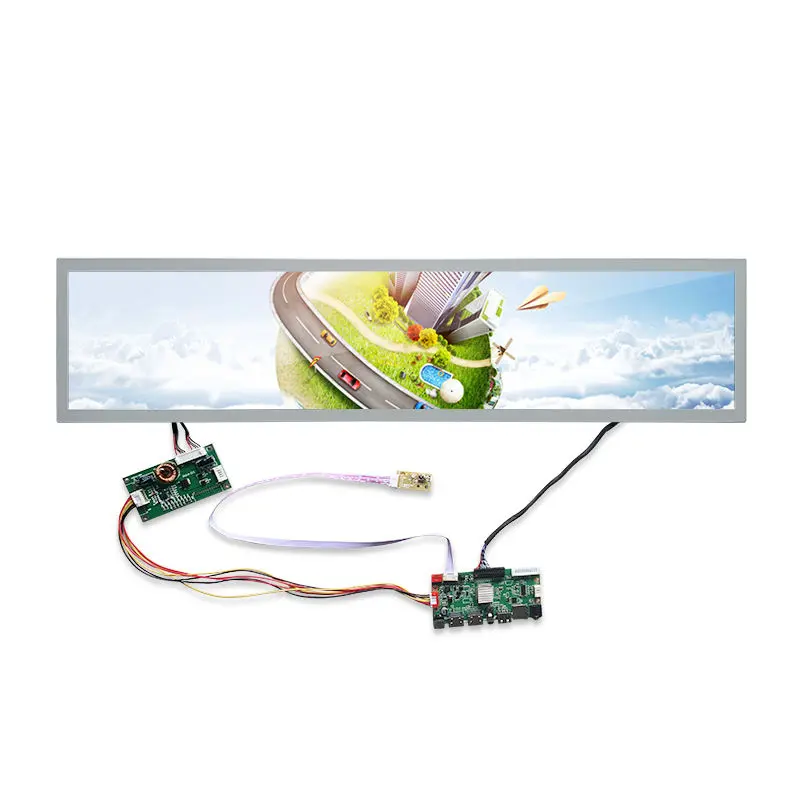
28″ 800 Nits Ultra High Brightness Stretched Bar LCD Display for OEM
Model P/N
Size
Resolution
Brightness
Viewing Angle
Connector Type
Operating Temp
Overall(mm)
huisoar
HS280HD-BAR
Brand
Panel Size (inch)
Model P/N
Resolution
Brightness (nits)
Viewing Angle
Contrast Ratio
Response Time
Overall (mm)
Active Area (mm)
Refresh Rate
Display Colors
Panel Type
Connector Type
Operating Temp
Touchscreen Type
Storage Temp
Work Mode
Pixel Format
Input Voltage (V)
Weight (g)
Operating Environment
Designed For
28" 800 Nits Ultra High Brightness Stretched Bar LCD Display for OEM
A 28-inch 1366 × 256 panoramic TFT-LCD panel with 800 cd/m² luminance and 30-pin LVDS for narrow OEM information and signage layouts.
Product Summary
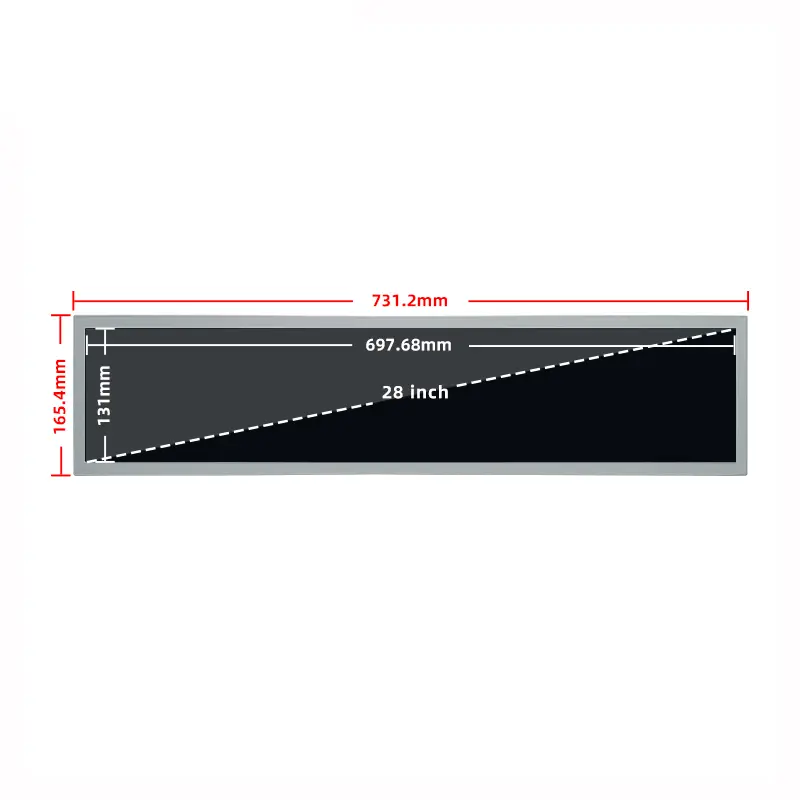
The 800 Nits Ultra High Brightness Stretched Bar LCD Display for OEM is a 28-inch panoramic panel built for equipment that needs a long horizontal information area without the height of a conventional 16:9 screen. Its native 1366 × 256 raster, 697.685 × 130.752 mm active area and 731.2 × 165.4 mm footprint support message bands, information strips and other narrow-format visual interfaces.
The display combines an a-Si TFT-LCD structure, ADS normally-black transmissive operation, 800 cd/m² luminance, 1200:1 contrast and wide viewing performance. A 30-pin LVDS connection and 12.0 V typical panel input provide the core electrical architecture for OEM integration.
Key Specifications
| Parameter | Specification |
|---|---|
| Display size | 28 inches |
| Resolution | 1366 × 256 pixels |
| Panel technology | a-Si TFT-LCD |
| Operating mode | ADS, normally black, transmissive |
| Active area | 697.685 × 130.752 mm |
| Panel footprint | 731.2 × 165.4 mm |
| Luminance | 800 cd/m² |
| Contrast ratio | 1200:1 |
| Viewing performance | 89°/89°/89°/89° typical, CR ≥ 10 |
| Display colors | 16.7M colors |
| Pixel arrangement | RGB vertical stripe |
| Response time | 8 ms typical, G-to-G |
| Refresh rate | 60 Hz |
| Signal interface | 30-pin LVDS |
| Panel input | 12.0 V typical |
| Backlight | WLED |
| Backlight-life reference | 30,000 hours listed |
| Panel weight | 2.51 kg |
| Operating temperature | 0°C to +50°C |
| Storage temperature | −20°C to +60°C |
Designing Content for the 1366 × 256 Panoramic Format
Use the native raster for long-format graphics
The 1366 × 256 canvas is intended for panoramic information rather than conventional desktop or television layouts. UI designers can allocate the width to route information, promotional messages, status sequences, product categories or other horizontally organized content.
The native 1366 × 256 raster should be used whenever possible to avoid unnecessary scaling. Artwork originally designed for 16:9 screens will normally need to be recomposed so that text, icons and images use the available horizontal area effectively.
Separate the active area from the panel footprint
The visible active region is 697.685 × 130.752 mm, while the panel footprint is 731.2 × 165.4 mm. These dimensions serve different mechanical purposes. The active area determines the visible content region, while the larger footprint affects enclosure clearances, mounting support and surrounding structure.
An approved mechanical drawing should control tooling because panel thickness and final mounting tolerances still need to be locked for the production revision.
Optical Performance for Bright Commercial Installations
800 cd/m² provides a higher-luminance panel base
The panel is specified at 800 cd/m². This gives OEM designers a stronger luminance base for commercial environments where a conventional lower-brightness screen may not provide enough visual separation from ambient lighting.
The finished optical result still depends on the front-window stack, surface reflection, installation angle and ambient light. Front glass, touch layers or additional optical materials can reduce effective luminance and increase reflection, so complete-system visibility should be evaluated under the intended installation conditions.
ADS normally-black operation supports wide-angle viewing
ADS normally-black transmissive operation is combined with 89°/89°/89°/89° typical viewing performance at CR ≥ 10 and a 1200:1 contrast ratio. This is useful for long-format public information because viewers may approach the display from different horizontal positions.
The panel also supports 16.7M colors, RGB vertical stripe arrangement, 8 ms typical G-to-G response and 60 Hz refresh operation, providing a practical visual platform for text, icons, graphics and moving promotional content.
Integrating the Ultra High Brightness Stretched Bar LCD Display
Qualify the 30-pin LVDS connection completely
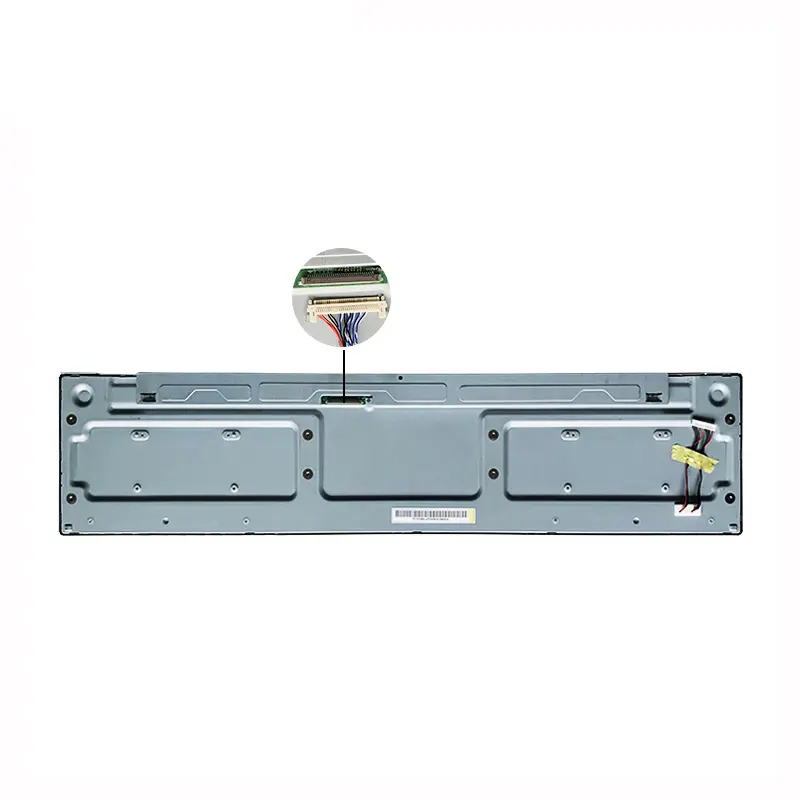
The native panel signal interface is 30-pin LVDS. A matching connector count alone does not establish electrical compatibility with a controller. Timing, voltage levels, channel mapping, bit mapping, complete pin assignment, connector orientation and cable definition should be checked before controller hardware is released.
A 30-pin LVDS connector does not by itself guarantee timing, voltage, pin mapping or controller compatibility.
Keep panel and controller-board functions separate
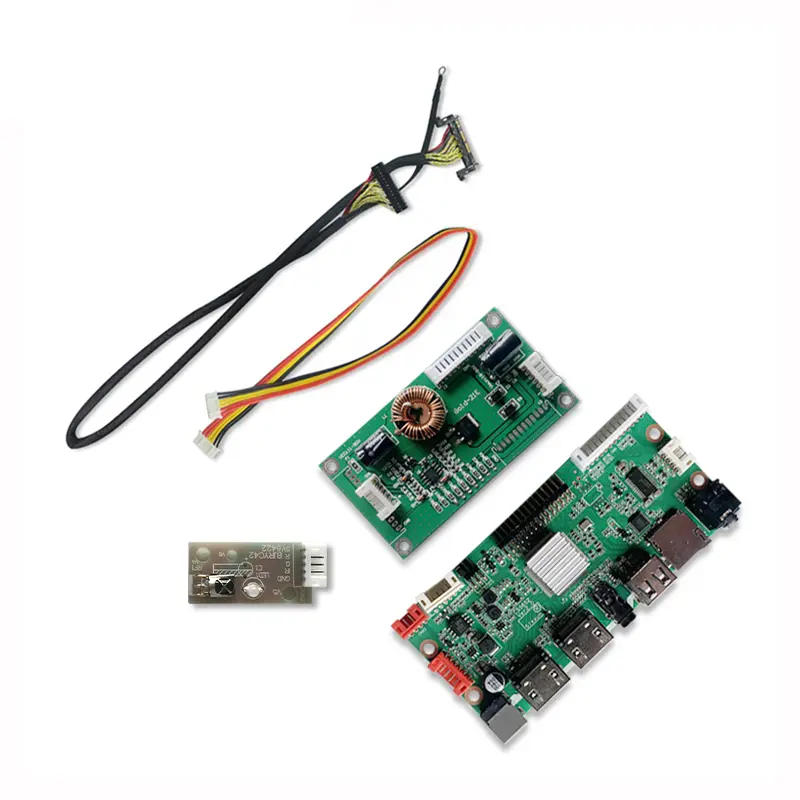
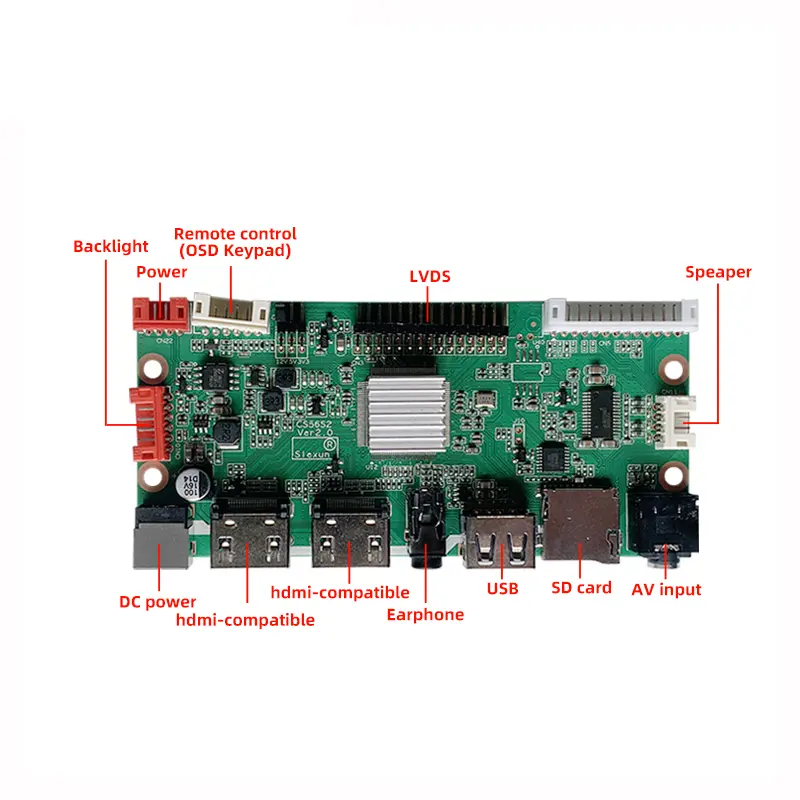
The panel input is specified at 12.0 V typical. External controller boards may add interfaces such as HDMI-compatible video, USB, removable media or audio functions, but those functions belong to the selected control architecture rather than the native LCD interface.
This distinction matters during procurement. Teams requiring a complete playback or conversion system should define the controller-board scope separately instead of assuming that external ports are standard panel features.
Mechanical and Environmental Integration
Plan around the 731.2 × 165.4 mm panel footprint
The long, narrow mechanical format needs continuous structural support across its width. Enclosure designers should check the active opening, outer footprint, cable exit, connector position, mounting strategy and any protective front layer before tooling.
The panel weight is approximately 2.51 kg. Shipping weight should not be substituted for mounting calculations because packaging materials and accessories change the gross value.
Keep component temperature limits within their stated boundaries
The panel is specified for operation from 0°C to +50°C and storage from −20°C to +60°C. These component limits do not establish the environmental rating of a completed vehicle, transit, outdoor or industrial assembly.
Thermal design, enclosure sealing, vibration, shock, humidity, UV exposure and regulatory requirements must be qualified at system level when the installation demands them.
Where the 800 Nits Ultra High Brightness Stretched Bar LCD Display Fits
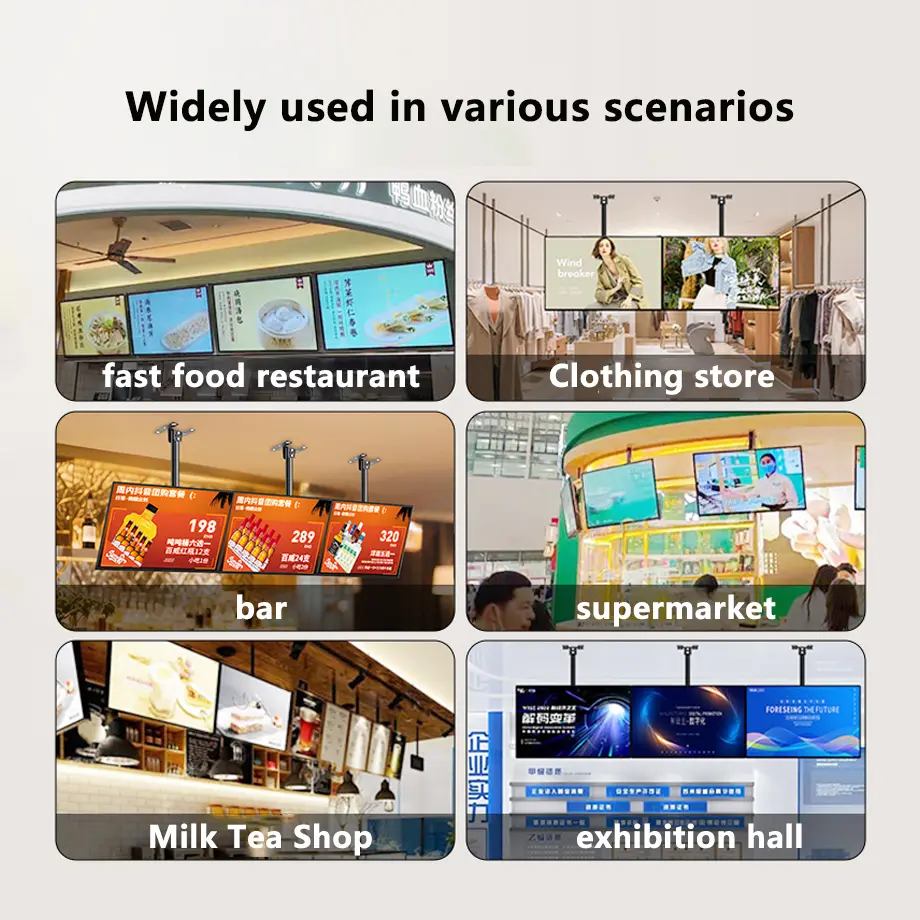
The long-format geometry makes this panel relevant to digital signage bands, advertising strips, retail headers, public-information displays, transportation-information concepts and other OEM systems where horizontal space is available but vertical space is restricted.
It can also be evaluated for vehicle-adjacent information-display concepts when the completed equipment is separately qualified for the required electrical, mechanical, environmental and regulatory conditions. The component specification alone should not be treated as evidence of automotive grade.
For projects that primarily need a conventional full-height interface, a standard 16:9 panel may be easier to integrate. This stretched configuration is most useful when the product architecture genuinely benefits from a panoramic content zone.
Customization and Project Qualification
Project evaluation can cover LVDS cable definition, controller-board matching, front glass, anti-glare or anti-reflective treatment, optical bonding, enclosure adaptation, mounting support, touch development, branding and packaging.
Custom configurations are generally reviewed from 500 pieces, subject to tooling requirements, material availability and the requested specification. Samples and standard-module quantities are confirmed separately.
Procurement Checklist
Before approving a sample or production configuration, confirm the native 1366 × 256 timing, full 30-pin LVDS assignment, channel and bit mapping, connector orientation, cable design, panel input requirements, WLED electrical requirements, active-area drawing, panel footprint, front-window stack and installation lighting.
Also define the required controller-board functions, touch requirement, operating environment, mounting structure, sample acceptance criteria, expected quantity and annual demand. Any vibration, sealing, UV, humidity or compliance requirement should be included in the engineering brief rather than inferred from the panel specification.
FAQ
About 28" 800 Nits Ultra High Brightness Stretched Bar LCD Display
What must be checked before connecting a 30-pin LVDS controller?
How should artwork be prepared for the 1366 × 256 panel?
Is 800 cd/m² sufficient behind protective front glass?
Are the HDMI-compatible, USB, SD and AV connections native panel interfaces?
Which dimensions should control enclosure design?
Freya Yang
+86 18318948097