Freya Yang
+86 18318948097
+852 62667476
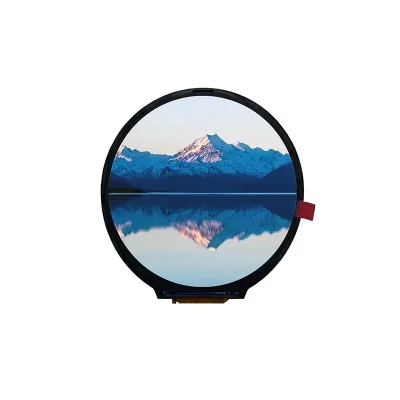
4 Inch Circular TFT LCD Module 720×720 IPS for Automotive Displays
Model P/N
Size
Resolution
Brightness
Viewing Angle
Connector Type
Operating Temp
Overall(mm)
huisoar
HS40015C40-Y
Brand
Panel Size (inch)
Model P/N
Resolution
Brightness (nits)
Viewing Angle
Contrast Ratio
Response Time
Overall (mm)
Active Area (mm)
Refresh Rate
Bezel Opening
Display Colors
Panel Type
Connector Type
Surface Treatment
Operating Temp
Touchscreen Type
Storage Temp
Work Mode
Pixel Format
Input Voltage (V)
Designed For
720×720 Round IPS TFT Screen with SPI RGB, UART Options, and MCU-Board Integration
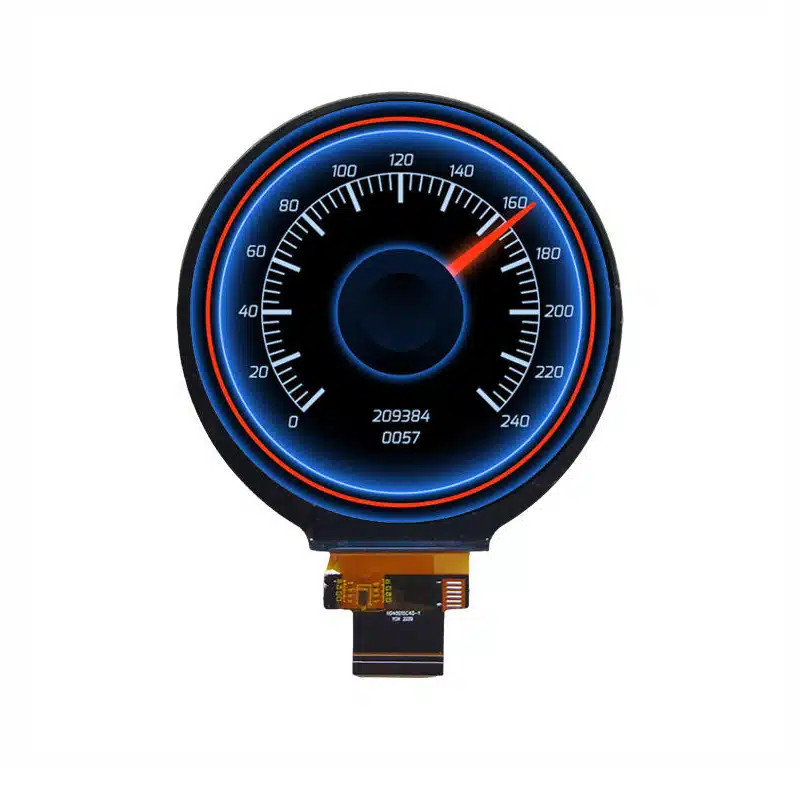
The 4 Inch Circular TFT LCD Module is a 720×720 round IPS display module for automotive dashboards, industrial control interfaces, smart home controllers, HMI panels, and compact interactive equipment. It combines a circular TFT LCD form factor, full-view IPS display behavior, SPI RGB communication, UART mode options, 16.7M color support, 1200:1 typical contrast, 60Hz refresh rate, 30ms MPRT response time, and -20°C to 70°C operation. It is suitable for product teams that need a differentiated round display rather than a conventional rectangular screen.
At a Glance: 4 Inch Round TFT Display Highlights
- 4 inch circular TFT LCD structure supports dashboard-style, dial-style, and compact HMI interface designs.
- 720×720 resolution gives the round display a square pixel canvas suitable for icons, menus, gauges, and status visuals.
- IPS full viewing angle supports multi-position readability in cabins, equipment panels, and shared control locations.
- SPI RGB interface and UART mode options help engineers evaluate flexible embedded system integration.
- 16.7M color support and 1200:1 typical contrast support clear graphics, warning icons, and functional UI layouts.
- -20°C to 70°C operating temperature range supports automotive and industrial use cases.
- Optional touch, app-related functions, temperature / humidity sensing, ambient lighting, Bluetooth, WiFi, and MCU-board integration can be evaluated for customized projects.
Product Overview of the 4 Inch Circular TFT LCD Module
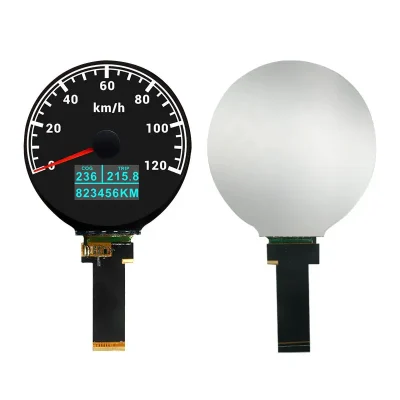
The 4 Inch Circular TFT LCD Module is a specialized round display designed for products where visual differentiation, compact mechanical fit, and functional UI presentation matter. Instead of using a standard rectangular LCD, designers can use the circular screen format for speedometer-style dashboards, smart controllers, rotary equipment interfaces, automotive auxiliary displays, medical / beauty device indicators, and industrial control panels.
The 720×720 resolution provides enough pixel density for centered circular graphics, status rings, menu icons, dynamic gauges, and compact data visualization. The IPS full viewing angle helps keep information readable when the display is installed at an angle or viewed by multiple users. This is especially relevant for vehicle cabins, smart home wall controllers, industrial equipment panels, and robot operation interfaces.
For engineers, the key value is not only the circular display shape. The module also provides SPI RGB interface support, UART mode options, optional MCU-board use, 60Hz refresh, 30ms MPRT response, and wide-temperature operation. Procurement teams should confirm interface mode, pinout, active area, drawing fit, power requirement, optional touch, MCU-board function scope, and sample validation before production.
Key Features of the 4 Inch Circular TFT LCD Module
| Key Feature | B2B Value |
|---|---|
| 4 inch circular display shape | Enables round dashboards, smart controllers, dial-style HMIs, and differentiated product front panels. |
| 720×720 resolution | Supports compact graphics, gauge visuals, icons, and readable UI content in a circular layout. |
| IPS display type | Helps maintain consistent visibility from different viewing positions. |
| SPI RGB interface | Provides a defined embedded display signal path for hardware integration. |
| UART mode options | Supports TTL / RS232 / RS485 communication scenarios for system-level projects. |
| 16.7M colors | Supports vivid UI graphics, application icons, and visual status differentiation. |
| 1200:1 typical contrast | Helps improve separation between foreground information and background graphics. |
| -20°C to 70°C operation | Supports automotive, industrial, and equipment-use environments with wider temperature variation. |
Technical Specifications of the 4 Inch Circular IPS TFT Display
| Specification | Value |
|---|---|
| Product Type | 4 Inch Circular TFT LCD Module |
| Display Size | 4 inch |
| Resolution | 720 × 720 |
| Display Type | TFT LCD, IPS |
| Interface | SPI RGB |
| UART Mode | TTL / RS232 / RS485 |
| Active Area | 101.52 × 101.52 mm |
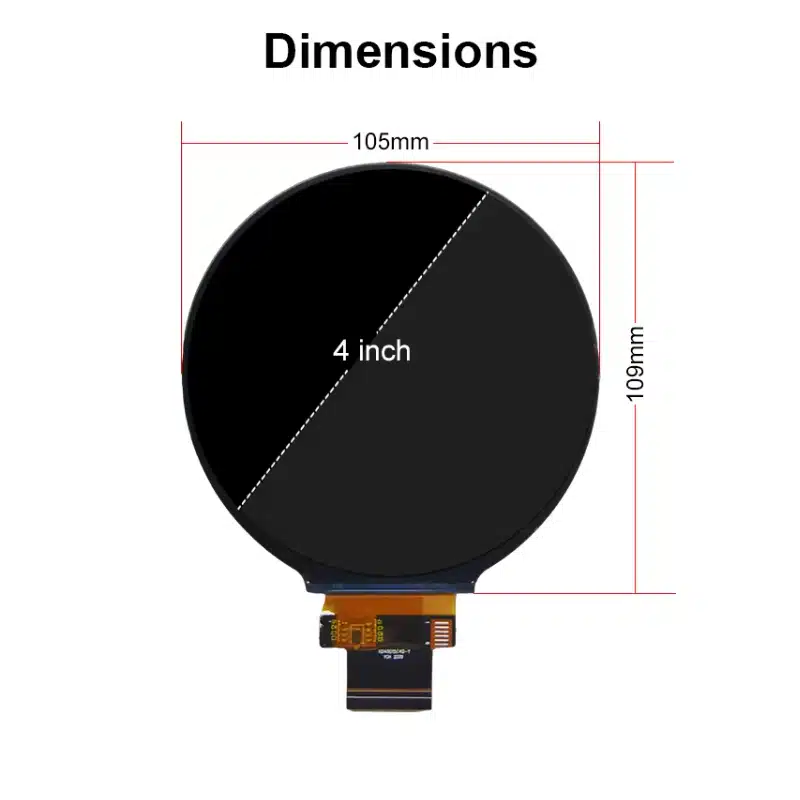
| Overall Size | 105.6 × 109.87 mm |
| Contrast Ratio | 1200:1 typical |
| Operating Temperature | -20°C to 70°C |
These specifications should be reviewed as an integration package. The circular outline affects housing and window design, the 720×720 resolution affects UI layout, SPI RGB affects signal planning, UART mode affects system communication, and the wide operating temperature range affects automotive or industrial validation.
Why Choose This 4 Inch Round TFT LCD Display?
This 4 inch round TFT LCD display is useful when a product needs a visual interface that feels purpose-built rather than generic. The circular format can align with gauges, rotary controls, decorative smart panels, automotive clusters, and equipment states where a rectangular screen may look oversized or visually mismatched.
720×720 Circular LCD Format for Dashboard and HMI Design
The 720×720 resolution is well suited to a circular display because it gives designers a square pixel base while the visible product form remains round. This makes it easier to design dial-style interfaces, radial indicators, circular menus, status rings, weather icons, speed graphics, and equipment feedback screens.
For automotive and industrial design teams, the circular display can support a more intuitive interface. Vehicle auxiliary displays can show status indicators, smart home controllers can show temperature or lighting states, and industrial HMIs can show machine status in a compact round window.
IPS Viewing and Wide-Temperature Operation for Reliable Use
IPS full viewing angle behavior is valuable when the display is not always viewed straight-on. Automotive cabins, robot interfaces, public equipment panels, and smart home controllers often involve different viewing positions. The IPS display type helps maintain more stable viewing performance in those conditions.
The -20°C to 70°C operating range also improves suitability for automotive and industrial environments. Product teams should still validate performance in their actual enclosure, because temperature behavior depends on thermal design, duty cycle, power configuration, and installation conditions.
Display Performance of the Circular TFT LCD Module for Automotive and Industrial Interfaces
The circular TFT LCD module supports compact, high-information user interfaces by combining 720×720 resolution, IPS viewing, 16.7M colors, 1200:1 contrast, 60Hz refresh rate, and 30ms MPRT response. It is designed for functional display use, not only decorative product styling.
16.7M Colors and 1200:1 Contrast for Visual Interface Clarity
The module supports 16.7M colors and 90% CIE1931 color coverage as listed in the provided data. This allows interface designers to use richer visual states, warning colors, icons, system modes, and layered graphics in compact devices.
The 1200:1 typical contrast ratio helps separate important indicators from backgrounds. This is useful for automotive status screens, smart device dashboards, and industrial panels where users must quickly distinguish normal, warning, and action states.
60Hz Refresh and 30ms MPRT for Dynamic Status Screens
The 60Hz refresh rate and 30ms MPRT response time support general dynamic interface content, such as moving gauges, active status indicators, menu transitions, and real-time data updates. These specifications should be validated with the final UI, controller, and content format.
For vehicle and equipment interfaces, smoothness is important, but reliability matters more. Engineers should test the actual MCU board, display driver, cabling, and UI animation load before approving the module for production.
Circular Screen Conditions for Automotive and Embedded Environments
Circular displays introduce different mechanical and optical constraints than rectangular screens. The active area, front cover, round display window, adhesive border, FPC exit, and bezel design should be checked carefully. A circular display can improve industrial design, but only if the enclosure is matched accurately.
For automotive or harsh equipment environments, teams should also evaluate anti-interference behavior, shock exposure, static protection, cable retention, power stability, and operating temperature. These factors determine whether the display performs reliably after installation.
Integration and Mounting Options for SPI RGB Circular LCD and MCU Board Projects
SPI RGB circular LCD projects should be reviewed through interface, power, MCU-board function, firmware, mechanical drawing, and optional function planning. A round display needs careful alignment between the screen, UI design, and enclosure structure.
SPI RGB Interface and UART Mode Integration
The module lists SPI RGB interface support, with UART mode options including TTL, RS232, and RS485. This gives product teams several possible system-level integration paths, depending on whether the display is used as a raw screen module, MCU-board screen module, or communication-based interface.
Before selecting the final configuration, engineers should confirm pin definition, signal timing, cable length, controller compatibility, firmware support, command protocol, and whether the project uses SPI RGB directly or relies on the MCU board for display control.
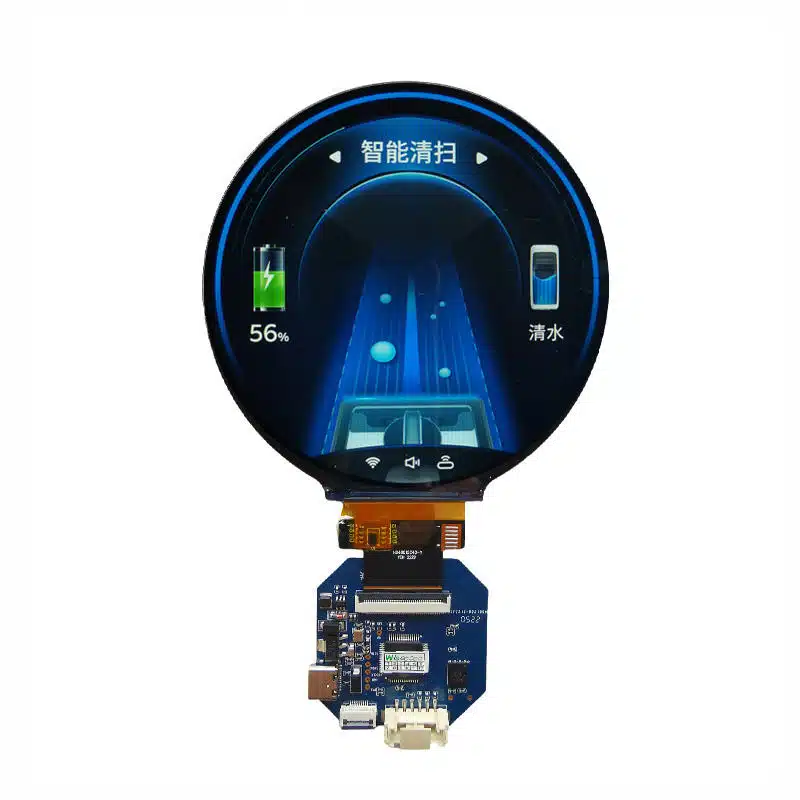
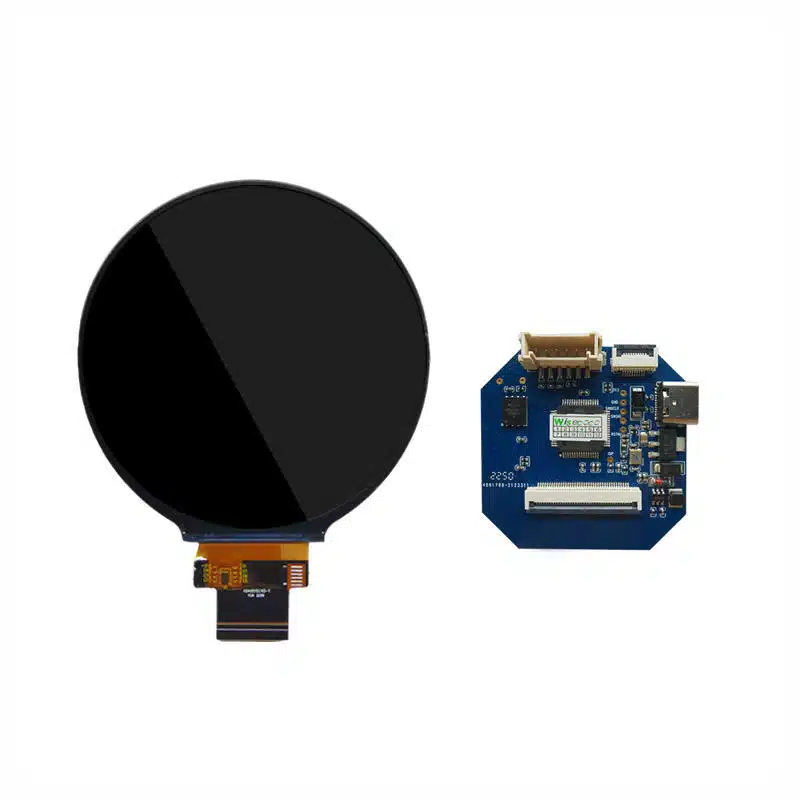
MCU Board, Type-C Power, and Secondary Development Review
The source information references MCU-board use, with Type-C 5V 2A power behavior for viewing the default protocol interface. It also references ZQ2234, 64M SDRAM, 128M SPI FLASH, FreeRTOS, and LVGL. These details are relevant for product teams that want a faster application-development route rather than building every display-control layer from scratch.
Secondary development should be planned around UI framework, memory, communication protocol, boot behavior, update method, input function, and system stability. Engineers should request the latest datasheet, protocol document, sample code, and electrical drawing before committing to a production design.
Mechanical Mounting, Circular Housing, and Cable Planning
The 105.6 × 109.87 mm outline and 101.52 × 101.52 mm active area should be checked against the enclosure drawing. The round window must align with the active display area, while the lower FPC and connector path must remain protected and serviceable.
For automotive or industrial equipment, mounting should also consider shock, vibration, cable strain, dust, moisture, and maintenance access. If touch, cover glass, or bonding is required, the display stack height and front surface design should be reviewed before tooling.
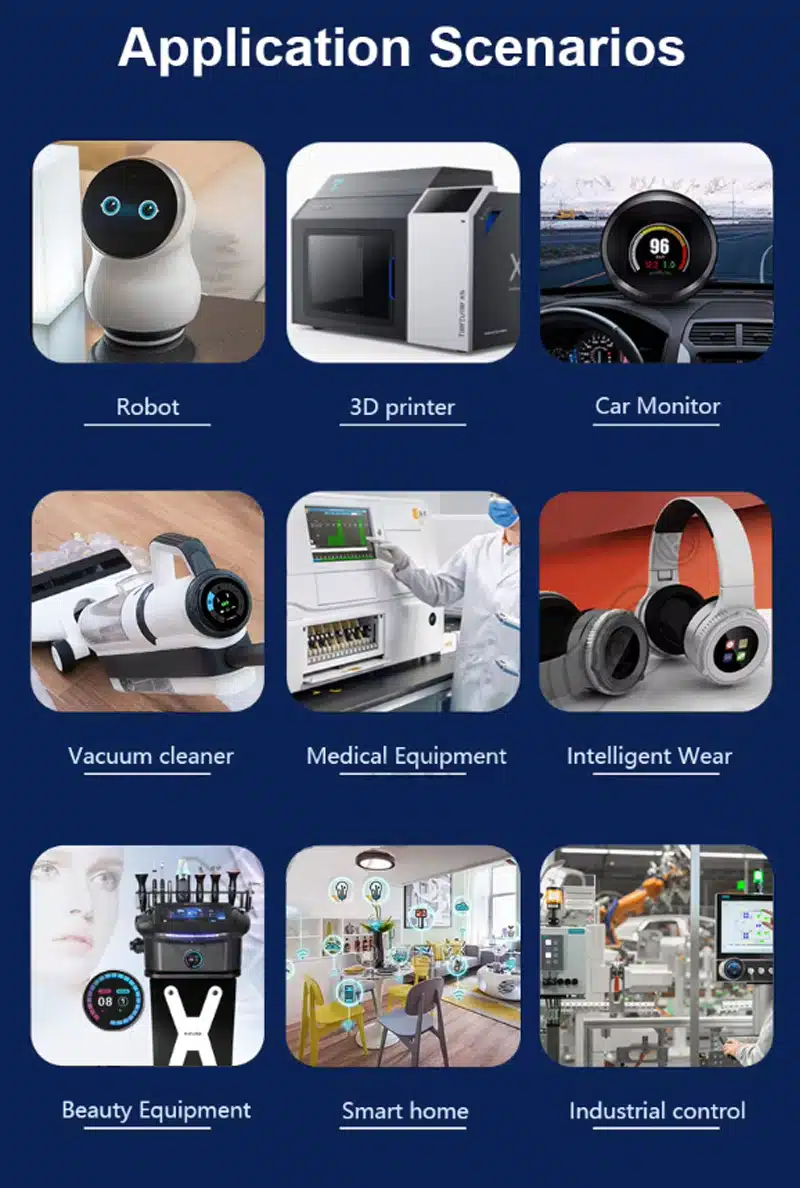
Recommended Applications for Circular TFT LCD Automotive and Industrial Displays
This circular TFT LCD display is best suited for products where the round form factor improves usability, visual identity, or control logic. It should be evaluated for real system integration instead of selected only for appearance.
Automotive Dashboard Auxiliary Displays with Round Visual Logic
Automotive dashboards often use circular or semi-circular visual patterns for speed, energy, warning, and status information. This 4 inch circular TFT LCD module can support auxiliary vehicle displays, in-car status screens, custom automotive panels, and cabin information displays. The IPS viewing and -20°C to 70°C range support vehicle-related evaluation.
Industrial Control Panels with Compact Equipment Status Feedback
Industrial equipment often needs compact information panels for status, alarms, machine modes, and parameter feedback. A round TFT display can match rotary controls, robot interfaces, 3D printer control screens, and compact machine HMIs. The UART options and MCU-board context make it useful for projects that need structured control communication.
Smart Home Controllers with Circular UI and Optional Functions
Smart home products often benefit from an attractive front-panel design. This circular display can support lighting controllers, security panels, environmental control interfaces, and decorative smart modules. Optional functions such as touch, temperature / humidity sensing, Bluetooth, WiFi, app-related functions, and ambient lighting can be evaluated for customized smart-device projects.
Medical, Beauty, and AR/VR-Oriented Equipment Displays
The supplied data references HMD AR/VR and also positions the module for medical and beauty equipment. In these projects, a circular display can support compact information feedback, mode selection, and visual indicators. Buyers should validate brightness, cover material, cleaning requirements, touch needs, and regulatory constraints separately.
Customization Options for Circular TFT LCD Module Projects
Customization for circular TFT LCD module projects can be evaluated for logo, packaging, graphic customization, touch panel integration, ambient lighting, temperature and humidity sensing, Bluetooth, WiFi, app function, small program support, MCU-board firmware, communication protocol, FPC path, cover glass, housing fit, and interface adaptation.
These options should be treated as project-evaluation items, not default included features. Buyers should confirm which functions are required, whether they are hardware or software features, how they affect power consumption, and whether they change the final drawing, lead time, MOQ, or validation process.
For OEM / ODM projects, the most useful starting package is a mechanical drawing, target UI, interface plan, power budget, function list, sample quantity, expected production quantity, and application environment. This allows engineering review before sample confirmation.
Procurement and Engineering Checklist for Circular TFT LCD Module Selection
A 4 inch circular TFT LCD module should be selected through mechanical, electrical, UI, and application validation. Use this checklist before sample approval or production procurement.
- Confirm circular fit: check 105.6 × 109.87 mm outline, 101.52 × 101.52 mm active area, window opening, and FPC exit.
- Validate resolution and UI: test 720×720 circular graphics, fonts, icons, gauges, and status screens on real hardware.
- Confirm interface mode: decide whether SPI RGB, UART TTL, RS232, RS485, or MCU-board operation is required.
- Review power input: confirm whether the final project uses Type-C 5V 2A MCU-board power or another display-level supply plan.
- Check operating environment: validate -20°C to 70°C operation, enclosure heat, shock exposure, static protection, and interference conditions.
- Define optional functions: confirm whether touch, sensors, Bluetooth, WiFi, app function, or lighting features are required.
- Request technical files: obtain datasheet, drawing, pinout, firmware reference, protocol document, and sample test instructions.
- Validate production plan: confirm MOQ, customization scope, sample lead time, bulk quantity, packaging, and long-term supply.
Interface / Power / Mounting Selection Guide for Round LCD Projects
For round LCD projects, interface, power, and mounting should be selected together. SPI RGB affects display driving, UART modes affect system communication, MCU-board use affects software development, and circular mounting affects housing design. A successful sample test should use the real enclosure, actual UI, expected cable route, and intended power source.
FAQ
About 4 Inch Circular TFT LCD Module
What is a 4 Inch Circular TFT LCD Module used for?
What resolution does this round LCD module provide?
Does the display support IPS viewing?
What interfaces can be evaluated for integration?
Can this circular display include touch?
Is this module suitable for automotive use?
What optional functions are available for custom projects?
What should buyers provide before requesting a sample?
Does the module support secondary development?
How should the circular housing be designed?
Freya Yang
+86 18318948097