Freya Yang
+86 18318948097
+852 62667476
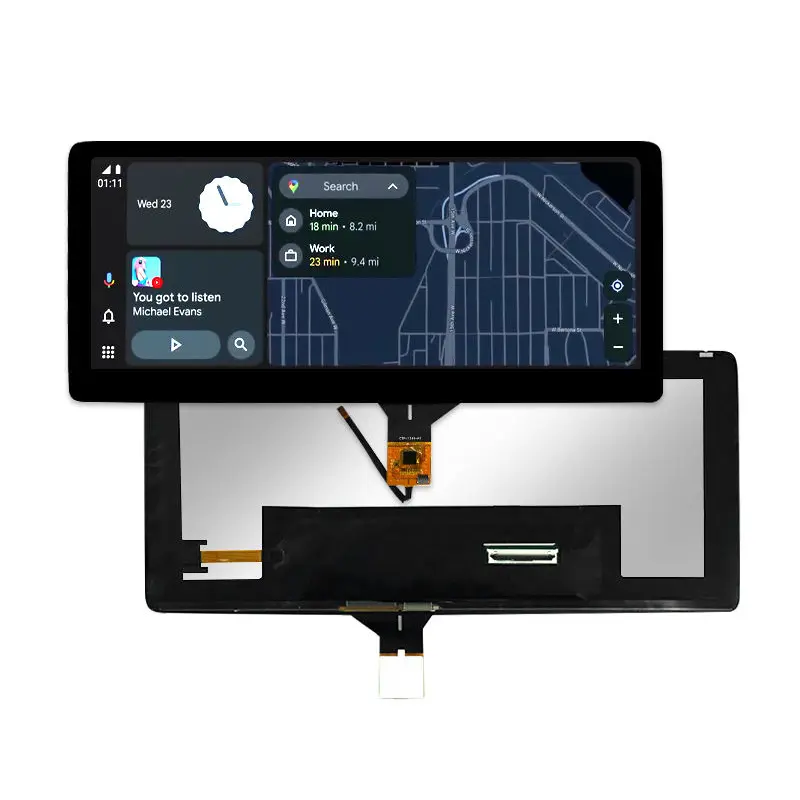
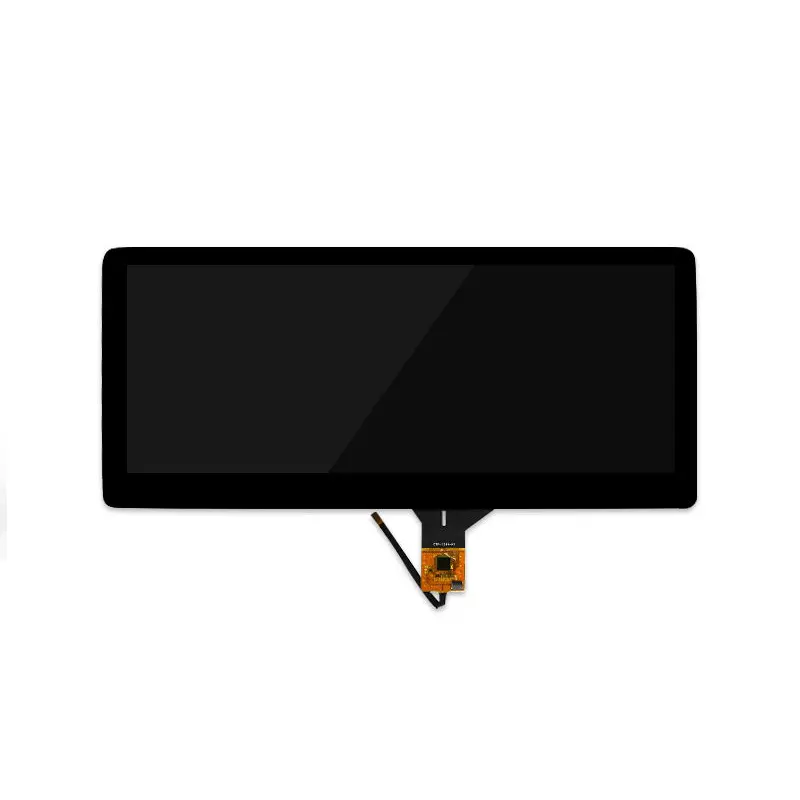
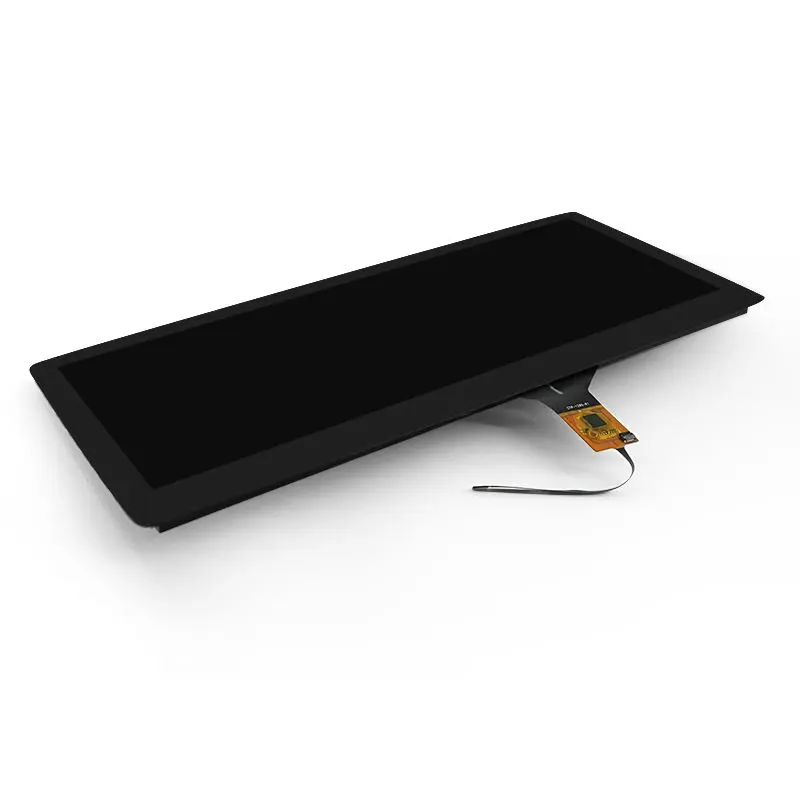
10.25 Inch Automotive Capacitive Touchscreen TFT Panel for EV HMI
Model P/N
Size
Resolution
Brightness
Viewing Angle
Connector Type
Operating Temp
Overall(mm)
huisoar
HS103Z7P-K10-50
Brand
Panel Size (inch)
Model P/N
Resolution
Brightness (nits)
Viewing Angle
Contrast Ratio
Response Time
Overall (mm)
Active Area (mm)
Refresh Rate
Bezel Opening
Display Colors
Panel Type
Connector Type
Operating Temp
Touchscreen Type
Storage Temp
Work Mode
Pixel Format
Operating Environment
Designed For
10.25 Inch Automotive Capacitive Touchscreen TFT Panel for EV HMI
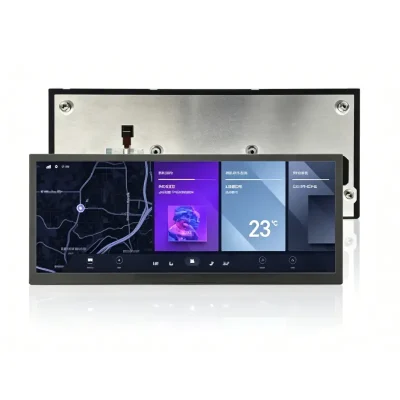
A panoramic 10.25-inch TFT combines 1920 × 720 LVDS graphics with capacitive touch for EV cockpit and center-stack integration.
The Automotive Capacitive Touchscreen TFT Panel provides an ultra-wide 1920 × 720 canvas for vehicle information, climate, navigation, media, and equipment-control interfaces. Its 243.648 × 91.368 mm active area, 1000 cd/m² configuration, normally-black display mode, and wide temperature limits support engineering evaluation for bright vehicle cabins. Production approval still requires the exact LVDS definition, touchscreen-controller path, optical stack, mechanics, and environmental qualification.
Product Summary
This 10.25-inch format uses a wide 8:3 image area suited to horizontal dashboards and center-stack interfaces. The native raster allows designers to organize status indicators, maps, menus, alerts, and vehicle data without adapting a conventional 16:9 panel to an unusually wide opening.
Native 1920 × 720 Interface Design
The panel uses RGB vertical-stripe pixels with 0.1269 × 0.1269 mm pixel pitch, 16.7M colors, and a minimum 70% NTSC color-gamut specification. UI assets should be prepared at the native 1920 × 720 resolution, with critical text and controls positioned inside the approved visible area and cover-lens opening.
Capacitive Touch Integration Boundary
Capacitive touch is included as a product function, but the touch-controller model, touch-point count, communication interface, firmware, and host-driver requirements are not confirmed. Those details must be approved separately from the LCD video channel before the mainboard and cable set are released.
Key Specifications at a Glance
| Parameter | Specification |
|---|---|
| Display size | 10.25 inch |
| Resolution | 1920 × 720 pixels |
| Active area | 243.648(H) × 91.368(V) mm |
| Pixel arrangement | RGB vertical stripe |
| Pixel pitch | 0.1269(H) × 0.1269(V) mm |
| Display mode | Normally black |
| Display colors | 16.7M, 8-bit |
| Color gamut | NTSC 70% minimum |
| Brightness | 1000 cd/m² configuration |
| Native interface | 50-pin, 2-port LVDS |
| Surface treatment | HC |
| Surface hardness | 3H |
| Operating temperature | −30°C to +85°C |
| Storage temperature | −40°C to +95°C |
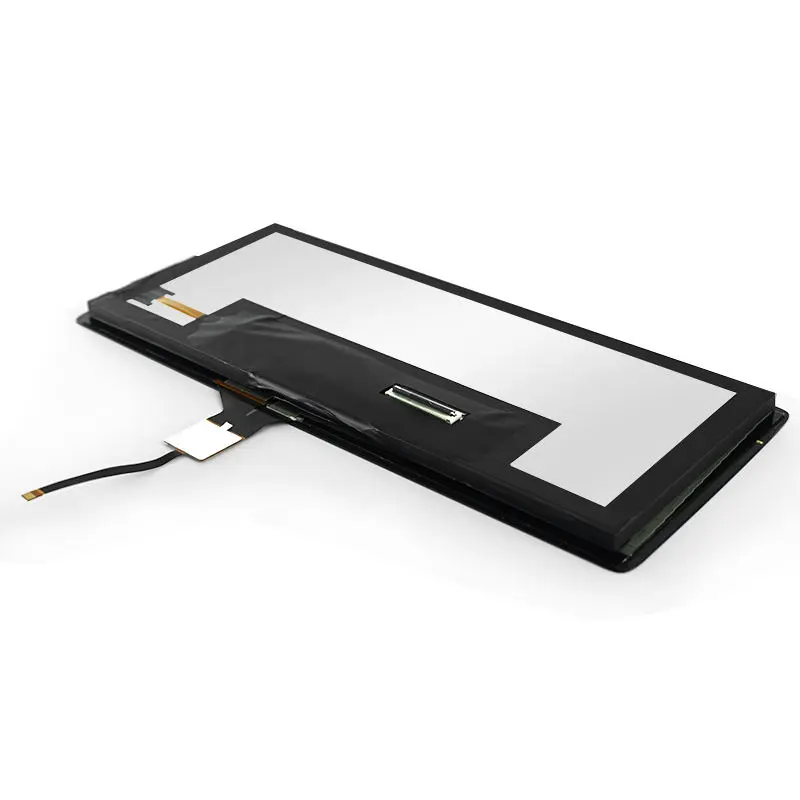
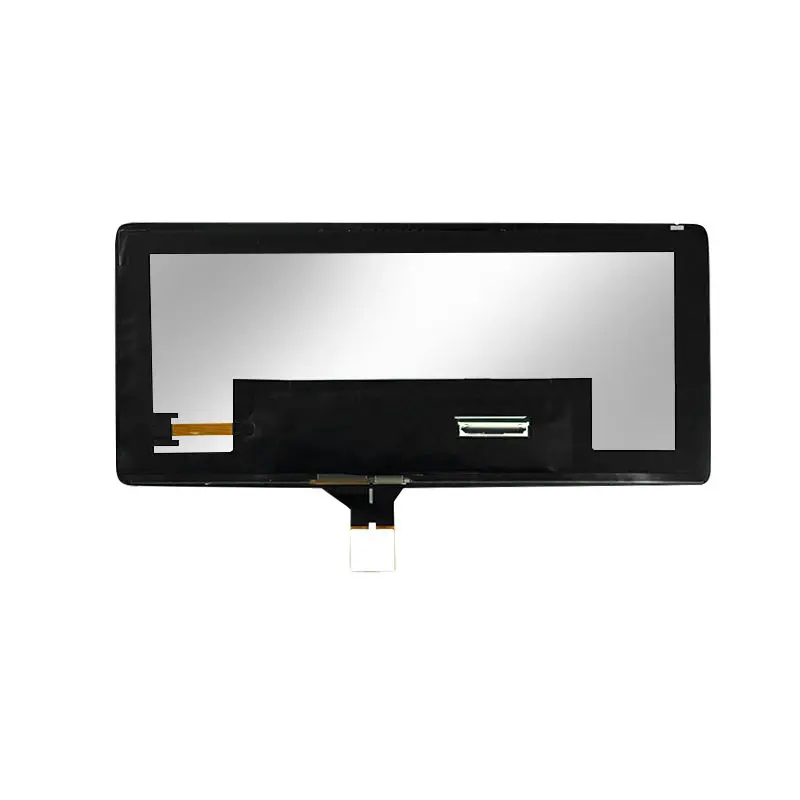
| Without-PCBA outline | 251.148 ± 0.2 × 101.098 ± 0.2 × 1.08 mm |
| With-PCBA outline | 251.148 ± 0.3 × 142.548 ± 0.5 × 3.2 mm maximum |
| Cover/touch outline | 253.09 ± 0.3 × 105.95 ± 0.3 mm |
Optical Performance and Bright-Cabin Evaluation
1000 cd/m² Does Not Complete the Optical Design
The 1000 cd/m² configuration provides a strong starting point for bright-cabin evaluation. Finished visibility still depends on cover-lens transmission, internal reflections, bonding method, surface treatment, dimming range, viewing position, thermal behavior, and ambient light. The panel rating does not by itself establish direct-sunlight readability in the installed system.
Color and Surface Requirements
The combination of 16.7M colors, 8-bit color depth, and NTSC 70% minimum supports vehicle graphics, icons, maps, and media-oriented interfaces. HC surface treatment and 3H hardness describe the panel surface condition; they do not establish impact resistance, vandal resistance, or a finished cover-glass protection grade.
LVDS Integration for the Automotive Capacitive Touchscreen TFT Panel
Confirm the Complete 50-Pin Definition
The display uses a 50-pin, 2-port LVDS interface. A matching 50-pin connector does not guarantee timing, voltage, channel mapping, bit mapping, connector orientation, or cable compatibility. Engineering review should include native timing, LVDS mapping, logic and backlight power, enable and dimming control, connector part number, contact side, cable length, and grounding.
Keep Touch and Display Signals Separate
LVDS carries LCD image data. The capacitive-touch controller and communication path require their own approved specification. Do not assume the touch signals share the LVDS link or that an optional HDMI/VGA controller board automatically provides the required touch connection.
Mechanical Envelope and PCBA Variants
Active Area, Visible Area, and Cover Outline
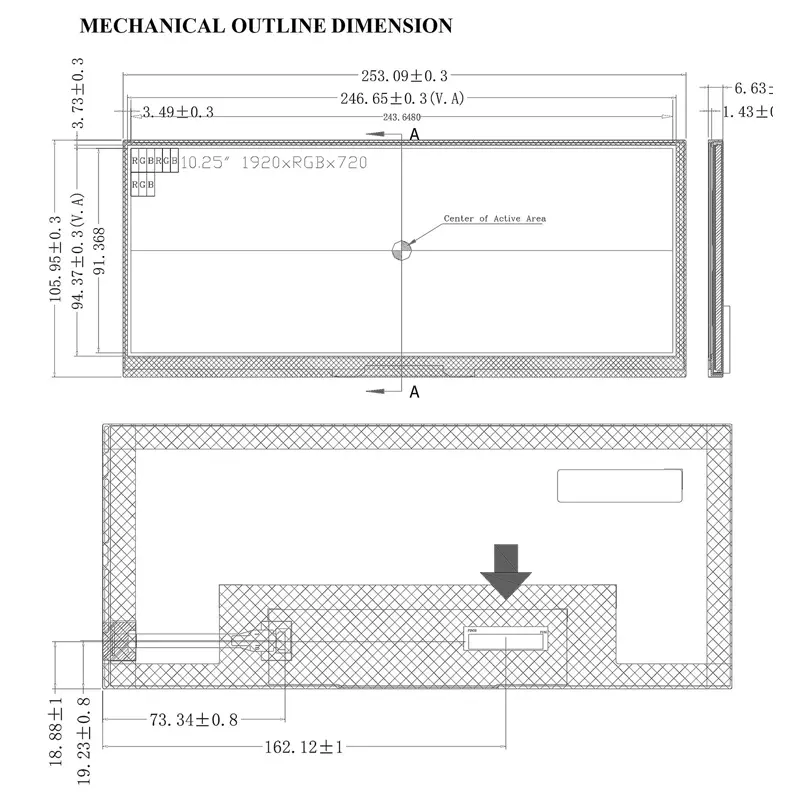
The 243.648 × 91.368 mm active area defines the pixel matrix. The drawing also identifies a 246.65 ± 0.3 × 94.37 ± 0.3 mm visible area and a 253.09 ± 0.3 × 105.95 ± 0.3 mm cover/touch outline. These values serve different enclosure functions and should not be substituted for one another.
Without-PCBA and With-PCBA Dimensions
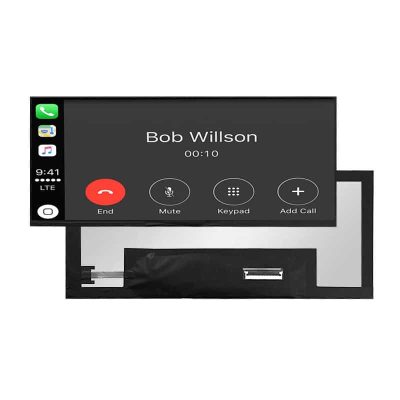
The display-only configuration is specified at 251.148 ± 0.2 × 101.098 ± 0.2 × 1.08 mm. The version with PCBA extends to 251.148 ± 0.3 × 142.548 ± 0.5 × 3.2 mm maximum. The approved build must define which envelope controls the housing, connector clearance, cable bend, mounting datum, and service access.
Temperature Range and Vehicle Qualification Boundary
The component is specified for operation from −30°C to +85°C and storage from −40°C to +95°C. These limits support wide-temperature vehicle and equipment projects, but temperature range alone does not prove automotive qualification, vibration resistance, humidity performance, EMC compliance, functional safety, or a particular regulatory standard.
Environmental approval should use the final display, touch stack, controller board, cable set, power supply, enclosure, cooling method, and mounting structure.
Recommended Applications
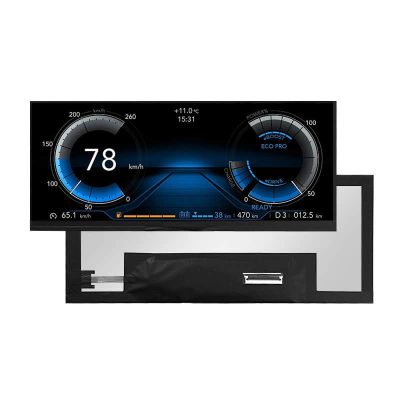
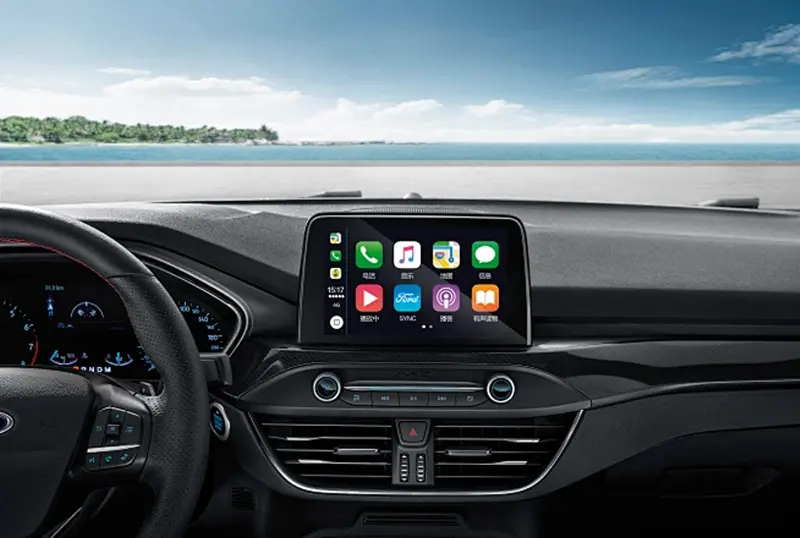
The panoramic format can be evaluated for EV center-stack interfaces, cockpit information displays, auxiliary dashboards, passenger controls, vehicle-status panels, charging-equipment HMIs, and protected industrial consoles. Driver-facing use requires system-level assessment of glance behavior, UI legibility, control placement, reflections, thermal conditions, and applicable vehicle requirements.
Applications that require certified automotive, medical, outdoor, waterproof, or safety-critical performance need separate evidence and qualification.
Customization and Controller-Board Options
An Automotive Capacitive Touchscreen TFT Panel project may include graphic printing, interface adaptation, brightness review, FPC changes, cover-lens design, bonding, surface treatment, and controller-board matching. Graphic, interface, and brightness customization is generally reviewed from 500 pieces, subject to tooling, material availability, and the requested specification. Sample and standard-panel quantities are confirmed separately.
An optional controller-board route is shown with HDMI, VGA, DC power, remote-control, button, speaker, and audio connections. These ports belong to the controller-board configuration rather than the native 50-pin LVDS panel and should not be presented as standard included interfaces without a confirmed bill of materials.
Procurement Checklist
- Confirm the assigned model and exact ordered revision.
- Submit native 1920 × 720 timing and complete 50-pin LVDS mapping.
- Confirm panel logic, backlight voltage/current, enable, dimming, and power sequencing.
- Submit the touch-controller model, touch-point requirement, interface, firmware, and host-driver plan.
- Select the without-PCBA or with-PCBA configuration.
- Approve the active area, visible area, cover outline, thickness, tolerances, and FPC positions.
- State the cover lens, bonding method, surface treatment, and 1000 cd/m² optical target.
- Define operating, storage, vibration, humidity, EMC, and compliance requirements.
- Provide sample quantity, annual demand, project schedule, and acceptance criteria.
FAQ
About 10.25 Inch Automotive Capacitive Touchscreen TFT Panel
What must be checked before connecting an existing 50-pin LVDS controller?
Is the touchscreen interface carried through the LVDS connector?
Which dimensions should control the enclosure design?
Does 1000 cd/m² guarantee direct-sunlight readability?
Does the temperature range prove automotive-grade qualification?
Freya Yang
+86 18318948097