Freya Yang
+86 18318948097
+852 62667476
2.86 Inch Portrait TFT Display Panel for Audio Equipment
Model P/N
Size
Resolution
Brightness
Viewing Angle
Connector Type
Operating Temp
Overall(mm)
huisoar
HS0286AA02A-V1
Brand
Panel Size (inch)
Model P/N
Resolution
Brightness (nits)
Viewing Angle
Contrast Ratio
Response Time
Overall (mm)
Active Area (mm)
Refresh Rate
Display Colors
Panel Type
Connector Type
Operating Temp
Touchscreen Type
Storage Temp
Work Mode
Pixel Format
Control Type
Operating Environment
Designed For
2.86 Inch Portrait TFT Display Panel for Audio Equipment
Its narrow 376 × 960 canvas, MIPI connection and 350 cd/m² luminance support compact vertical interfaces where enclosure width is limited.
Product Summary
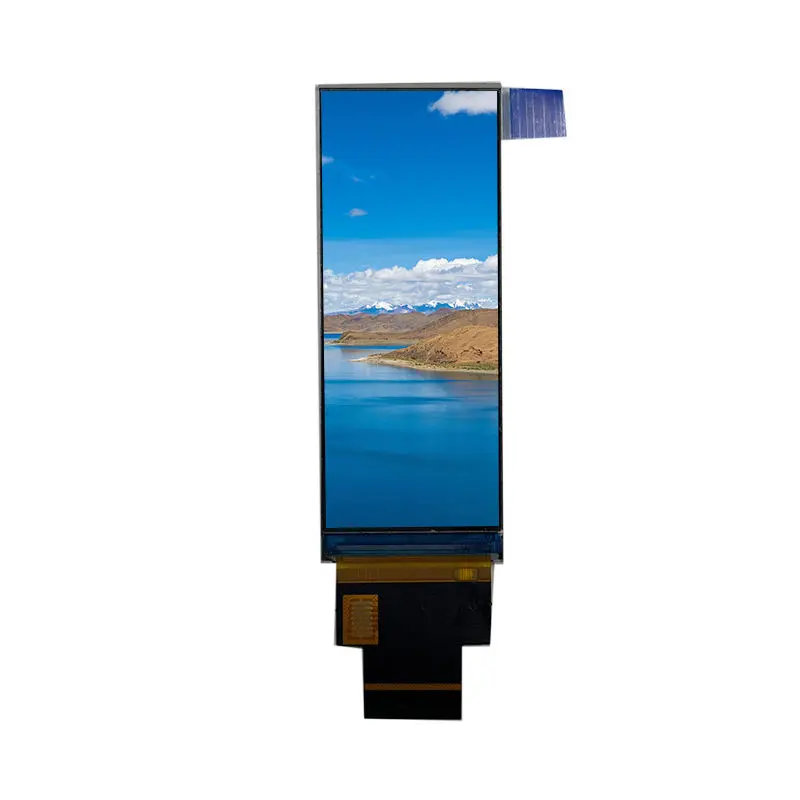
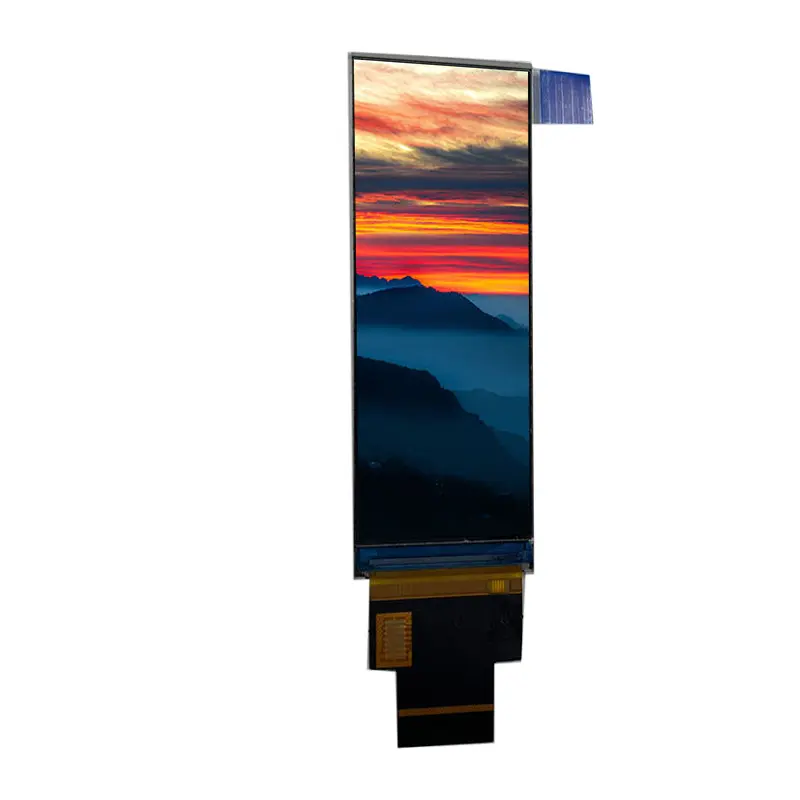
The Portrait TFT Display Panel is a 2.86-inch IPS TFT component for electronic audio equipment and other compact vertical interfaces. Its native 376 × 960 raster creates a tall image area for status information, track data, level indicators, menus and control feedback without requiring a wide enclosure.
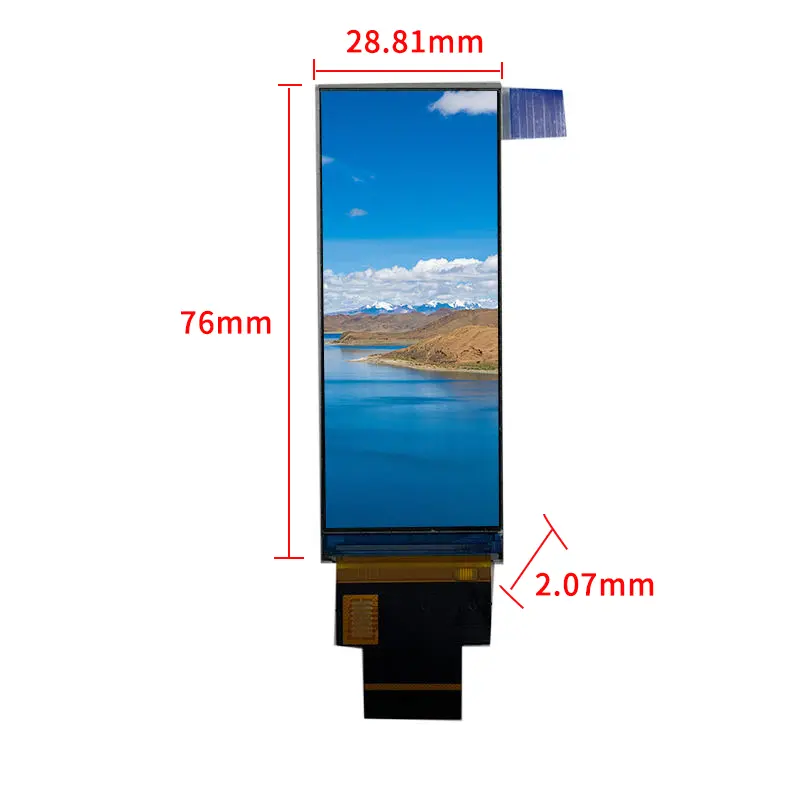
The display uses a transmissive, normally black structure with all-o’clock viewing wording. A 350 cd/m² panel luminance supports indoor and controlled-light product designs. The module outline is 28.81 × 76.00 × 2.07 mm, giving mechanical teams a slim component envelope for narrow front-panel layouts.
Key Specifications
| Parameter | Confirmed value |
|---|---|
| Display size | 2.86 inches |
| Resolution | 376 × 960 pixels |
| Panel type | IPS TFT |
| Work mode | Transmissive, normally black |
| Interface | MIPI |
| Driver reference | ST7701 |
| Luminance | 350 cd/m² |
| Viewing wording | All-o’clock |
| Module outline | 28.81 × 76.00 × 2.07 mm |
| Backlight | 12 white LEDs; exact electrical arrangement requires confirmation |
| Operating temperature | −20°C to +70°C |
| Storage temperature | −30°C to +80°C |
376 × 960 Portrait UI Planning
Use the Native Raster
Prepare interface assets at 376 × 960 pixels rather than scaling a conventional landscape design. The tall canvas can organize information in vertical zones, such as a title area, primary status field, level or progress section and lower control area. Native rendering helps preserve small text, line graphics and icon alignment.
Define a Safe Layout Before Mechanical Release
The enclosure opening, visible area and active image boundary must be confirmed from an approved drawing. One dimensional record assigns 28.81 × 76.00 mm to both the active area and the module face, so that value should not be used as a final visible-area definition without revision approval. Keep critical text and controls inside a provisional inset until the active-area dimensions are reconciled.
Optical and Mechanical Qualification
Evaluate 350 cd/m² in the Final Stack
The controlled luminance value is 350 cd/m². This is appropriate for indoor and controlled-light evaluation, but it does not establish direct-sunlight readability. Front windows, printing, air gaps, optical bonding and reflections can reduce apparent contrast. Test the intended cover stack and define acceptance criteria for luminance, black level and viewing position.
Use the 2.07 mm Module Depth Correctly
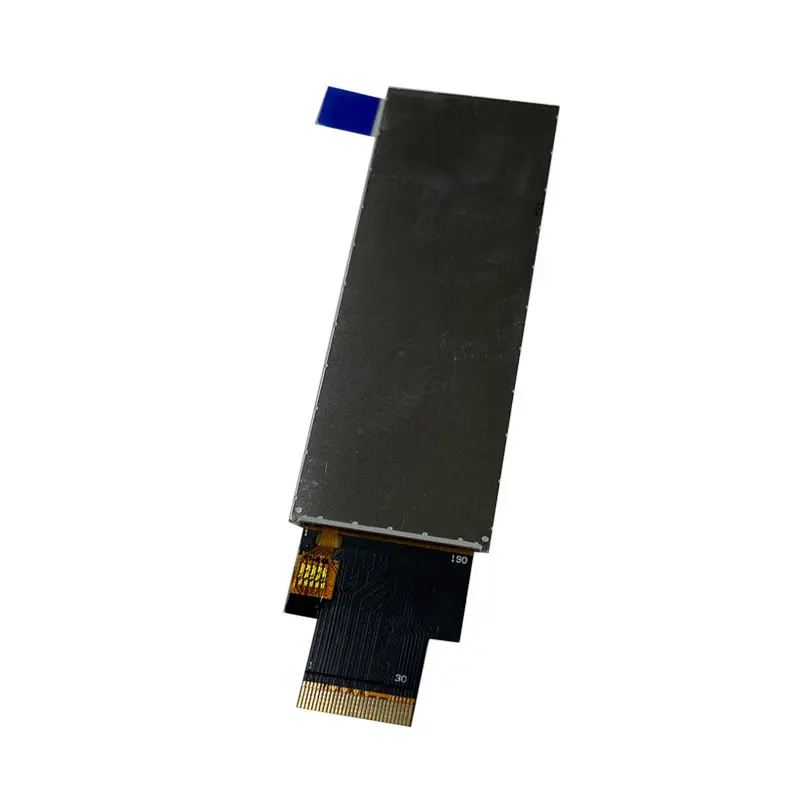
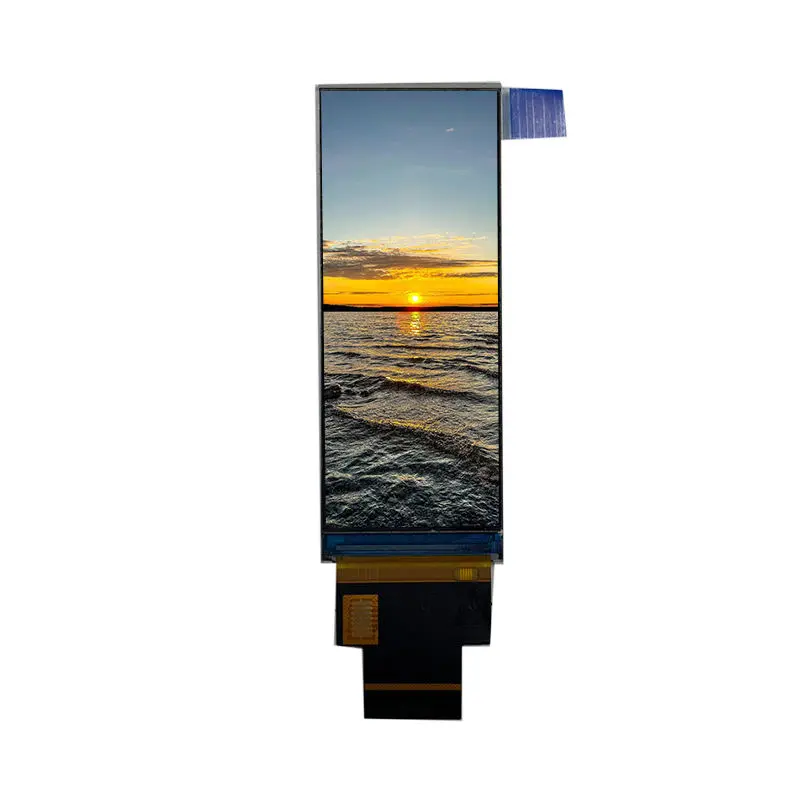
The module outline is 28.81 × 76.00 × 2.07 mm. Housing design must also allow for the FPC exit, connector height, bend radius, adhesive zones and assembly tolerances. The visible product image shows a long portrait panel with a lower FPC tail, so cable routing should be included in the first enclosure prototype rather than added after the bezel is frozen.
Portrait TFT Display Panel MIPI Integration
Confirm the Host Interface
The standard model documentation identifies a MIPI interface, but the lane count, operating mode, data rate, connector pinout, logic rails and initialization package are not defined in the available technical fields. A host with MIPI capability is not automatically compatible. Submit the processor specification and complete display connection requirements for interface review.
Approve the Ordered Driver Revision
ST7701 is the primary driver reference associated with the standard MIPI configuration. A separate configuration field also identifies SPI and NV3007A. These identifiers should not be treated as interchangeable. The purchase order, approved drawing, pin definition and software package must all refer to the same hardware revision before sample release.
Backlight and Environmental Boundaries
Qualify the White-LED Backlight
The module is described with 12 white LEDs, while the series/parallel wording is incomplete. Do not design the backlight driver from LED count alone. Confirm the actual string topology, forward-voltage range, operating current, dimming method, startup behavior, power dissipation and lifetime test condition for the ordered revision.
Apply the Temperature Limits at System Level
The component operating range is −20°C to +70°C, with storage from −30°C to +80°C. Finished-equipment qualification should also consider the host board, FPC, adhesives, cover materials, backlight driver and internal heat rise. These component limits do not establish vibration, humidity, waterproof, medical or automotive qualification.
Applications and Qualification Boundaries
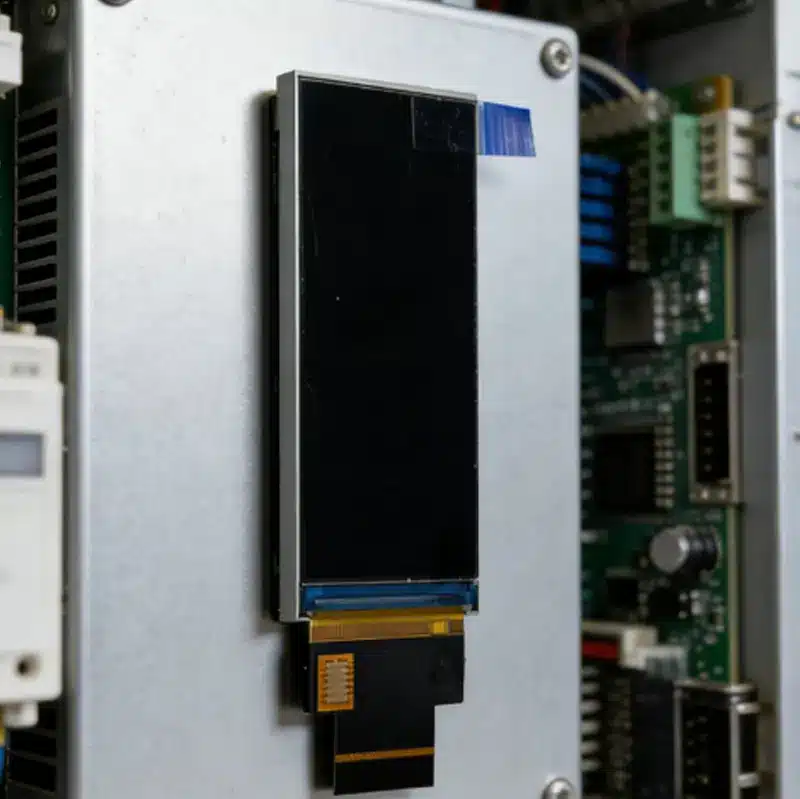
The Portrait TFT Display Panel is primarily positioned for electronic audio equipment, including compact control surfaces, status displays and vertical information windows. Its form factor may also be evaluated for handheld electronics, smart-device controls and narrow embedded status interfaces after electrical, optical and mechanical qualification.
The page does not claim an included touch panel, controller board, finished enclosure or universal host compatibility. Touch, cover-lens, brightness, FPC and interface changes require separate configuration review.
Configuration and Customization
Drawing-based, sample-based and full customization services may be reviewed for the project. Relevant options can include FPC geometry, connector definition, interface revision, cover lens, touch integration, luminance target, backlight design, mechanical adaptation, branding and packaging.
Custom configurations are generally reviewed from 500 pieces, subject to tooling requirements, material availability and the requested specification. Sample and standard-module quantities are confirmed separately.
Procurement Checklist
Confirm the following before sample approval:
- Assigned and supplier model numbers and revision
- Native 376 × 960 timing and orientation
- MIPI lane count, mode and data rate
- Complete connector and FPC pin definition
- Logic and interface voltage requirements
- ST7701 initialization and command package
- Resolution of the SPI/NV3007A alternate identifiers
- Approved active-area and visible-opening dimensions
- 28.81 × 76.00 × 2.07 mm mechanical fit
- FPC pitch, contact side, direction and bend clearance
- Backlight topology, voltage, current and dimming
- 350 cd/m² optical target behind the final cover
- Touch status and interface requirement
- Temperature, sample quantity and annual demand
FAQ
About 2.86 Inch Portrait TFT Display Panel
What must be checked before connecting a MIPI host?
How should graphics be prepared for the 376 × 960 portrait canvas?
Which interface and driver combination should be approved?
Which dimensions should control enclosure release?
Is 350 cd/m² sufficient, and what backlight data is still required?
Can you provide samples for testing before placing a bulk order, and what are the terms?
Yes, samples are typically available for testing before bulk orders. For the HS0286AA02A-V1, we recommend contacting our sales team to confirm sample availability and lead time. Standard terms often include a sample fee that is credited against the first bulk order, with shipping costs borne by the buyer. Bulk order MOQs and pricing can be negotiated based on volume. Please reach out with your requirements to receive a formal quotation and sample request form.
What are the packaging options for shipping and handling of fragile LCD panels?
LCD panels are fragile, so we use protective packaging such as anti-static bags, foam inserts, and rigid cartons. For the HS0286AA02A-V1, we ensure each unit is individually cushioned to prevent damage during transit. We can also customize packaging for volume orders, including custom inserts or palletization. Shipping methods include air and sea freight, with options for expedited delivery. We recommend confirming your preferred shipping terms and destination to optimize packaging and reduce costs.
What are the brightness levels available for industrial displays, and can you customize beyond 1500 nits?
The HS0286AA02A-V1 offers a brightness of 350 nits, suitable for indoor and controlled-light applications. For higher brightness requirements, customization is possible, but exceeding 1500 nits typically requires special backlight designs and may impact power consumption and thermal management. We advise discussing your specific brightness needs with our engineering team to evaluate feasibility and lead time. We can provide guidance on achieving higher luminance while maintaining display performance.
Can you provide a custom LCD panel with specific dimensions and a round shape?
Yes, we can provide custom LCD panels with specific dimensions and shapes, including round designs. However, the HS0286AA02A-V1 is a rectangular portrait panel with fixed dimensions (28.81 × 76.00 mm active area). For a round or custom-shaped display, we would need to assess your requirements and may develop a new tooling. Please share your target size, resolution, and interface preferences so our engineering team can provide a feasibility study and cost estimate.
Can you customize the mechanical dimensions and mounting holes of a standard LCD panel to fit our specific enclosure design?
Yes, we can customize mechanical dimensions and mounting holes to fit your enclosure. Customization may require tooling changes and minimum order quantities. We recommend providing your enclosure drawings to our engineering team for a detailed review and to confirm feasibility, lead time, and any associated costs.
Freya Yang
+86 18318948097