Freya Yang
+86 18318948097
+852 62667476
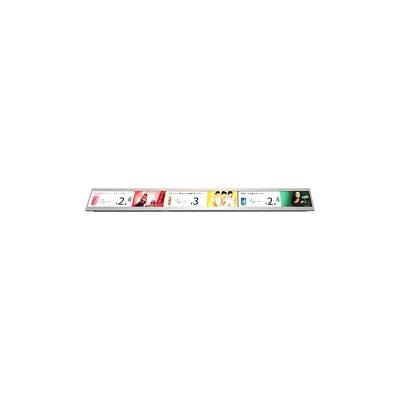
27.5 Inch Retail Shelf Header LCD Panel 1000nits Ultra-Narrow LCD Screen



Model P/N
Size
Resolution
Brightness
Viewing Angle
Connector Type
Operating Temp
Overall(mm)
huisoar
HS0275ZJ01-C100
Brand
Panel Size (inch)
Model P/N
Resolution
Brightness (nits)
Viewing Angle
Contrast Ratio
Response Time
Overall (mm)
Active Area (mm)
Refresh Rate
Display Colors
Panel Type
Connector Type
Operating Temp
Touchscreen Type
Storage Temp
Work Mode
Designed For
27.5 Inch Retail Shelf Header LCD Panel for Promotional Signage
This ultra-wide panel provides a native 1920 × 137 canvas, 1000 cd/m² luminance and a 698.4 × 50 mm active area for narrow commercial-message layouts.
Product Summary
The Retail Shelf Header LCD Panel is designed for equipment and fixtures where promotional content must fit into a long, shallow opening. Its 27.5-inch format provides a 698.4 × 50 mm active area within a 722.1 × 78.8 × 25 mm module outline, allowing integrators to place dynamic messages in spaces that cannot accommodate a conventional 16:9 display.
The native 1920 × 137 resolution is suited to horizontal price messages, product-category headers, brand graphics, short promotional statements and directional information. A 1000 cd/m² panel luminance rating supports use in brightly illuminated commercial interiors, while the 1400:1 contrast ratio provides separation between text, backgrounds and graphical elements.
The 1920 × 137 native canvas requires purpose-built ultra-wide content rather than scaled 16:9 artwork.
Key Specifications at a Glance
| Feature | Value |
|---|---|
| Display size | 27.5 inches |
| Native resolution | 1920 × 137 pixels |
| Aspect ratio | 16:1.15 |
| Active area | 698.4 × 50 mm |
| Module outline | 722.1 × 78.8 × 25 mm |
| Luminance | 1000 cd/m² |
| Contrast ratio | 1400:1 |
| Backlight | WLED |
| Power reference | 12 W |
| Operating temperature | 0°C to +50°C |
| Touch | Optional project configuration |
Native 1920 × 137 Content for Ultra-Wide Signage
The extreme horizontal format should be treated as a dedicated signage canvas rather than a cropped conventional monitor. Preparing media at 1920 × 137 pixels preserves text proportions, logo geometry and image composition without forcing the playback system to distort standard artwork.
Build Artwork for the Actual Pixel Canvas
Content teams should create templates at the native resolution and define safe margins around text, logos and price information. Small type should be tested at the intended viewing distance, especially where the panel is installed above a shelf, inside a header rail or behind protective glass.
A useful qualification set includes:
- high-contrast promotional messages;
- product-category names;
- price and discount combinations;
- directional arrows;
- scrolling or changing text;
- brand artwork with thin lines;
- dark and light background variants.
Organize Promotions into Horizontal Content Zones
The 1920-pixel width can be divided into practical message zones. One area may carry a product category, another may show promotional artwork, and a third may display pricing or guidance. This approach is more effective than shrinking a full-screen advertisement into a strip only 137 pixels high.
Avoid relying on a playback scaler to correct badly proportioned creative. The media workflow should be validated with the real panel and controller configuration before final content templates are approved.
Retail Shelf Header LCD Panel Integration
Successful integration depends on both mechanical fit and electrical qualification. The display dimensions define the required enclosure opening, internal clearance and support structure, while the complete electrical specification determines whether the selected controller can drive the panel correctly.
Mechanical Opening and Mounting Support
The visible active area measures 698.4 × 50 mm. The full module is larger at 722.1 × 78.8 × 25 mm, so the enclosure must provide room beyond the visible window for the border, internal structure, cable path and mounting support.
The mechanical review should confirm:
- viewing-window dimensions;
- bezel overlap;
- rear clearance;
- support locations;
- cable exit direction;
- ventilation space;
- cover-glass thickness;
- assembly and service access.
The panel should not be supported only by the visible-area border. The finished fixture must distribute mechanical load without twisting the long display structure.
Controller and Interface Qualification
The display interface and connector assignment must be confirmed from the complete module specification before a controller board or cable assembly is selected.
A matching connector or controller label does not prove compatibility without the complete electrical and timing specification.
Engineering review should cover native timing, pixel clock, voltage levels, connector assignment, backlight requirements, cable orientation and power sequencing. HDMI, DisplayPort or USB input should not be assumed unless a suitable controller system is included and qualified separately.
Optical Performance and Power Planning
The 1000 cd/m² luminance rating supports high-visibility promotional content in bright retail interiors and covered commercial installations. Finished-system visibility will also depend on ambient light, front-cover reflection, viewing distance, content contrast and the optical stack placed in front of the panel.
Evaluating the 1000 cd/m² Panel Behind Cover Glass
A clear or treated cover may be added for protection and appearance, but every additional optical layer can influence reflection and transmitted brightness. Sample evaluation should therefore use the intended cover material, printing, adhesive or air gap and installation angle.
The 1000 cd/m² panel rating does not by itself establish finished-system readability behind cover glass in every installation.
High-contrast layouts generally provide a stronger result than low-contrast photographs or fine gray text. The final content should be tested under the actual store lighting rather than judged only on a workbench.
Designing Around the 12 W Power Reference
The 12 W value provides a starting point for system power planning. The enclosure design should also account for the controller, power-conversion losses and any optional touch electronics.
Power and thermal validation should include:
- input-supply capacity;
- cable voltage drop;
- internal air space;
- heat from the controller;
- brightness operating conditions;
- fixture ventilation;
- nearby lighting or power equipment.
The module operating range is 0°C to +50°C. The finished product should be qualified for its real internal enclosure temperature rather than ambient room temperature alone.
Recommended Commercial Applications
This ultra-wide format is suitable for projects that require a long message area with limited height, including:
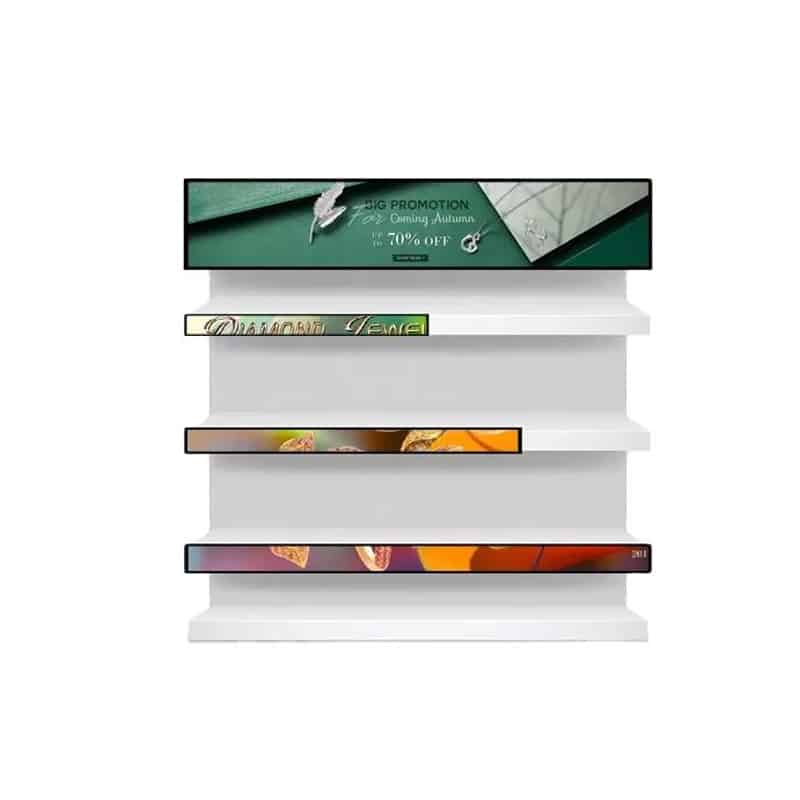
- retail shelf headers;
- aisle-category signs;
- promotional strips above product displays;
- elevator guidance panels;
- corridor and queue messages;
- covered transit information strips;
- compact building directories;
- branded fixture headers;
- narrow equipment-information panels.
The Retail Shelf Header LCD Panel is most appropriate where the enclosure and content workflow are designed around its native shape. It should not be selected as a direct replacement for a standard widescreen display without reviewing resolution, physical dimensions and controller compatibility.
Customization and Sample Qualification
Optional touch may be considered where the installation requires direct interaction. Because a touch layer changes the optical and mechanical stack, it must be reviewed as a separate project configuration.
Other project-specific items may include:
- cover-glass dimensions;
- border printing;
- surface treatment;
- mounting support;
- cable length or direction;
- controller integration;
- enclosure adaptation;
- labeling and packaging.
Custom scope, tooling requirements, material availability and order quantity are confirmed after the technical drawings and project requirements are reviewed.
A physical sample should be evaluated with the intended controller, power system, content files, enclosure and cover stack. Approval based only on the bare panel does not confirm the performance of the complete signage assembly.
Procurement Checklist
Submit the following information for technical review:
- required annual quantity and sample quantity;
- installation application;
- controller or media-player model;
- complete interface and connector requirements;
- native 1920 × 137 content workflow;
- enclosure opening and available internal space;
- mounting and support method;
- cable direction and permitted cable length;
- cover-glass material and printing;
- ambient-light conditions;
- viewing distance;
- optional-touch requirement;
- power budget;
- operating-temperature target;
- sample acceptance criteria;
- required compliance documents.

FAQ
About 27.5 Inch Retail Shelf Header LCD Panel
What must be checked before selecting a controller for this panel?
How should promotional content be prepared for the 1920 × 137 format?
Which dimensions should control the enclosure design?
Is the 1000 cd/m² rating sufficient for every bright installation?
How does optional touch affect the project specification?
Freya Yang
+86 18318948097