Freya Yang
+86 18318948097
+852 62667476
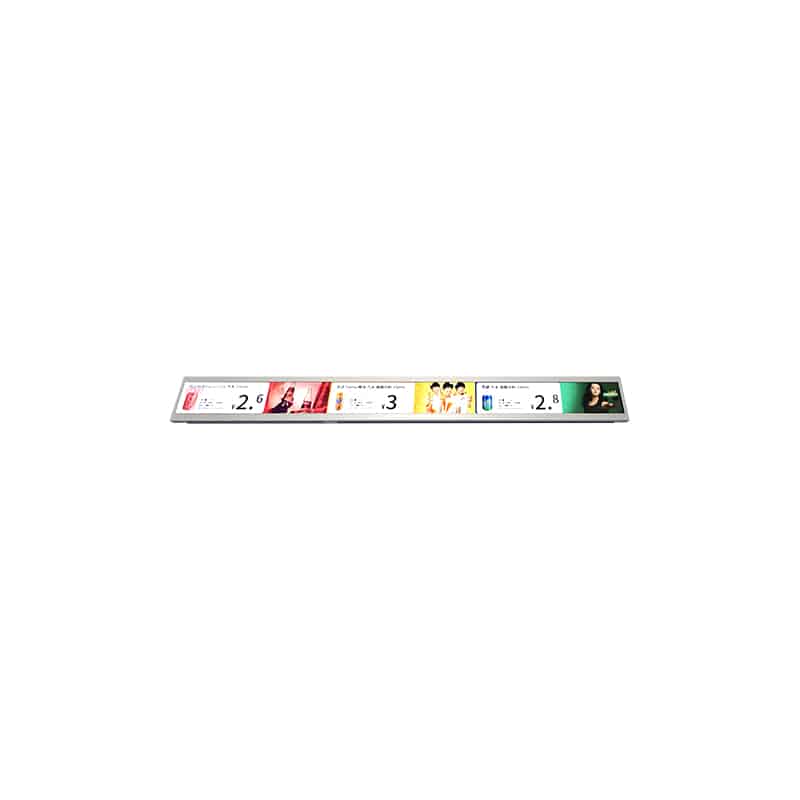
27.5 Inch Shelf Edge LCD Module for Retail Price Displays


Model P/N
Size
Resolution
Brightness
Viewing Angle
Connector Type
Operating Temp
Overall(mm)
huisoar
HS0275TA01-C070
Brand
Panel Size (inch)
Model P/N
Resolution
Brightness (nits)
Viewing Angle
Contrast Ratio
Response Time
Overall (mm)
Active Area (mm)
Refresh Rate
Display Colors
Panel Type
Connector Type
Operating Temp
Touchscreen Type
Storage Temp
Work Mode
Designed For
27.5 Inch Shelf Edge LCD Module for Retail Price Displays
This ultra-wide module combines a native 1920 × 136 canvas, 700 cd/m² typical luminance and dual-channel LVDS for narrow retail-fixture integration.
Product Summary
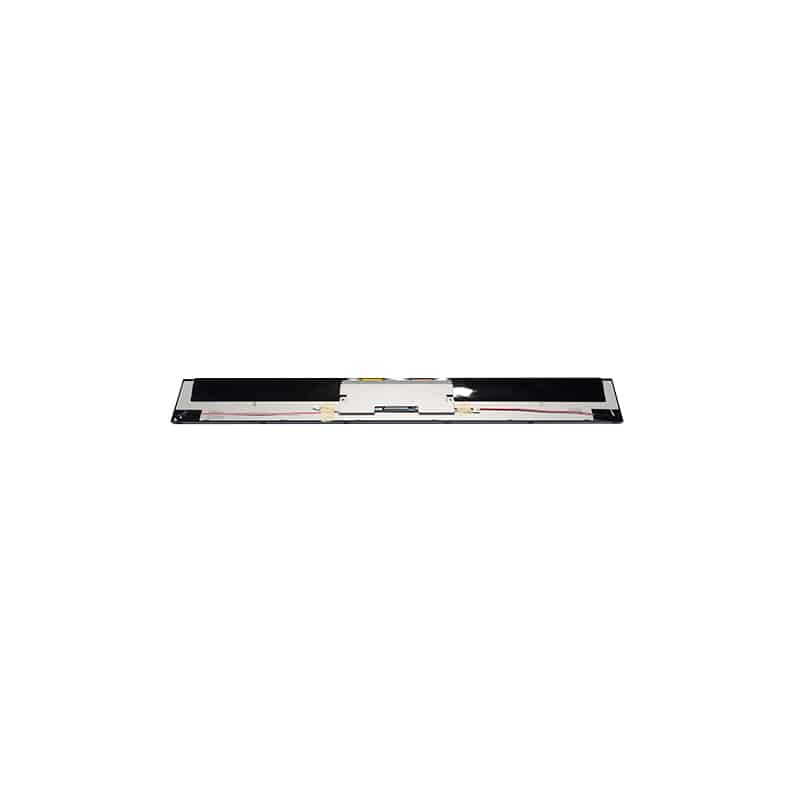
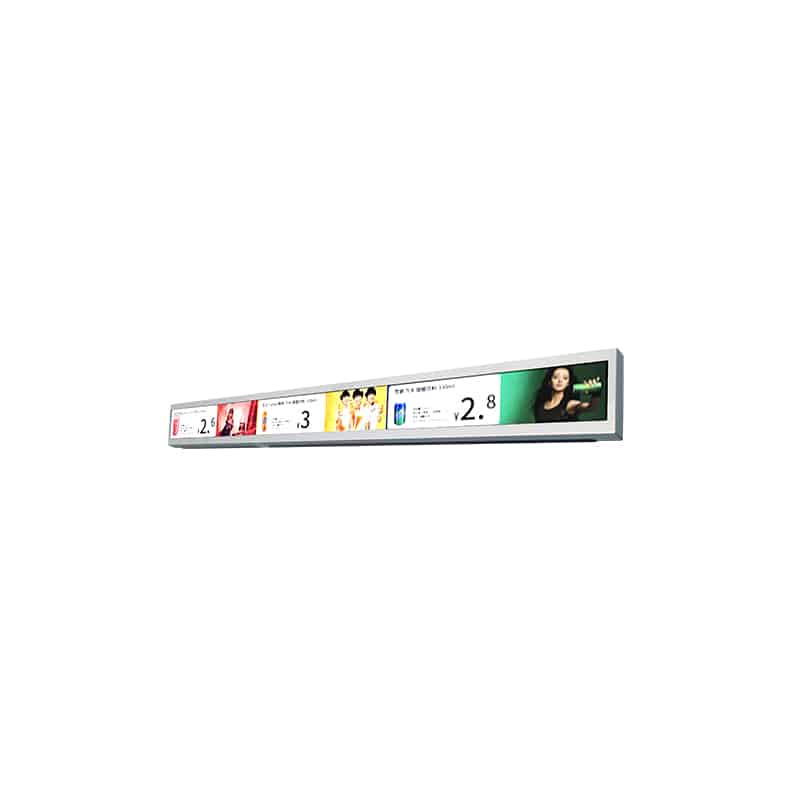
The Shelf Edge LCD Module is a 27.5-inch ultra-wide display designed for installations where conventional rectangular screens are too tall. Its 698.4 × 50 mm active area creates a narrow visual strip for prices, product names, promotions, directional information and short service messages.
A native resolution of 1920 × 136 provides a highly elongated canvas that should be treated as a purpose-built content format. Standard 1920 × 1080 advertising material should not be compressed into this geometry because text, logos and product images can become distorted or too small to read.
The module measures 714.4 × 75 × 19.2 mm and uses a 2-channel, 8-bit LVDS interface. It provides 700 cd/m² typical luminance, a 4000:1 contrast ratio, WLED backlighting and a 10 W power reference. The standard configuration is non-touch and has a confirmed operating range of 0°C to +50°C.
Key Specifications
| Specification | Value |
|---|---|
| Display size | 27.5 inches |
| Native resolution | 1920 × 136 pixels |
| Active area | 698.4 × 50 mm |
| Overall dimensions | 714.4 × 75 × 19.2 mm |
| Luminance | 700 cd/m² typical |
| Contrast ratio | 4000:1 |
| Interface | LVDS, 2-channel, 8-bit |
| Power consumption | 10 W |
| Backlight | WLED |
| Touch | Non-touch |
| Operating temperature | 0°C to +50°C |
A module with the same LVDS channel count or resolution is not automatically interchangeable. The complete timing, electrical and connector requirements must be compared before connecting a host or controller board.
Native 1920 × 136 Content Planning
Build Artwork for the Ultra-Wide Canvas
The 1920 × 136 pixel matrix should be used as the master artwork size. Preparing assets at the native resolution avoids unnecessary scaling and helps keep text edges, price digits and icons clear.
Suitable content structures include:
- product name and price
- promotion and discount message
- short feature line
- category or aisle identifier
- directional arrow
- queue or service status
- route or stop name
- compact warning message
The 136-pixel height places a practical limit on the number of text rows. Content should prioritize one clear message rather than attempting to reproduce a full conventional digital-signage page.
Plan Text for Short Viewing Distances
Retail shelf-edge information is normally viewed at a shorter distance than wall-mounted advertising. Text height, line spacing and contrast should therefore be validated at the actual installation distance.
Prepare sample layouts using the intended:
- font family
- smallest price digits
- currency symbols
- promotional colors
- product-image size
- QR-code dimensions
- viewing distance
- cover-glass construction
- store illumination
The 698.4 × 50 mm active area should control visible artwork placement. The larger 714.4 × 75 mm outline controls fixture and enclosure planning.
LVDS Host and Controller Integration
Confirm Timing and Pin Mapping
“LVDS, 2-channel, 8-bit” identifies the general signal format, but it does not define the complete electrical interface.
Before prototype connection, obtain and compare:
- connector part number
- connector orientation
- pin count
- pin assignment
- LVDS pair order
- mapping convention
- pixel clock
- horizontal timing
- vertical timing
- refresh rate
- logic voltage
- panel supply
- enable signals
- backlight control
- grounding arrangement
The host or controller must output the native 1920 × 136 timing. A board that supports standard 1920 × 1080 resolution may not automatically generate the required bar-screen timing.
Validate the Complete Signal Path
The controller, cable and display should be tested as one system. Non-standard resolutions can produce a black screen, image offset, flicker, incorrect colors or repeated pixels when the timing or LVDS mapping does not match.
A controller qualification should cover:
- Native 1920 × 136 output
- Correct dual-channel mapping
- Pixel-clock tolerance
- Cable length and impedance
- Connector orientation
- Power-up and backlight control
- Image rotation requirements
- Scaling behavior
- Restart behavior after power loss
- Long-duration sample testing
An HDMI-to-LVDS or other bridge board may be evaluated separately, but compatibility cannot be inferred from the LVDS label alone.
Shelf Edge LCD Module Mechanical Integration
Fixture Opening and Bezel Planning
The overall dimensions are 714.4 × 75 × 19.2 mm, while the active image area is 698.4 × 50 mm. The fixture design should distinguish among:
- active area
- visible opening
- module outline
- structural support
- cable exit
- service clearance
- protective front
- printed border or mask
The visible opening should not obstruct the 698.4 × 50 mm display area. At the same time, the fixture must support the module without applying concentrated pressure to the glass or display surface.
Cable and Support Requirements
The module’s elongated form requires distributed mechanical support. Supporting only one end can introduce bending or torsional load during assembly and transport.
The mechanical review should define:
- mounting orientation
- support points
- rear clearance
- cable direction
- connector access
- cable bend radius
- thermal clearance
- cover-glass spacing
- assembly tolerance
- replacement procedure
The stated 19.2 mm thickness does not include an external controller board, cable bend, protective cover or final retail fixture.
Optical, Power and Environmental Boundaries
The standard module rating is 700 cd/m² typical. This value can support many brightly illuminated indoor retail installations, but it does not by itself establish direct-sunlight readability.
Finished visibility depends on:
- ambient-light direction
- cover transmission
- surface reflection
- content contrast
- text size
- viewing angle
- installation height
- observer distance
- fixture shading
The module should be evaluated behind the actual protective front under the intended store lighting.
The 10 W value is a system-planning reference for the display module. The final power supply must also accommodate conversion loss, controller consumption and design margin. Thermal performance should be tested in the completed fixture rather than inferred from the module value alone.
The confirmed operating range is 0°C to +50°C. This does not establish outdoor, refrigerated, high-humidity, condensation-resistant or vehicle-grade operation. Projects outside the confirmed range require a separate environmental review.
Suitable Retail and Commercial Applications
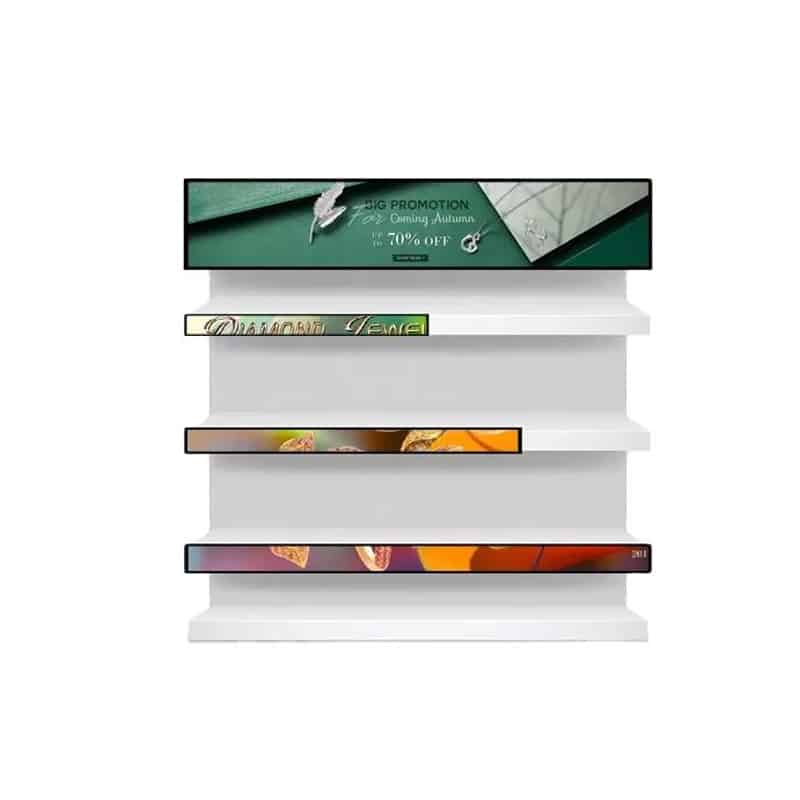
Retail shelf-edge pricing
The ultra-wide canvas can present product names, prices, unit-price information and promotional labels along a shelf rail.
Promotional shelf headers
The display can be positioned above or below merchandise to show campaign graphics, brand messages and short product comparisons.
Refrigerated-case information strips
The narrow geometry may fit display cases where vertical space is restricted. Temperature, condensation and enclosure requirements must be assessed separately.
Service-counter information
The module can display counter numbers, service status, queue messages or short instructions in a narrow fascia.
Elevator and corridor guidance
The wide strip can present floor names, directions or compact building notices when the host controller supports the native resolution.
Bank and public-service notices
The display can be evaluated for call numbers, service-desk information and compact public messages in controlled indoor installations.
Covered transportation information
Route names, stop identifiers and short service notices are possible integration directions. Vibration, temperature and environmental qualification must be established at finished-system level.
Customization and Sample Review
Project-specific review may cover:
- controller-board matching
- cable length and direction
- connector orientation
- mounting features
- protective cover glass
- optical bonding
- anti-glare treatment
- branding or printed mask
- fixture integration
- luminance requirements
- power-supply configuration
- touch-panel development
These items are not automatically included in the standard module.
Custom configurations are generally reviewed from 500 pieces, subject to tooling requirements, material availability and the requested specification. Sample and standard-module quantities are confirmed separately.
Procurement Checklist
Submit the following before sample approval:
- host or controller model
- required native output timing
- LVDS pin mapping
- connector and cable requirements
- final content orientation
- native 1920 × 136 artwork examples
- smallest text and price size
- intended viewing distance
- fixture opening
- mechanical support drawing
- cable exit and bend direction
- protective-front specification
- store-lighting conditions
- power budget
- operating-temperature conditions
- compliance-document requirements
- sample acceptance criteria
- estimated annual quantity
FAQ
About 27.5 Inch Shelf Edge LCD Module
What must be checked before connecting a dual-channel LVDS controller?
How should content be adapted to the 1920 × 136 canvas?
Is 700 cd/m² sufficient for a brightly lit retail shelf?
Which dimensions should control the shelf-fixture design?
Can the module be used as a standalone digital-signage screen?
Can customers interact directly with the displayed prices or promotions?
Freya Yang
+86 18318948097