Freya Yang
+86 18318948097
+852 62667476
6 Inch Flexible OLED Display Smart Device Module for Wearables
Model P/N
Size
Resolution
Brightness
Viewing Angle
Connector Type
Operating Temp
Overall(mm)
huisoar
HS060S02K
Brand
Panel Size (inch)
Model P/N
Resolution
Brightness (nits)
Viewing Angle
Contrast Ratio
Response Time
Overall (mm)
Active Area (mm)
Refresh Rate
Display Colors
Panel Type
Connector Type
Operating Temp
Touchscreen Type
Storage Temp
Work Mode
Pixel Format
Input Voltage (V)
Control Type
Operating Environment
Motherboard Type
Designed For
6 Inch Flexible OLED Display Smart Device Module for Wearables
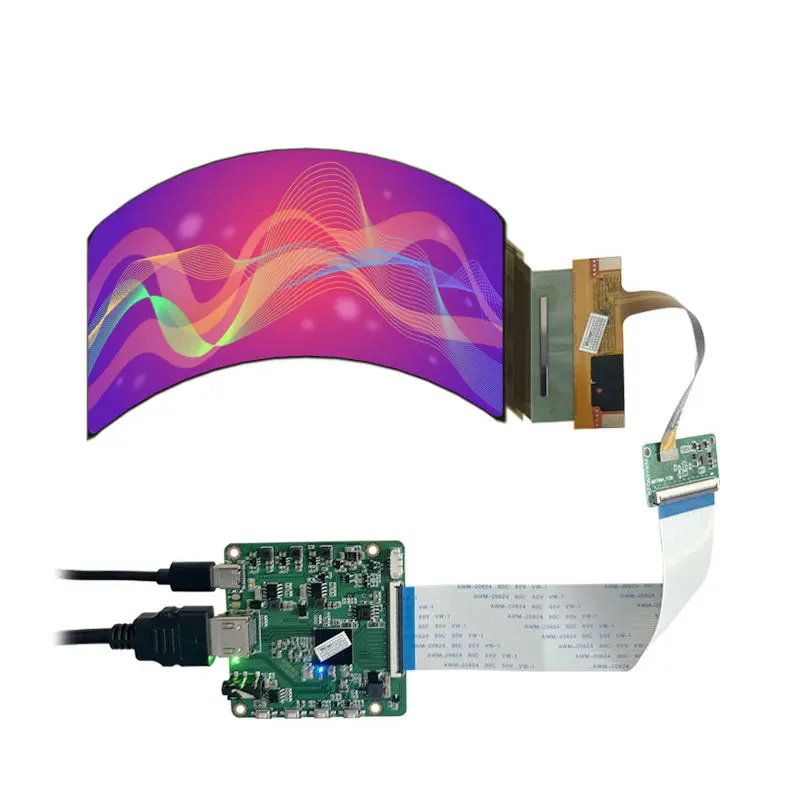
This 6-inch flexible AMOLED module combines a 2880 × 1440 image with four-lane MIPI-DSI and a curved-form option for wearable and compact smart-product development.
Product Summary
The Flexible OLED Display Smart Device Module is a 6-inch flexible AMOLED component for products that need a high-resolution visual area and a MIPI-based embedded display path. It combines 2880 × 1440 pixels, 600 cd/m² typical luminance, a 90000:1 typical contrast ratio, 16.7M colors, and four-lane MIPI-DSI. Its flexible construction supports curved mechanical concepts, while the uncurved active area is approximately 136.08 × 68.04 mm in the default landscape orientation.
This is a panel-level integration product rather than a finished monitor. Host timing, panel power, FPC details, bend geometry, touch requirements, and any evaluation hardware should be qualified as part of the complete device design.
Key Specifications at a Glance
| Specification | Confirmed Value |
|---|---|
| Display size | 6 inches |
| Display technology | Flexible AMOLED / OLED |
| Native resolution | 2880 × 1440 pixels |
| Pixel format | RGB vertical stripe |
| Typical luminance | 600 cd/m² |
| Typical contrast ratio | 90000:1 |
| Display colors | 16.7M |
| Viewing angle | 85°/85°/85°/85° typical at CR 10; direction order not specified |
| Native interface | MIPI-DSI, 4 lanes |
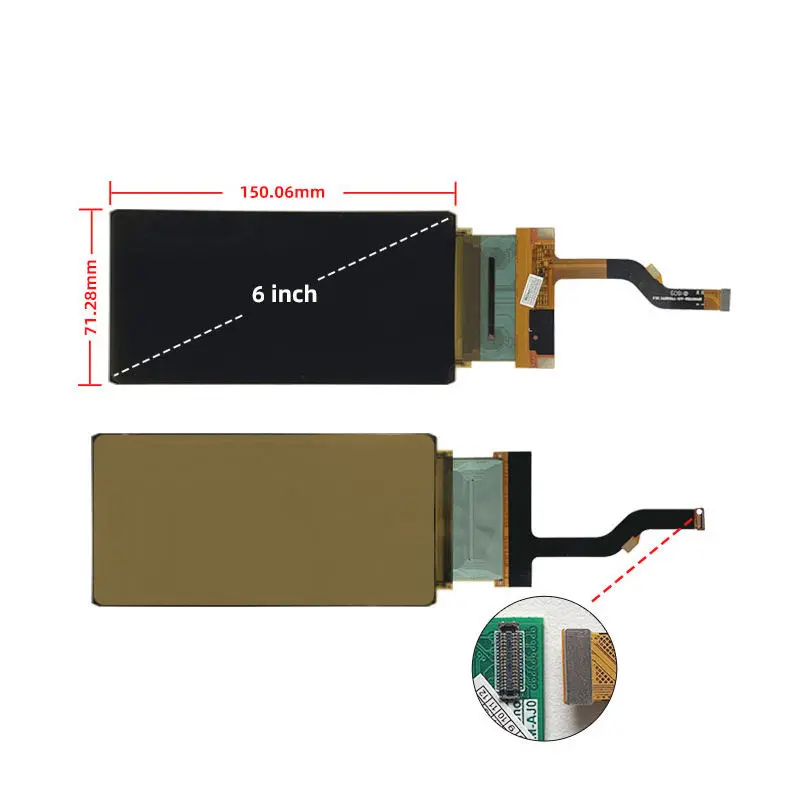
| Uncurved active area | Approximately 136.08 × 68.04 mm in landscape orientation |
| Panel envelope | 150.06 × 71.28 mm |
| Operating temperature | −20°C to +70°C |
| Touch | Not confirmed |
Flexible AMOLED Architecture for Smart Product Design
2880 × 1440 Content Planning
The native raster provides a detailed landscape workspace for graphics, compact text, media content, and modern UI layouts. Content should be prepared for 2880 × 1440 rather than scaled from a lower-resolution prototype, particularly for close-range viewing.
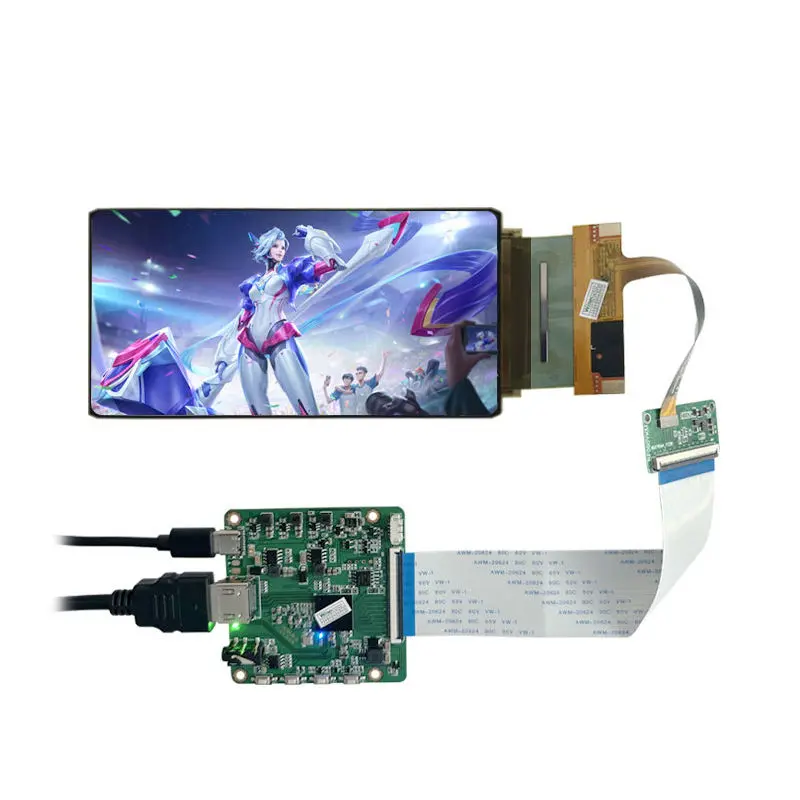
The display is shown in landscape orientation by default. If another orientation is required, software rotation, host timing, connector direction, and mechanical clearance should be validated together.
Curved Integration Requires a Defined Mechanical Condition
The flexible construction is useful for products that need a non-flat display surface, but flexibility should not be interpreted as an unlimited folding specification.
Flexibility does not establish a qualified minimum bend radius or repeated-flex cycle life.
Before tooling, define whether the panel remains flat, uses a fixed curvature, or moves during operation. Bend direction, radius, supported area, adhesive stack, edge clearance, and FPC strain should be part of the mechanical review.
Integrating the Flexible OLED Display Smart Device Module
Four-Lane MIPI-DSI Host Qualification
The native display interface is four-lane MIPI-DSI. Lane count is useful for early host selection, but it is not enough to approve a controller.
A four-lane MIPI-DSI label does not guarantee direct host compatibility.
Confirm the panel timing, operating mode, lane mapping, clock requirements, FPC pin assignment, voltage rails, initialization data, image orientation, and software support for the selected processor. For a new board, submit the processor display-interface specification before committing the PCB and cable layout.
Evaluation Hardware Does Not Redefine the Native Interface
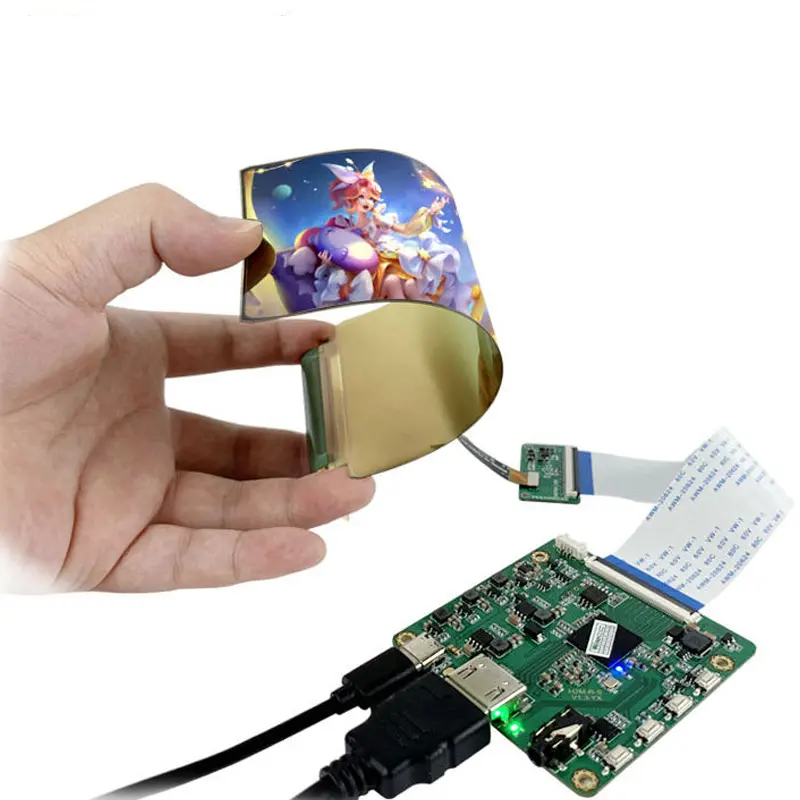
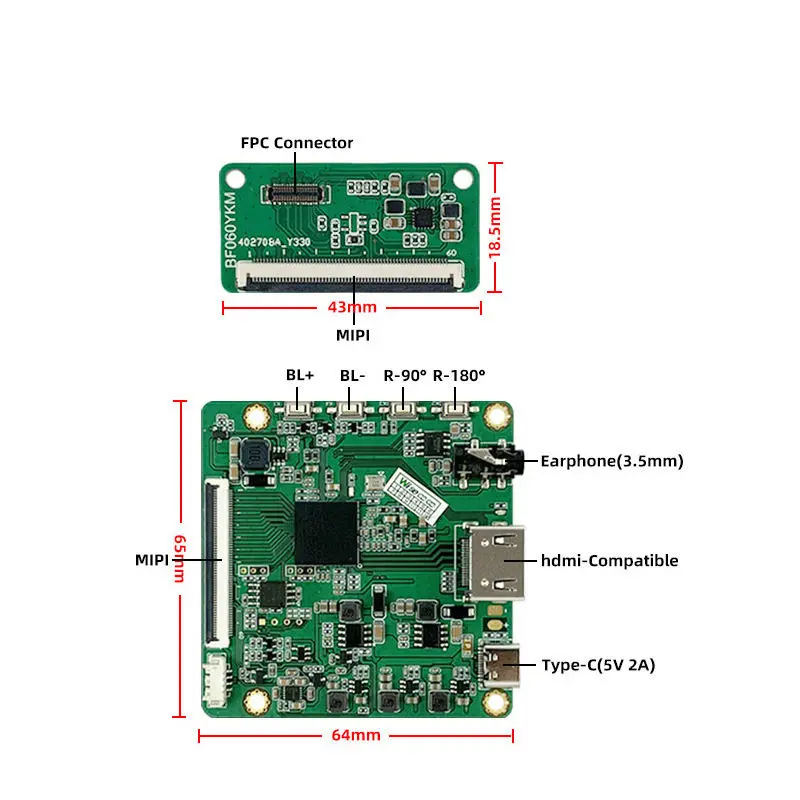
Development imagery shows an evaluation path with an HDMI-compatible connector, USB Type-C power marked 5 V / 2 A, a 3.5 mm earphone connector, and MIPI output.
The HDMI-compatible connector shown on an evaluation board is not the panel's native interface.
The panel remains a MIPI-DSI device. If HDMI input is required for prototyping, confirm the bridge board, supported timing, rotation behavior, power requirement, cable set, and ordered accessory scope. The 5 V / 2 A marking belongs to the illustrated board path and should not be treated as panel logic voltage.
Optical Performance for Close-Range Interfaces
600 cd/m² Luminance and 90000:1 Contrast
The 600 cd/m² typical luminance and 90000:1 typical contrast support strong separation between bright interface elements and darker screen areas for indoor smart products, handheld systems, and wearable-oriented concepts.
The luminance value is a panel-level optical specification. Cover materials, curvature, viewing geometry, and enclosure design can change final appearance, so direct-sun readability or an outdoor grade should not be assumed without system testing.
Color and Off-Axis Viewing
The display supports 16.7M colors with an RGB vertical stripe pixel format. The viewing-angle entry is 85°/85°/85°/85° typical at CR 10, but its directional order is not defined.
For a curved installation, practical viewing geometry should be checked on the assembled device because curvature can change how different screen regions face the user.
Mechanical Planning for a Flexible OLED Module
Active Area and Panel Envelope
The uncurved active area is approximately 136.08 × 68.04 mm in landscape orientation. The panel envelope is 150.06 × 71.28 mm.
The active area controls the visible image and UI layout; the larger envelope controls enclosure opening, edge support, cable clearance, and integration. The approved drawing should also define the FPC exit and non-display border.
Fixed Curvature Versus Repeated Bending
A flexible AMOLED module can be useful even when the finished product does not repeatedly fold. A fixed curved enclosure may use flexibility only to create a non-flat visual surface.
If repeated bending is required, define bend radius, bend axis, cycle count, temperature, support structure, adhesive materials, and FPC stress as separate acceptance criteria. These values are not established by the standard optical and interface specifications.
Recommended Smart-Device Applications
The Flexible OLED Display Smart Device Module is relevant to mobile-oriented electronics, wearable-concept devices, compact smart terminals, curved control surfaces, portable development platforms, and custom embedded products where a 6-inch high-resolution AMOLED screen fits the mechanical design.
The finished device still requires its own protection, power architecture, processor support, thermal design, and environmental qualification.
Customization and Procurement Planning
Custom configurations are generally reviewed from 500 pieces, subject to tooling requirements, material availability, and the requested specification. Sample and standard-module quantities are confirmed separately.
For a flexible OLED project, identify the required FPC arrangement, interface documentation, panel orientation, curvature condition, mechanical envelope, optical target, evaluation-board need, and touch requirement before engineering review.
Procurement Checklist
Before releasing a Flexible OLED Display Smart Device Module order, confirm the 6-inch production revision, 2880 × 1440 timing, four-lane MIPI-DSI configuration, 600 cd/m² luminance grade, 90000:1 contrast definition, 16.7M color format, RGB vertical stripe structure, active-area orientation, 150.06 × 71.28 mm panel envelope, FPC pin assignment and orientation, panel voltage rails, initialization data, operating temperature, curvature requirement, minimum bend radius if applicable, static-versus-dynamic flex requirement, touch status, evaluation-board requirement, sample quantity, and annual demand.

FAQ
About 6 Inch Flexible OLED Display Smart Device Module
What must be checked before connecting a four-lane MIPI-DSI host?
Is HDMI the native interface of this 6-inch flexible AMOLED panel?
What bend radius should be used for a curved product design?
What resolution should the host and UI assets target?
Is touch included with the flexible OLED module?
Freya Yang
+86 18318948097