Freya Yang
+86 18318948097
+852 62667476
12.3 Inch Wide Vehicle HMI LCD Panel for Navigation Systems
Model P/N
Size
Resolution
Brightness
Viewing Angle
Connector Type
Operating Temp
Overall(mm)
huisoar
HS123002B0
Brand
Panel Size (inch)
Model P/N
Resolution
Brightness (nits)
Viewing Angle
Contrast Ratio
Response Time
Overall (mm)
Active Area (mm)
Refresh Rate
Display Colors
Panel Type
Connector Type
Operating Temp
Touchscreen Type
Storage Temp
Work Mode
Pixel Format
Control Type
Operating Environment
Designed For
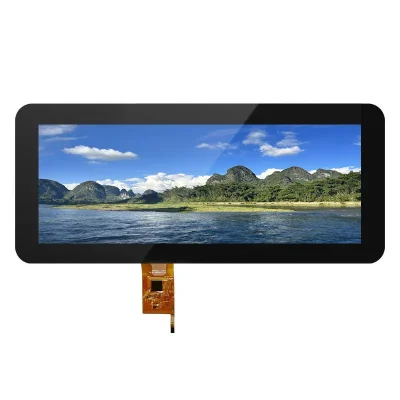
12.3 Inch Wide Vehicle HMI LCD Panel for Navigation Systems
A panoramic 1920 × 720 IPS panel with 1200 cd/m² luminance and 40-pin LVDS for vehicle and equipment interfaces.
Product Summary
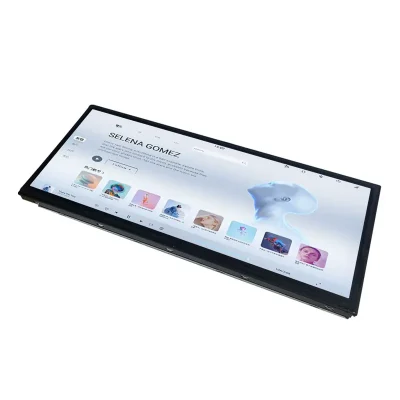
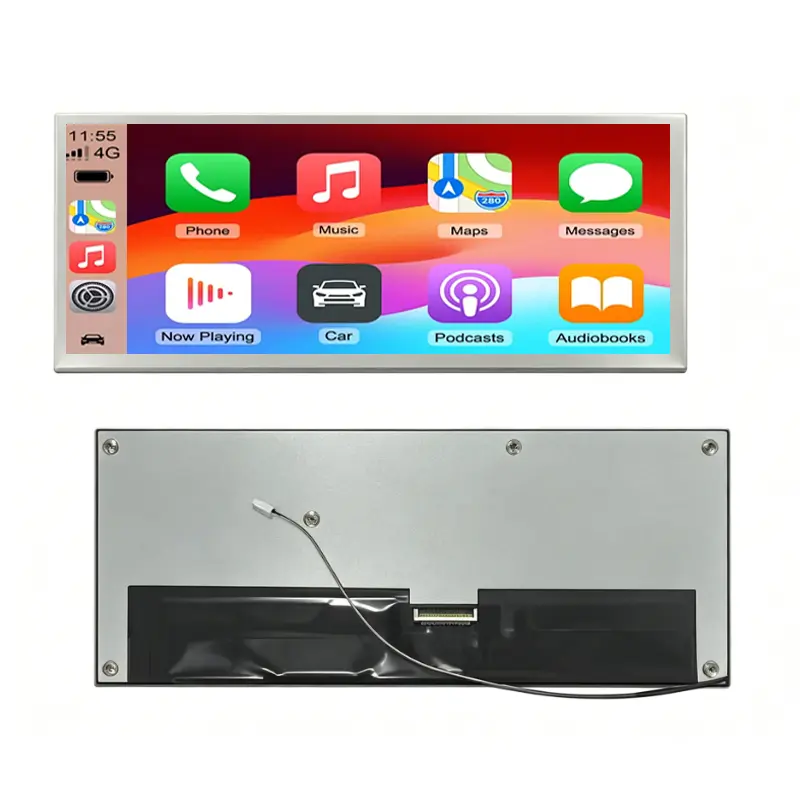
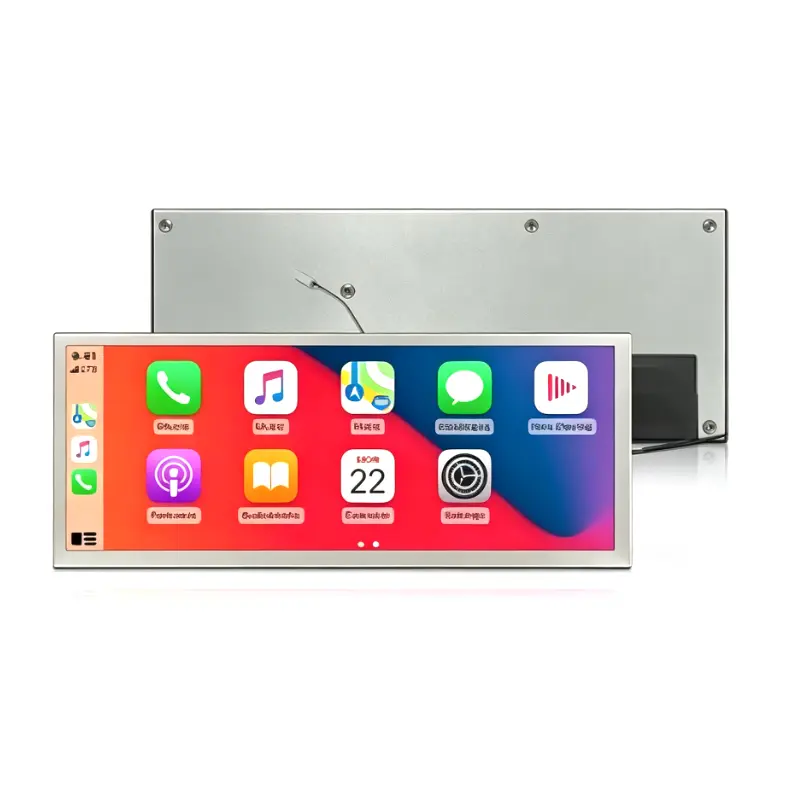
The Wide Vehicle HMI LCD Panel provides a long horizontal canvas for navigation, instrument, center-control and industrial interface layouts. Its 1920 × 720 native resolution supports route guidance, vehicle status, warning icons, operating data and segmented control graphics without requiring the height of a conventional widescreen panel.
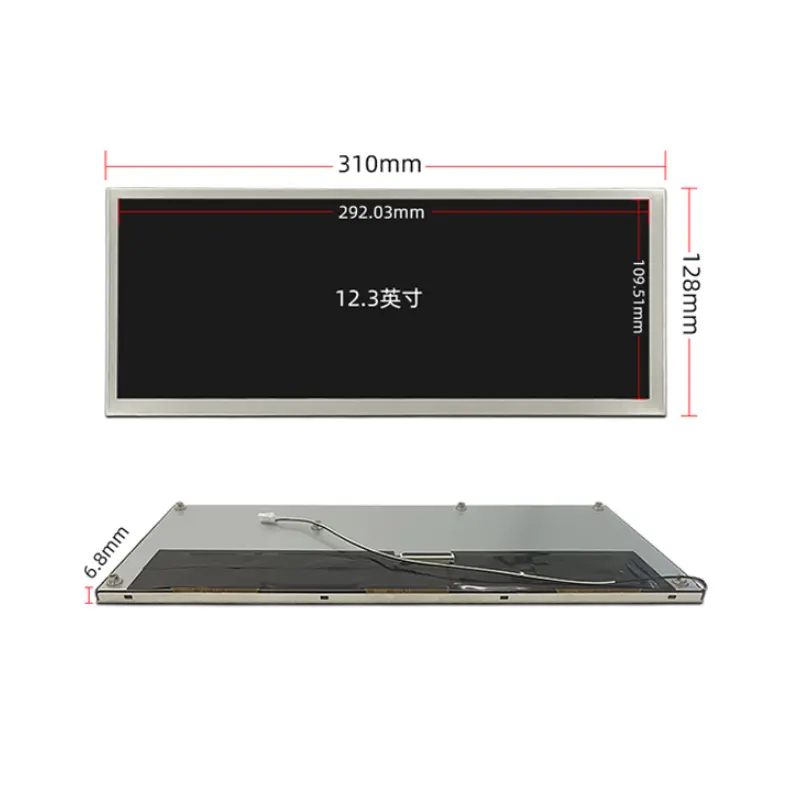
The 12.3-inch module combines IPS viewing, 1200 cd/m² typical luminance, a 40-pin LVDS interface and a 292.03 × 109.51 mm active area. It is supplied as a non-touch display component and requires a compatible host, approved cable, defined panel and backlight power, and a mechanically validated enclosure.
Key Specifications
| Specification | Value |
|---|---|
| Display size | 12.3 inch |
| Resolution | 1920 × 720 pixels |
| Aspect ratio | 8:3 |
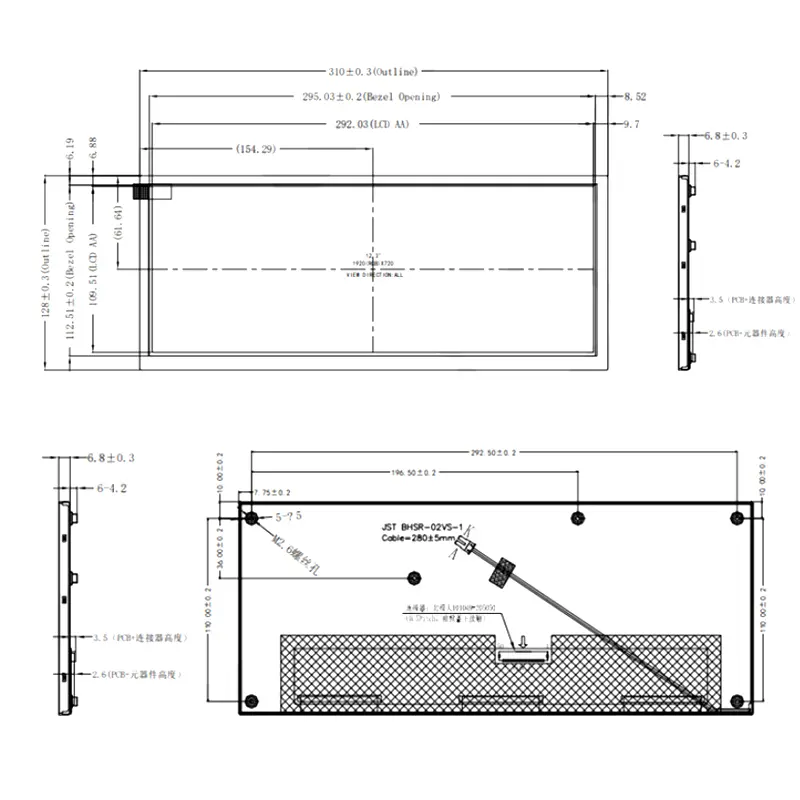
| Active area | 292.03 × 109.51 mm |
| Outline | 310 × 128 × 6.8 mm |
| Panel type | IPS a-Si TFT LCD |
| Luminance | 1200 cd/m² typical |
| Contrast ratio | 1000:1 typical |
| Viewing angle | 88°/88°/88°/88°, L/R/U/D |
| Display colors | 16.7 million |
| Interface | LVDS, 40 pins |
| Backlight | WLED |
| Touch | None |
| Operating temperature | −30°C to +80°C |
| Storage temperature | −30°C to +85°C |
Panoramic 1920 × 720 Interface Layout
Navigation and Instrument Composition
The 8:3 format is suited to interfaces that distribute information horizontally. A vehicle layout can divide the screen into map guidance, route prompts, speed or machine data, warnings and status controls while maintaining a compact vertical profile.
Truck, agricultural-machine and industrial designs can use the same geometry for center-control navigation, operating states, process values or guidance information.
UI development should define:
- Driver or operator viewing distance
- Minimum text height
- Warning-zone priority
- Navigation-map allocation
- Icon and touch-free control sizes
- Day and night visual modes
- Screen mounting angle
- Physical-button or rotary-control workflow
Native Raster and Active Area
The display should be driven at its native 1920 × 720 resolution whenever practical. Non-native scaling can soften text, change gauge proportions and reduce the clarity of navigation graphics.
The active image region measures 292.03 × 109.51 mm. This value should be separated from the 310 × 128 mm front outline when defining the visible window, decorative mask and enclosure bezel.
1200 cd/m² Optical Performance
Finished-System Readability
The panel luminance is specified at 1200 cd/m² typical. This provides a strong starting point for vehicle cabins, machinery consoles and equipment exposed to substantial ambient light.
A 1200 cd/m² panel does not by itself establish finished-system sunlight readability after front glass, reflections, dimming and thermal conditions are applied.
The optical review should include:
- Front-glass transmission
- Decorative printing
- Air gap or optical bonding
- Surface reflectance
- Installation angle
- Direct and indirect sunlight
- Night-time dimming
- Backlight heating
- Enclosure temperature
Brightness should be validated at the completed front surface under representative lighting.
IPS Viewing and Contrast
The panel specifies IPS full-view performance with 88-degree viewing in the left, right, up and down directions. This supports vehicle and machinery interfaces where the screen may be viewed from offset seating or standing positions.
The 1000:1 typical contrast ratio supports clear separation between dark backgrounds, bright symbols and navigation graphics. It does not establish HDR performance or color-critical calibration.
40-Pin LVDS Integration
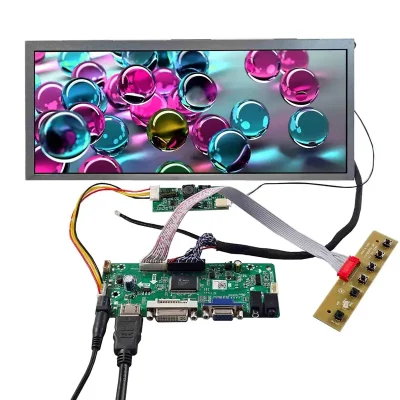
Host and Cable Qualification
The module uses a 40-pin LVDS connection.
A 40-pin LVDS connector does not guarantee timing, voltage, mapping or pin compatibility with another panel.
Before powering the panel, confirm:
- Native 1920 × 720 timing
- Pixel clock and blanking
- LVDS channel count
- Color-bit depth
- JEIDA or VESA mapping
- Connector manufacturer and pitch
- Contact side and pin-1 orientation
- Complete 40-pin assignment
- Panel-logic voltage
- Enable signals
- Ground and shielding design
The host schematic, cable drawing, panel pinout and controller documentation should be reviewed together.
Panel and Backlight Requirements
The product information confirms a WLED backlight but does not define the required panel voltage, backlight voltage, current, power, enable logic or dimming method.
Panel electronics and backlight power should be treated as separate design items until an approved electrical specification confirms their relationship.
The power review should cover:
- Panel-logic supply
- Input tolerance
- Startup sequence
- Backlight-driver output
- Enable polarity
- PWM or analog dimming
- Current limit
- Inrush behavior
- Thermal load
- Cable and connector rating
Mechanical Integration of the Wide Vehicle HMI LCD Panel
Outline and Rear-Structure Clearance
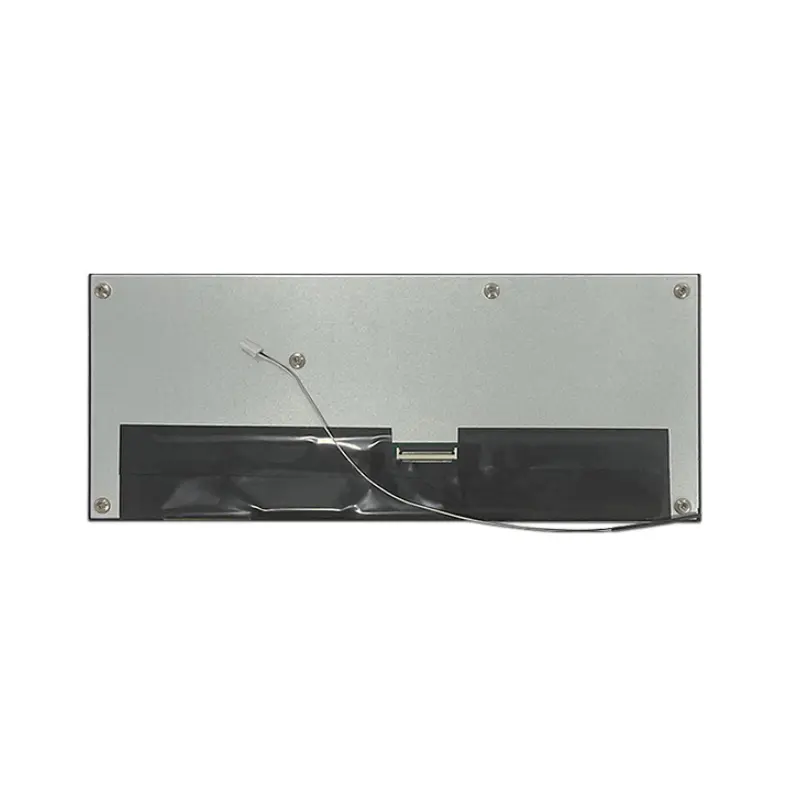
The product outline is 310 × 128 × 6.8 mm. The rear drawing shows a smaller rear-structure footprint, mounting features, cable routing and local thickness references that must also be considered.
Enclosure planning should define:
- Front opening
- Active-image margin
- Rear-cover clearance
- Cable exit
- Connector access
- Bend radius
- Mounting points
- Local keep-out zones
- Ventilation
- Service-removal path
The approved mechanical drawing should control bracket, bezel and housing release.
Non-Touch Front-Stack Planning
The standard configuration does not include touch.
The non-touch configuration requires a separate input method or independently qualified touch stack.
Projects may use:
- Physical buttons
- Rotary controllers
- Steering or console controls
- External keypad
- Independently developed touch panel
- Cover glass without touch
Adding a touch layer changes optical transmission, reflection, mechanical thickness, cable routing and electromagnetic behavior. It should be validated as a complete stack.
Temperature and Qualification Boundaries
The panel is specified for operation from −30°C to +80°C and storage from −30°C to +85°C.
These values support wide-temperature evaluation, but they do not independently prove:
- Automotive qualification
- Long-term operation at the maximum temperature
- Thermal-cycle durability
- Humidity resistance
- Vibration resistance
- EMC or ESD performance
- UV resistance
- Waterproofing
- Backlight lifetime
- Complete-system reliability
Qualification should use the final host, cable, backlight driver, enclosure, front glass and mounting structure.
Application and Configuration Review
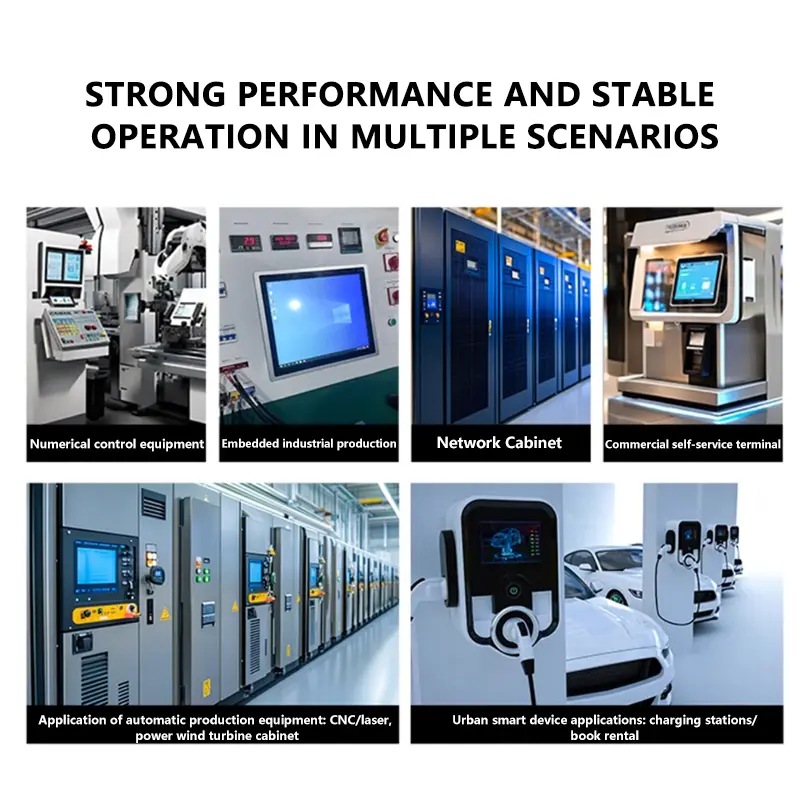
The panel can be evaluated for:
- Vehicle navigation displays
- Instrument and status panels
- Truck center-control interfaces
- Agricultural-machine guidance systems
- Off-highway equipment displays
- Industrial HMI panels
- Wide-format equipment information displays
- Non-touch control and monitoring terminals
The module is a component panel, not a finished navigation system. GPS, vehicle communications, HDMI conversion, audio, media playback, operating software and complete power conversion require additional hardware.
Configuration Scope
Project review may cover:
- LVDS controller and cable matching
- 40-pin assignment
- Front cover glass
- Anti-glare or anti-reflective treatment
- Optical bonding
- Enclosure adaptation
- Mounting brackets
- Backlight drive and dimming
- Optional touch development
- Branding and labeling
- Qualification documentation
Custom configurations are generally reviewed from 500 pieces, subject to tooling requirements, material availability and the requested specification. Sample and standard-module quantities are confirmed separately.
Procurement Checklist
Submit:
- Host processor or controller-board model
- Native 1920 × 720 timing
- LVDS channel and bit mapping
- JEIDA or VESA assignment
- Complete 40-pin pinout
- Connector manufacturer and orientation
- Panel-logic voltage
- Backlight voltage, current and dimming target
- Enclosure and bezel drawings
- Active-area and viewing-window requirements
- Front-glass or bonding plan
- Required finished-front luminance
- Non-touch input method
- Operating environment
- Sample quantity
- Annual demand
FAQ
About 12.3 Inch Wide Vehicle HMI LCD Panel
What must be checked before connecting the panel to a 40-pin LVDS host?
How should graphics be prepared for the 1920 × 720 format?
Does 1200 cd/m² guarantee sunlight readability?
Which dimensions should control enclosure design?
When should the non-touch configuration be selected?
Freya Yang
+86 18318948097