Freya Yang
+86 18318948097
+852 62667476
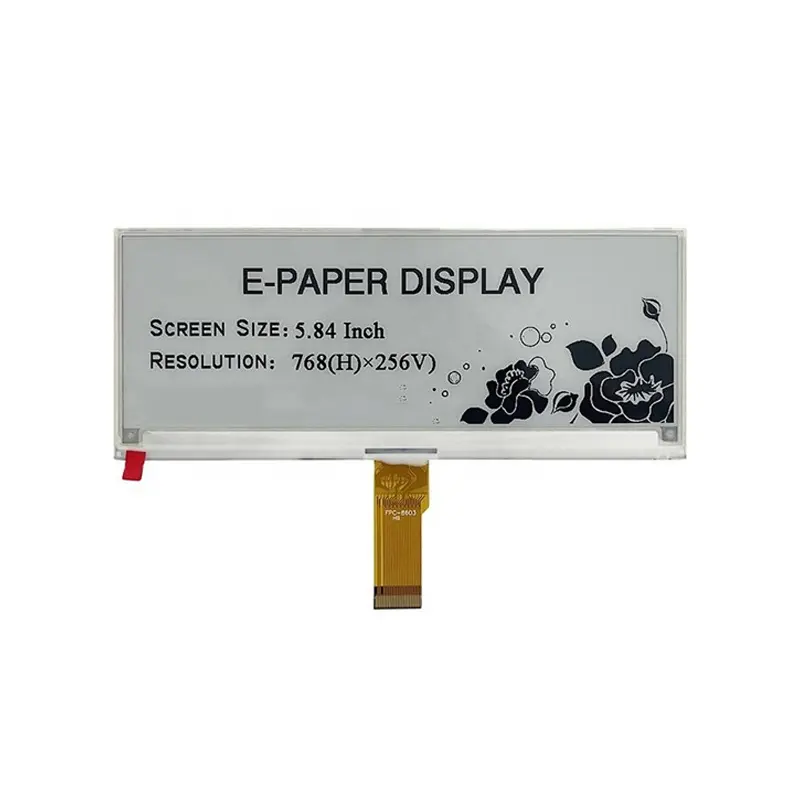
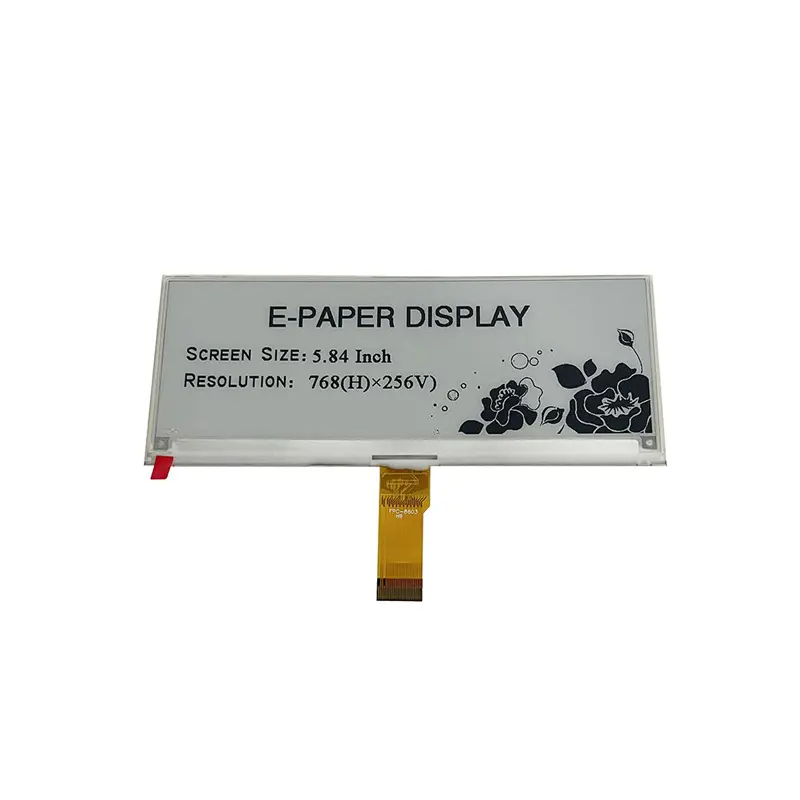
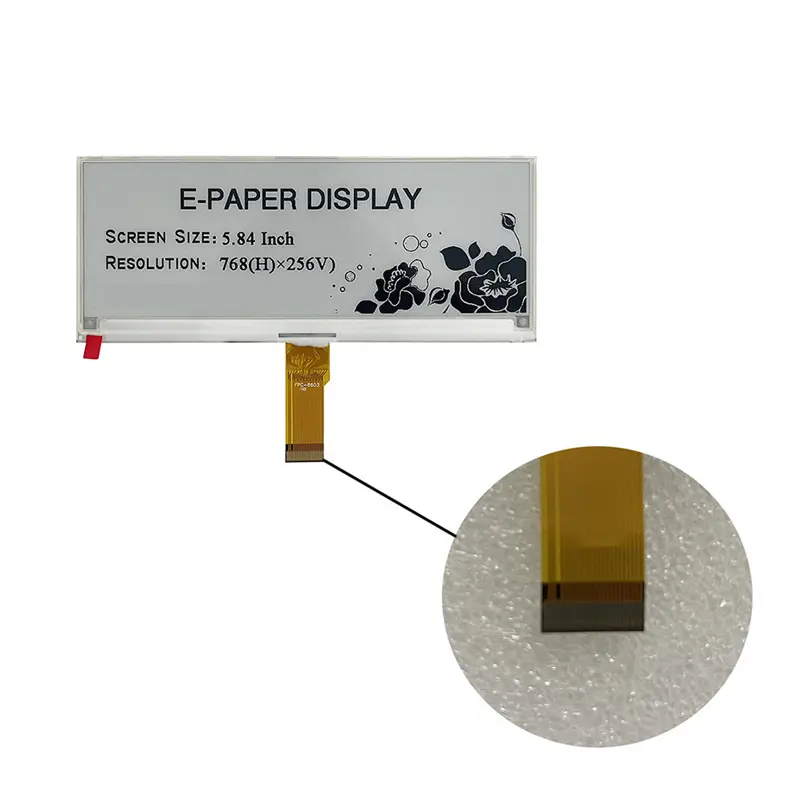
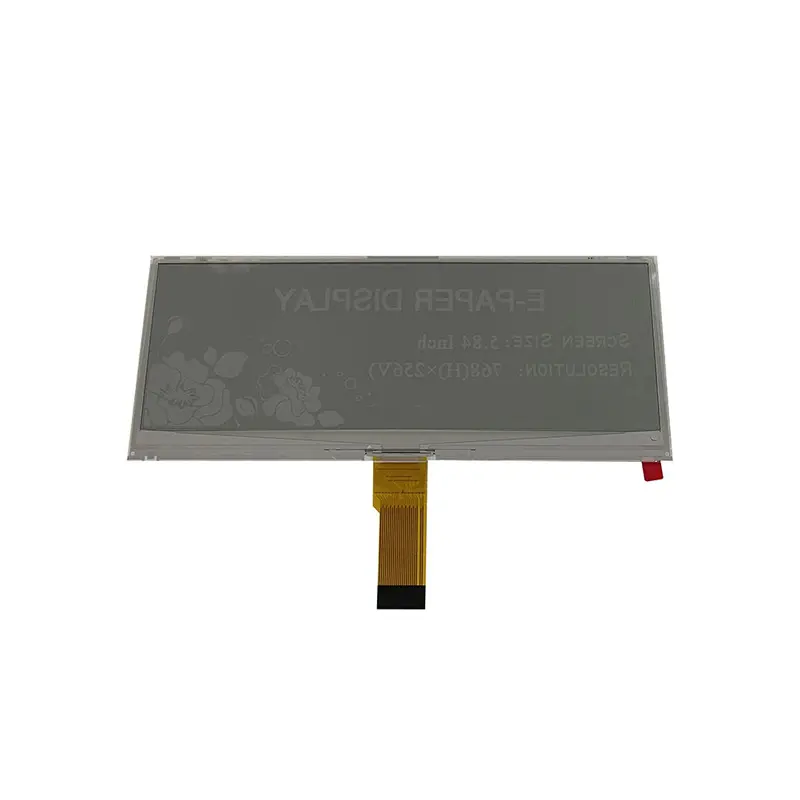
5.84 Inch Supermarket Shelf Label E-Paper Module for ESL Systems
Model P/N
Size
Resolution
Brightness
Viewing Angle
Connector Type
Operating Temp
Overall(mm)
huisoar
HS058AA01A-V1
Brand
Panel Size (inch)
Model P/N
Resolution
Brightness (nits)
Viewing Angle
Response Time
Overall (mm)
Active Area (mm)
Refresh Rate
Display Colors
Panel Type
Connector Type
Operating Temp
Touchscreen Type
Storage Temp
Work Mode
Input Voltage (V)
Designed For
5.84 Inch Supermarket Shelf Label E-Paper Module for ESL Systems
This long-strip reflective panel provides a 768 × 256 canvas, SPI host options and a 140.70 × 46.90 mm active area for retail-label integration.
Product Summary
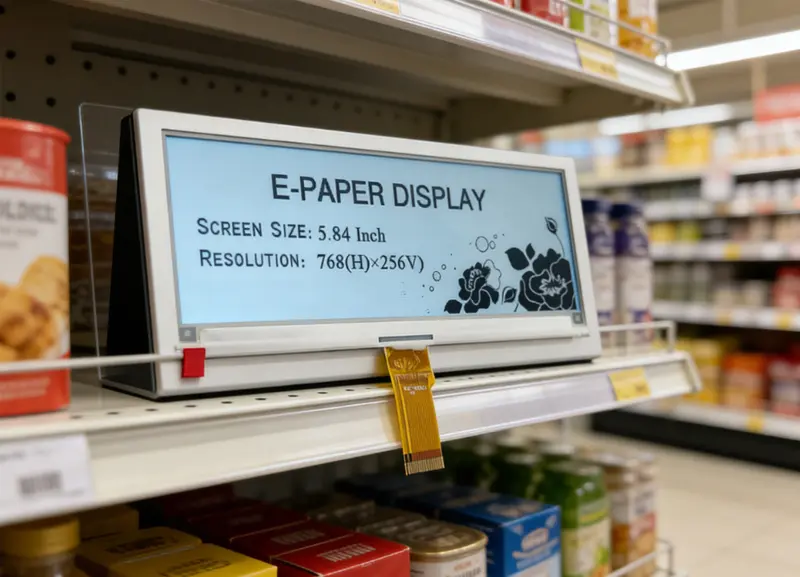
The Supermarket Shelf Label E-Paper Module is a 5.84-inch display component for retail systems that need a wide, shallow canvas for prices, product names, promotional messages and shelf-location information.
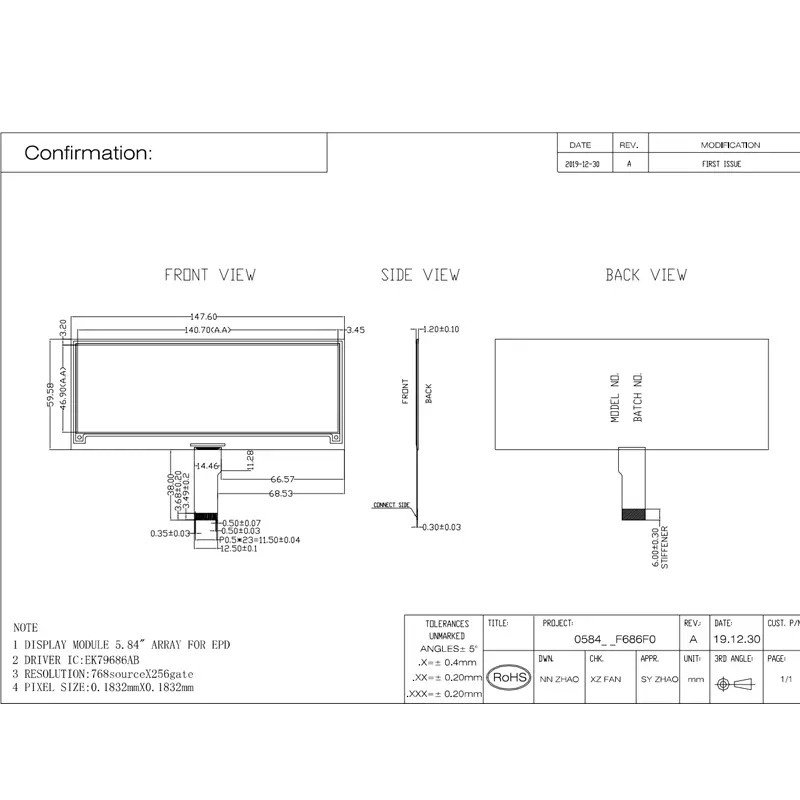
Its 768 × 256 pixel matrix forms a 3:1 landscape interface. The active image area measures 140.70 × 46.90 mm within a 147.60 × 59.58 × 1.20 mm panel outline, allowing the module to fit into elongated shelf-label housings.
This product is the display layer rather than a complete electronic shelf label. The finished system still requires a host controller, power architecture, communications path, enclosure and application software.
Key Specifications
| Specification | Value |
|---|---|
| Display size | 5.84 inches |
| Resolution | 768 × 256 pixels |
| Display technology | Active-matrix electrophoretic display |
| Active area | 140.70 × 46.90 mm |
| Panel outline | 147.60 × 59.58 × 1.20 mm |
| Pixel pitch | 0.1832 × 0.1832 mm |
| Interface | 3-wire SPI or 4-wire SPI |
| FPC | 24 contacts, 0.50 mm pitch |
| Driver identifier | EK79686AB |
| Color version | Confirm black/white or black/white/red requirement |
| Touch | No touch confirmed |
| Backlight | None |
A 5.84-inch E-paper panel is a display component rather than a complete wireless electronic shelf label.
Planning a 768 × 256 Retail Label Layout
Use the Long-Strip Canvas Efficiently
The 3:1 image format works well for horizontally arranged retail information. A practical layout may reserve separate zones for:
- product name
- current price
- unit price
- previous price
- promotion message
- barcode or QR code
- SKU
- shelf location
- stock status
- small brand mark
The most important price field should receive the largest type size. Secondary details should be grouped so that the layout remains readable from the intended shopper distance.
Artwork should be rendered at the native 768 × 256 pixel resolution before approval. Scaling content from an unrelated aspect ratio can create uneven text, misplaced borders or inefficient blank areas.
Prepare Artwork for the Confirmed Color Version
The exact manufacturer record supports black, white and red capability, while one listing table describes monochrome white. The production version must therefore be confirmed before artwork and firmware are frozen.
For a black/white/red version, red can be reserved for:
- sale prices
- promotion flags
- warnings
- limited-stock messages
- loyalty-program highlights
Do not assume that every sample or production batch uses the same pigment configuration. The approved part number, color definition and waveform package should be controlled together.
Reflective E-Paper Behavior and Refresh Boundaries
Separate Image Retention from System Power Claims
Electrophoretic displays are reflective and bistable. They are commonly selected for information that changes periodically rather than continuously. Similar modules are described as maintaining an image without continuous display power and using energy mainly during updates.
That behavior does not establish the battery life of a finished shelf label. System endurance also depends on:
- update frequency
- radio activity
- MCU sleep current
- regulator efficiency
- temperature sensing
- battery chemistry
- communication retries
- LED indicators
- firmware behavior
No months-or-years battery claim should be published without a complete system power budget.
Confirm Waveform and Temperature Resources
Electronic-paper refresh behavior depends on the controller, waveform or lookup-table resources and temperature conditions. Manufacturer material for the exact product family mentions waveform storage and temperature-related resources, but the exact firmware package and refresh grade must be confirmed for the ordered version.
Before firmware release, obtain:
- approved driver documentation
- initialization sequence
- waveform/LUT package
- supported color version
- full-refresh requirements
- partial-refresh support, when required
- BUSY behavior
- reset timing
- temperature-compensation method
- sleep and wake procedure
The exact color version, waveform resources and refresh behavior must be confirmed before firmware release.
SPI and 24-Pin FPC Integration
Select 3-Wire or 4-Wire SPI
The commercial specification lists both 3-wire and 4-wire SPI. These options must not be treated as interchangeable without reviewing the exact signal definition.
A typical SPI-controlled E-paper design may use:
- serial clock
- serial data
- chip select
- data/command selection
- reset
- busy/status
- power and ground
- panel-specific control or supply connections
The exact division between serial data and data/command signaling differs between interface modes.
A 3-wire or 4-wire SPI description does not establish voltage, timing or pin compatibility.
Verify Every FPC Signal
The drawing indicates a 0.50 mm contact pitch with 23 intervals across an 11.50 mm contact field, corresponding to 24 contacts. This mechanical information does not define the electrical signals.
Before PCB layout, confirm:
- full 24-pin assignment
- contact side
- connector orientation
- supply rails
- logic-voltage levels
- SPI mode
- maximum serial clock
- reset and BUSY polarity
- panel power sequencing
- discharge requirements
- unused-pin treatment
- FPC insertion direction
- connector part number
Do not substitute another 24-pin E-paper panel solely because the pitch and contact count are similar.
Supermarket Shelf Label E-Paper Module Mechanical Fit
Use the Drawing-Controlled Outline
Use these controlled dimensions for enclosure planning:
- active area: 140.70 × 46.90 mm
- panel outline: 147.60 × 59.58 mm
- total thickness: 1.20 ± 0.10 mm
- FPC width: 12.50 ± 0.10 mm
- contact pitch: 0.50 mm
- stiffener length: 6.00 ± 0.30 mm
The visible opening should be planned around the active area while allowing for:
- border masking
- panel tolerance
- adhesive placement
- enclosure support
- FPC exit
- connector clearance
- assembly tooling
- front-window tolerance
Protect the Thin Panel and FPC Exit
A 1.20 mm panel is not a finished structural assembly. The enclosure should avoid concentrated pressure, twisting and unsupported bending.
Mechanical review should consider:
- flat backing support
- edge clearance
- adhesive thickness
- FPC bend radius
- connector strain relief
- battery and PCB interference
- front-window pressure
- assembly sequence
- service or replacement access
The housing design should support the panel without clamping the active area.
Suitable Retail and Logistics Applications
Supermarket shelf labels
The long format can present product names, current prices, unit pricing and promotions within a compact shelf-edge housing.
Electronic price cards
The 768 × 256 canvas can support larger prices alongside smaller SKU, barcode and product-description fields.
Promotional shelf cards
A confirmed red-capable version may be considered for sale flags and promotional emphasis.
Convenience-store labels
The panel may support centrally managed price and product information when integrated into a complete wireless or wired label system.
Warehouse bin labels
The reflective display can present bin IDs, part numbers, picking information and status data that change periodically.
Reusable logistics labels
The module may be evaluated for low-update-rate container or routing information, subject to enclosure, interface and environmental qualification.
Customization and Version Control
Project review may cover:
- black/white or black/white/red version
- FPC definition
- connector orientation
- controller or adapter board
- enclosure geometry
- front window
- protective cover
- artwork
- branding
- packaging
- communication-system integration
Custom logo, packaging and graphic options are generally reviewed from 1,000 pieces. Samples and standard-module quantities are confirmed separately.
Any change to the panel color system, driver, FPC or waveform package should be treated as a controlled engineering revision.
Procurement Checklist
Submit:
- required display colors
- native 768 × 256 artwork
- 3-wire or 4-wire SPI choice
- complete 24-pin assignment
- host MCU or controller
- logic and panel voltages
- SPI timing requirement
- waveform/LUT resources
- reset and BUSY handling
- temperature-compensation plan
- refresh-frequency target
- FPC orientation
- connector choice
- enclosure drawing
- visible opening
- front-window construction
- sample quantity
- annual demand
- production schedule
FAQ
About 5.84 Inch Supermarket Shelf Label E-Paper Module
What must be checked before connecting the 24-pin FPC?
How does this panel differ from a complete electronic shelf label?
When should 3-wire SPI be selected instead of 4-wire SPI?
How should the black/white/red version be qualified?
What information is required to validate refresh behavior?
Which dimensions control the shelf-label housing?
Freya Yang
+86 18318948097