Freya Yang
+86 18318948097
+852 62667476
5.1 Inch Flexible AMOLED Touch Screen for HMD Devices


Model P/N
Size
Resolution
Brightness
Viewing Angle
Connector Type
Operating Temp
Overall(mm)
huisoar
HS051FI-AMOLED
Brand
Panel Size (inch)
Model P/N
Resolution
Brightness (nits)
Viewing Angle
Contrast Ratio
Response Time
Overall (mm)
Active Area (mm)
Refresh Rate
Display Colors
Panel Type
Connector Type
Operating Temp
Touchscreen Type
Storage Temp
Work Mode
Input Voltage (V)
Control Type
Operating Environment
Motherboard Type
I/O Interface
Designed For
5.1 Inch Flexible AMOLED Touch Screen for HMD Devices
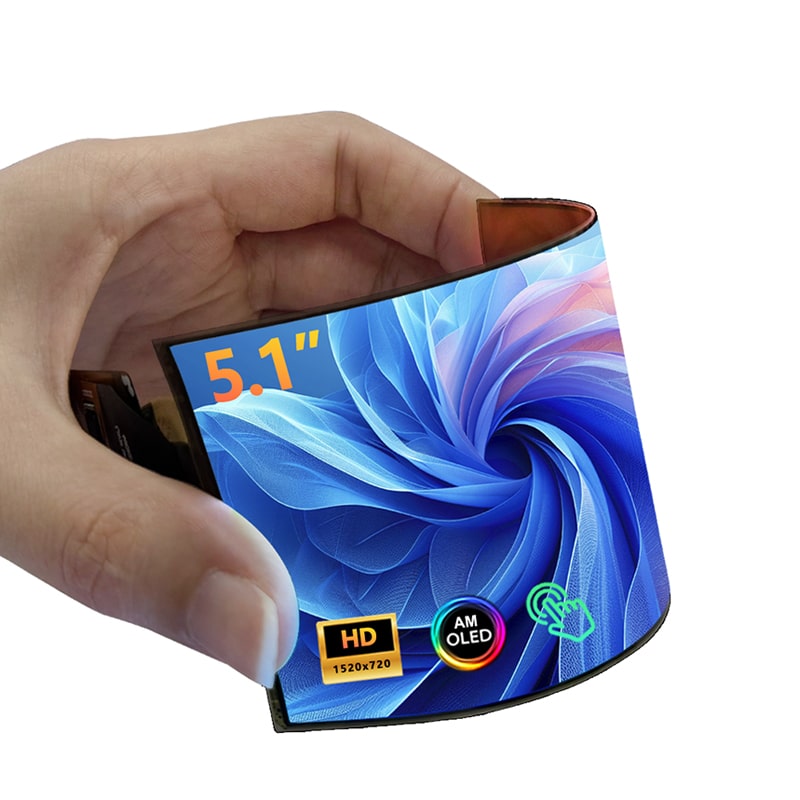
A Flexible AMOLED Touch Screen for HMD Devices gives engineering teams a compact display path when the product needs a curved visual surface, integrated touch, and a modern serial interface. This 5.1-inch module combines flexible self-emissive AMOLED construction, a 1520 × 720 pixel matrix, On-Cell capacitive touch, 390 cd/m² typical luminance, and four-lane MIPI-DSI. Its 1.38 mm stated thickness supports space-conscious prototypes, while the 55.404 × 116.964 mm active area provides a tall visual window for immersive or compact interfaces.
Key Specifications at a Glance
| Specification | Value |
|---|---|
| Display size | 5.1 inches |
| Display technology | Flexible AMOLED / OLED, self-emissive |
| Resolution | 1520 × 720 pixels; orientation convention requires host confirmation |
| Luminance | 390 cd/m² typical |
| Contrast ratio | 30,000:1 |
| Display colors | 16.7M stated |
| Refresh rate | 60 Hz |
| Touch | On-Cell capacitive touch |
| Display interface | MIPI-DSI, 4 lanes |
| Connector | 40-pin |
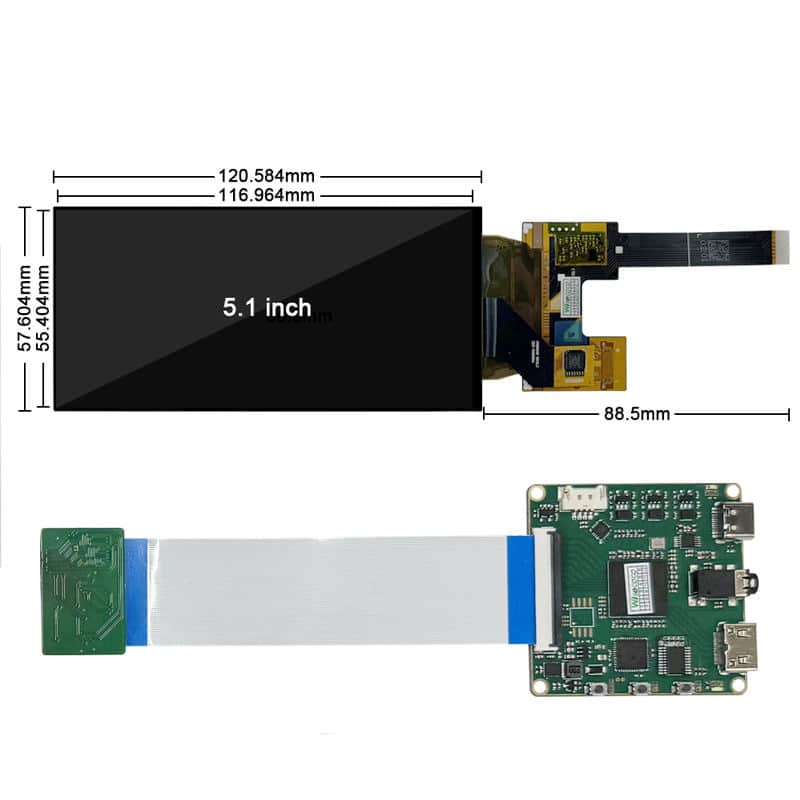
| Active area | 55.404 × 116.964 mm |
| Module outline | 57.604 × 120.564 × 1.38 mm |
| Operating temperature | −20°C to +70°C |
| Storage temperature | −40°C to +80°C |
| Intended direction | HMD, AR/VR and curved smart-device development |
Flexible AMOLED Construction for Curved Products
Thin self-emissive structure
AMOLED pixels generate their own light, so the display does not require a separate LCD backlight assembly. The 57.604 × 120.564 × 1.38 mm module envelope is useful where the display must share limited space with processors, sensors, batteries, optics, and FPC routing.
Flexibility still needs a mechanical limit
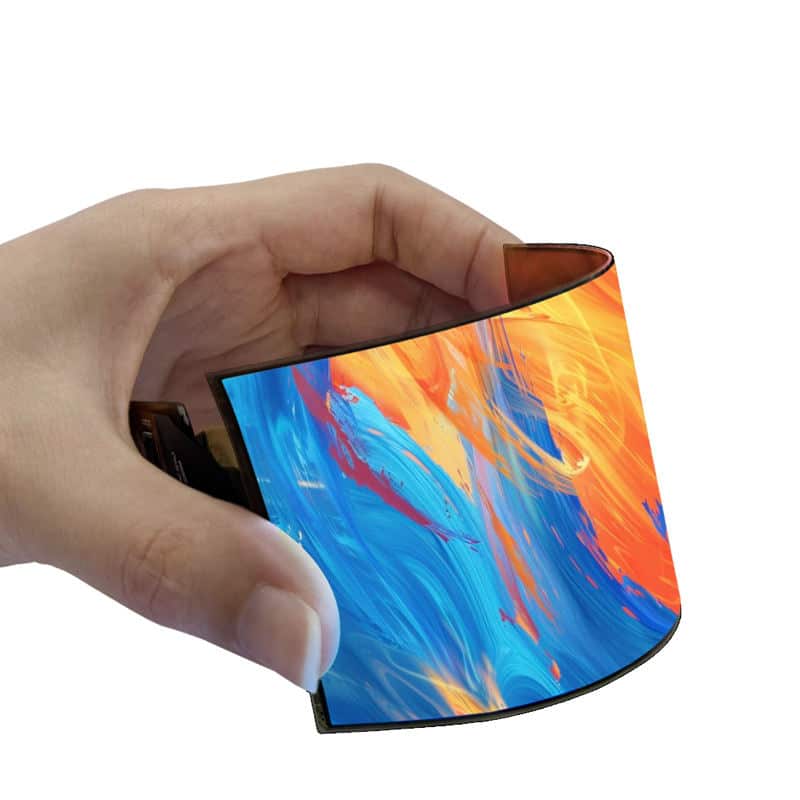
The product data confirms a bendable structure but does not define a minimum bend radius, static-versus-dynamic bending limit, or qualified bend-cycle life.
Flexible construction does not establish a minimum bend radius or bend-cycle life.
Before tooling, define the intended curvature, whether the module is fixed after assembly or repeatedly flexed, FPC exit direction, cover-window structure, and stress limits around bonded regions.
Image Quality for HMD and Smart Interfaces
1520 × 720 UI workspace
The pixel matrix is presented as 1520 × 720, while the same matrix may also be described as 720 × 1520 by orientation. The host graphics pipeline, boot image, touch coordinate map, and mechanical orientation should therefore follow the approved timing documentation.
Contrast and controlled-light luminance
The module combines 30,000:1 contrast with 390 cd/m² typical luminance and 16.7M stated colors. The luminance should be evaluated through the final cover and optical stack.
The 390 cd/m² typical panel luminance does not establish sunlight readability.
Integrating the Flexible AMOLED Touch Screen for HMD Devices
Four-lane MIPI-DSI host qualification
The native display path uses four-lane MIPI-DSI through a 40-pin connection. Matching the interface name and connector count is not enough; the host still needs the correct lane configuration, timing, operating mode, pin assignment, connector orientation, voltage rails, and initialization package.
A 40-pin four-lane MIPI-DSI label does not guarantee host compatibility without verified timing, pinout, lane configuration, power rails, and operating mode.
Multi-rail power requires exact mapping
The product data presents typical values of 1.8 V, 3.0 V, 4.6 V, 6.8 V and −2.4 V, but the available notation is not complete enough to lock each value to a named AMOLED rail.
Do not derive a power sequence from the numeric list alone. The production datasheet should control rail mapping, sequencing, tolerances and current requirements.
On-Cell Touch Integration
Integrated touch does not define the communication bus
On-Cell capacitive touch helps keep the front module thin, but it does not by itself identify the touch-controller IC, communication bus, firmware package, or host pin assignment.
On-Cell touch confirms integrated capacitive touch construction, but it does not by itself identify the touch controller or communication interface.
Confirm the touch controller, I/O voltage, touch bus, interrupt/reset requirements, coordinate orientation, cover-window design, and bonding requirement before hardware release.
Curved touch needs sample validation
Curvature, cover material, adhesive thickness, grounding, and edge support can affect touch behavior. Test the selected mechanical stack on samples before the cover window and enclosure are frozen.
Mechanical Planning and Evaluation Hardware
Active area versus module envelope
The active image area is 55.404 × 116.964 mm, while the module outline is 57.604 × 120.564 × 1.38 mm. One illustrated dimension differs slightly from the parameter table on the long side, so final tooling should follow the approved mechanical drawing.
Controller-board ports are not native panel ports
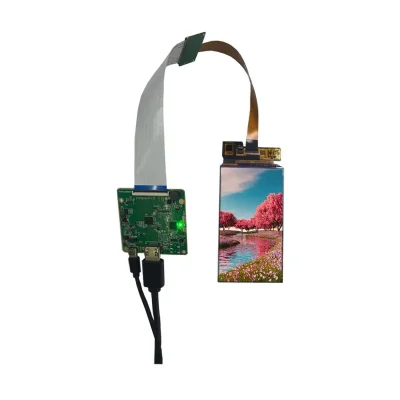
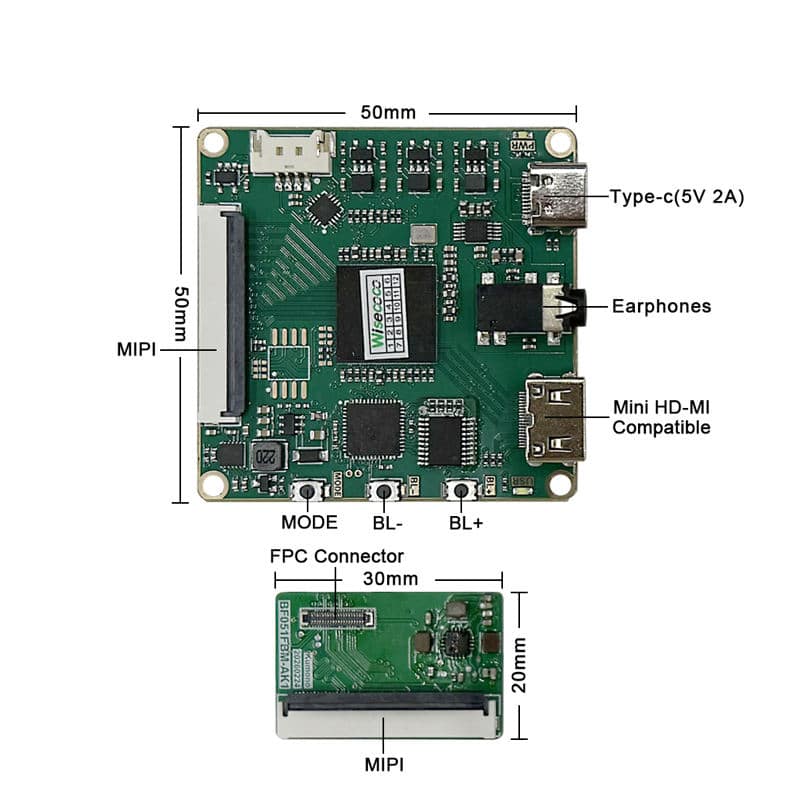
Evaluation imagery shows controller hardware with Type-C, audio and Mini HDMI-compatible connections. Those ports belong to the controller or bridge board rather than to the AMOLED panel.
HDMI or Type-C ports on an evaluation board do not redefine the panel's native MIPI-DSI interface.
Environmental and Application Boundaries
The operating range is −20°C to +70°C, with storage at −40°C to +80°C. These values do not establish waterproofing, outdoor certification, automotive qualification, medical certification, or unlimited flex reliability.
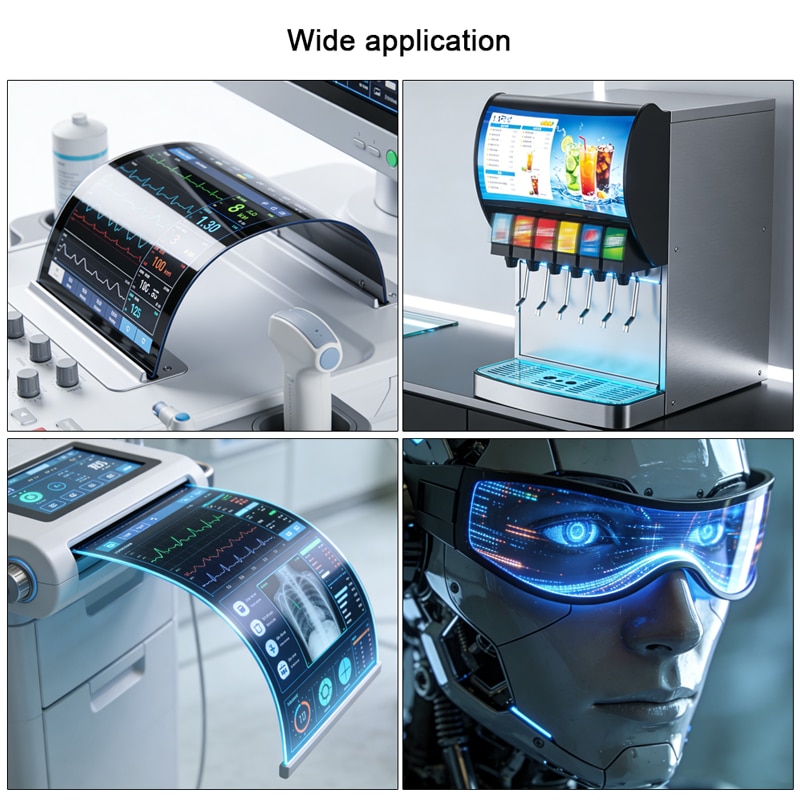
The Flexible AMOLED Touch Screen for HMD Devices is most relevant to HMD and AR/VR concepts, curved smart interfaces, robotic interaction panels, compact embedded UI devices, and portable display prototypes where flexible mechanics and integrated touch create useful design freedom.
Customization and Procurement Planning
Project-specific work may include FPC routing, cover-window geometry, controller-board selection, touch details, curvature support, enclosure adaptation, branding, and packaging.
Custom configurations are generally reviewed from 500 pieces, subject to tooling requirements, material availability, and the requested specification. Sample and standard-module quantities are confirmed separately.
Procurement Checklist
Before sample approval, confirm the production revision, 1520 × 720 versus 720 × 1520 orientation convention, 60 Hz timing, four-lane MIPI-DSI mode, complete 40-pin assignment, mating connector, FPC orientation, initialization package, exact power-rail mapping, 390 cd/m² luminance target, 30,000:1 contrast definition, 16.7M color statement, On-Cell touch controller and interface, 55.404 × 116.964 mm active area, 57.604 × 120.564 × 1.38 mm drawing, bend direction, minimum bend radius, bend-cycle target, cover-window stack, controller-board inclusion, operating environment, sample criteria, quantity, and annual demand.
FAQ
About 5.1 Inch Flexible AMOLED Touch Screen
What must be checked before connecting this panel to a MIPI host?
How should bend radius be qualified before enclosure tooling?
Does On-Cell touch mean the touch interface is carried over MIPI-DSI?
Which pixel orientation should the host use: 1520 × 720 or 720 × 1520?
Can the illustrated HDMI or Type-C board be treated as part of the standard module?
Freya Yang
+86 18318948097