Freya Yang
+86 18318948097
+852 62667476
2.13 Inch E Paper Display Module for Electronic Shelf Labels
Model P/N
Size
Resolution
Brightness
Viewing Angle
Connector Type
Operating Temp
Overall(mm)
huisoar
HS0213A03A
Brand
Panel Size (inch)
Model P/N
Resolution
Viewing Angle
Response Time
Overall (mm)
Active Area (mm)
Refresh Rate
Display Colors
Panel Type
Connector Type
Operating Temp
Touchscreen Type
Storage Temp
Work Mode
Pixel Format
Control Type
Operating Environment
Motherboard Type
Designed For
2.13 Inch E Paper Display Module for Electronic Shelf Labels
A compact reflective SPI panel for shelf-edge prices and low-update-rate smart labels.
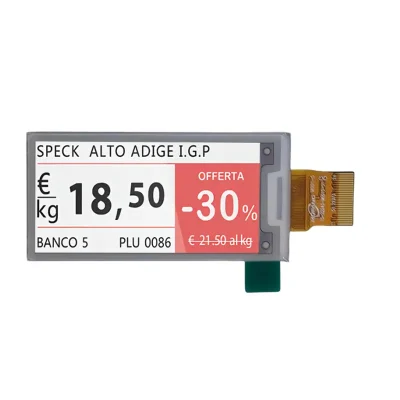
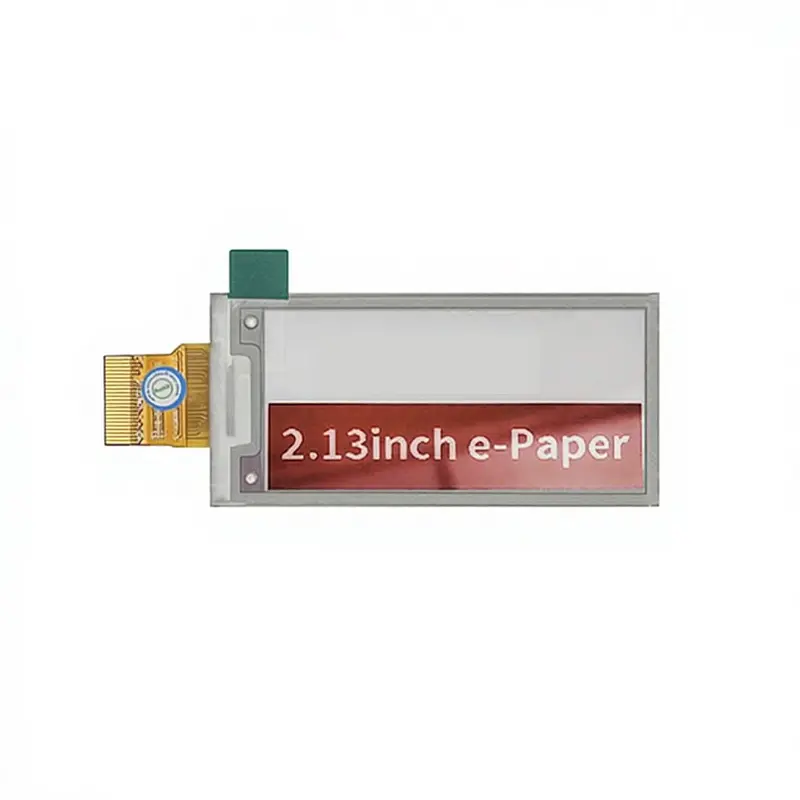
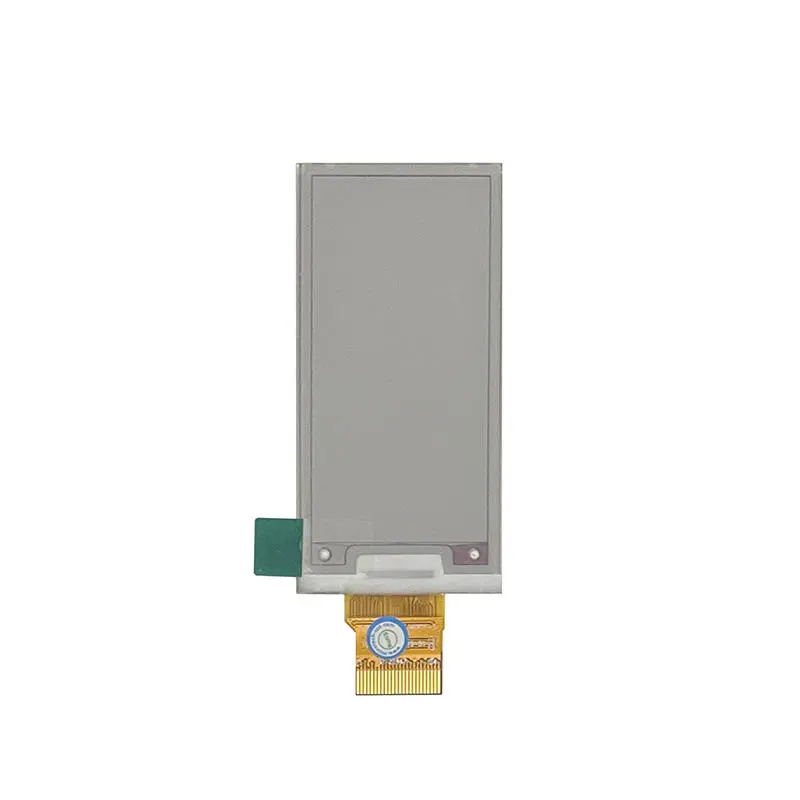
The 2.13 Inch E Paper Display Module is a compact reflective component for electronic shelf labels, smart retail tags, and other embedded indicators that update intermittently. Its 122×250 pixel format, 3-wire or 4-wire SPI options, 24-pin FPC, and 48.55 × 23.7046 mm active area support space-constrained label designs without implying a complete ESL system.
This is a bare display component, not a finished wireless shelf label with a battery, radio, enclosure, or retail-management platform.
Key Specifications at a Glance
| Parameter | Value |
|---|---|
| Diagonal size | 2.13 inch |
| Pixel format | 122 × 250 pixels |
| Display technology | Reflective electronic paper |
| Dot pitch | 0.1942 × 0.1943 mm |
| Active area | 48.55 × 23.7046 mm |
| TFT outline | 29.20 × 59.20 mm |
| Total thickness | 0.912 ± 0.10 mm excluding protective film and pull tape |
| Interface | 3-wire or 4-wire SPI |
| FPC | 24 pins |
| Driver IC | SEA330 |
| Operating temperature | 0°C to +40°C |
| Storage temperature | −25°C to +40°C |
| Touch | No touch confirmed |
The display-color version, electrical limits, update waveform, connector details, and refresh performance must be fixed in the approved module specification.
Product Overview
Electronic paper is reflective rather than emissive. It uses ambient light to present information and can retain a static image without continuous display power, which is one reason the technology is widely used for electronic shelf labels.
The module’s narrow rectangular active area is suited to pricing, product names, barcodes, identifiers, promotion text, and status symbols. Its suitability depends on the actual font size, graphic layout, color version, update behavior, and viewing distance.
122×250 content planning
The confirmed display format is 122×250 pixels. The separate 0.1942 × 0.1943 mm value is the dot pitch and must not be entered as the resolution.
UI assets should be prepared at the native pixel dimensions. Scaling, anti-aliasing, barcode rendering, QR-code density, and partial-update behavior require validation with the selected controller resources and waveform.
Reflective image retention
A static e-paper image can remain visible without continuous refresh power. Power is still required to update the image, operate the host controller, and run any wireless or sensing hardware in the completed label.
Color-version qualification
Available evidence is inconsistent: one parameter table describes a monochrome version, while the mechanical drawing identifies black, white, and red. The required display-color configuration must be confirmed before samples or artwork are approved.
Electronic Shelf Label Integration
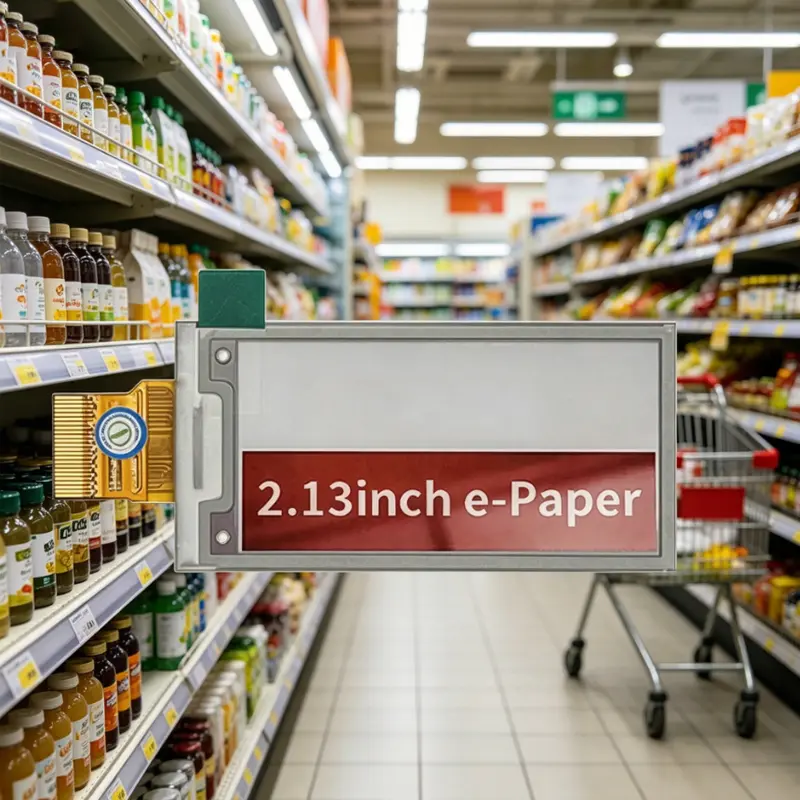
The 2.13 Inch E Paper Display Module can form the visual element of a shelf-edge label, but a complete ESL also requires a host controller, power architecture, communication system, housing, attachment method, software, and network-management workflow.
The module alone does not provide wireless price updates.
Shelf-edge information layout
A 122×250 canvas can be considered for:
- Product names and short descriptions
- Unit and promotional prices
- Product identifiers
- One-dimensional barcodes
- Appropriately sized QR codes
- Inventory or replenishment status
- Basic promotional graphics
Actual readability depends on the selected font, pixel design, color version, physical orientation, and shopper viewing distance.
Retail-system boundary
The display does not establish Bluetooth, NFC, RFID, sub-GHz radio, infrared, Wi-Fi, or proprietary ESL-network compatibility. Those functions belong to the completed label electronics and software platform.
Low-update-rate use
Electronic paper is best matched to content that changes intermittently rather than continuously. Refresh time, partial-update support, ghosting behavior, waveform requirements, and usable update count are not confirmed for this configuration.
3-Wire and 4-Wire SPI Compatibility
The interface is described as supporting 3-wire or 4-wire SPI. The selected mode must match the host hardware, display pin assignment, chip-select behavior, data/command control, reset handling, busy indication, and required update waveform.
A generic SPI connector or software library does not guarantee compatibility with this panel.
24-pin FPC review
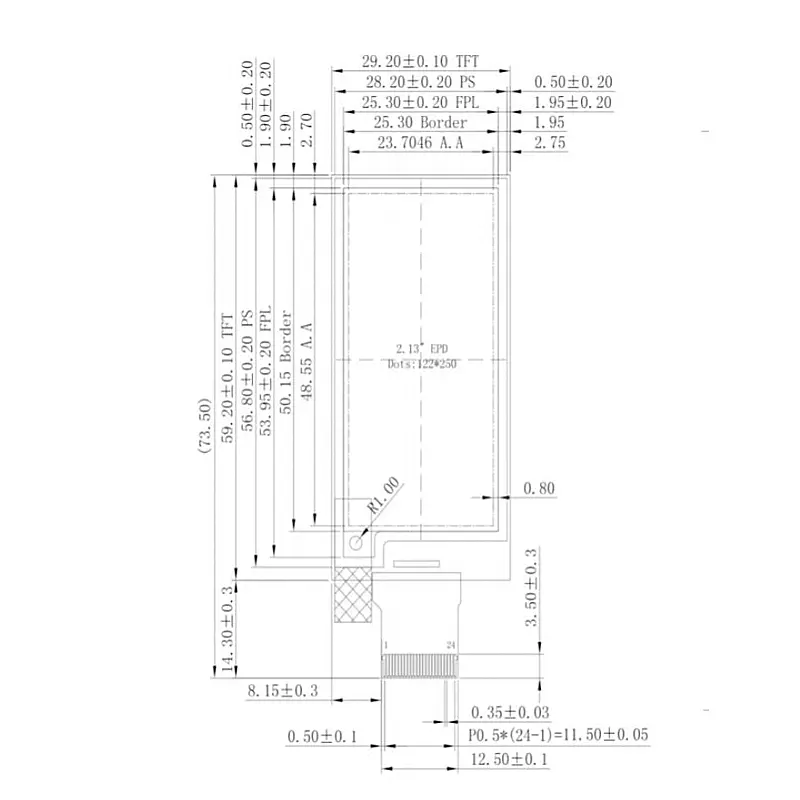
The drawing contains a 24-pin assignment including control and panel-driving connections. Before the host PCB or adapter is finalized, verify:
- Exact 24-pin sequence
- FPC pitch and contact orientation
- Supply and panel-driving voltage requirements
- Reset and busy-signal behavior
- Chip-select and serial-clock requirements
- Data/command signaling
- Ground and unused-pin treatment
- Connector insertion and cable direction
SEA330 driver boundary
SEA330 is identified as the driver IC. Its presence alone does not establish a universal host initialization sequence, register set, waveform table, voltage-generation method, or power sequence.
The complete electrical and timing specification must control the host implementation.
Controller-board requirement
A microcontroller or display-control board must create the required SPI transactions and update sequence. HDMI, MIPI DSI, LVDS, eDP, USB video, and parallel RGB sources cannot drive this raw module directly without suitable conversion and control hardware.
Mechanical Integration of the 2.13 Inch E Paper Display Module
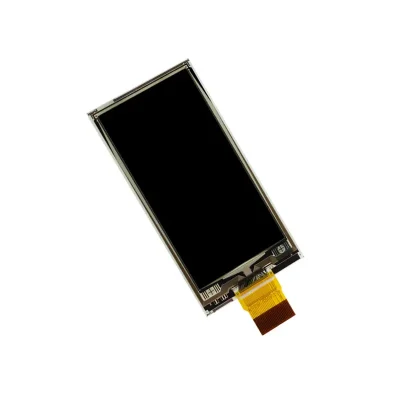
The active area measures 48.55 × 23.7046 mm. The drawing gives a TFT outline of approximately 29.20 × 59.20 mm and a total thickness of 0.912 ± 0.10 mm when the protective film and pull tape are excluded.
Orientation and enclosure opening
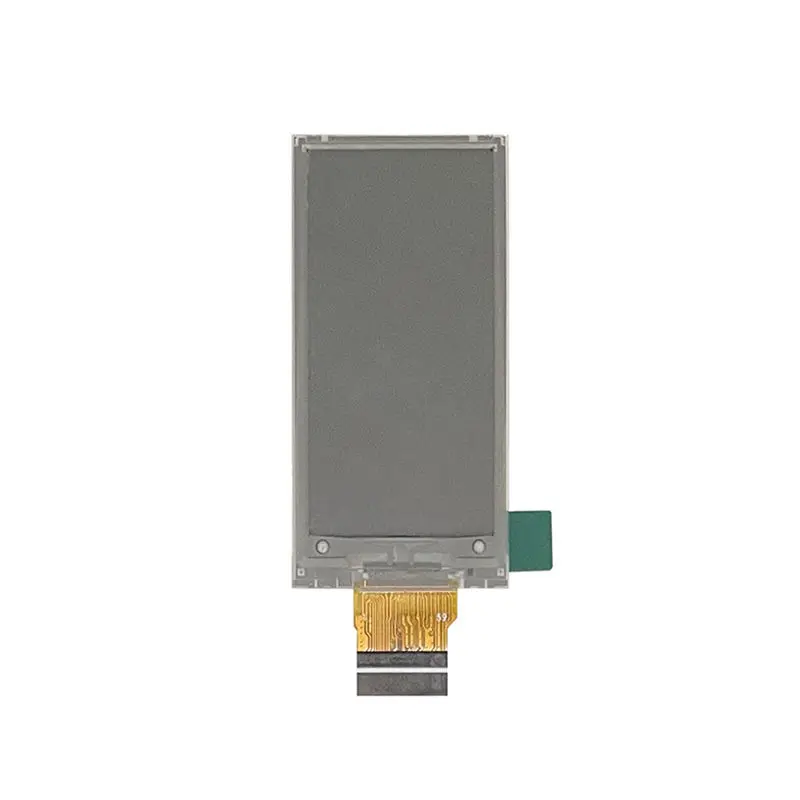
The dimensional pair is presented in different orientations across the available material. The final enclosure window, label orientation, and artwork direction should therefore follow the approved mechanical drawing rather than an assumed landscape or portrait convention.
FPC and component clearance
The enclosure must protect the display edge, glass or substrate structure, FPC exit, and rear component area. Avoid sharp cable folds, adhesive pressure on active areas, and interference with the pull tape or connector.
Protective front structure
No cover lens, protective window, impact rating, waterproofing, or abrasion grade is confirmed. Shelf labels exposed to carts, products, cleaning, or frequent handling may need a separately engineered front cover and enclosure.
Temperature and Environmental Boundaries
The confirmed operating range is 0°C to +40°C, with storage from −25°C to +40°C. These limits do not establish suitability for refrigerated shelves, freezer cabinets, hot outdoor installations, or direct exposure to moisture.
The 2.13 Inch E Paper Display Module should be evaluated with the final battery, host electronics, adhesive, housing, and update waveform across the required temperature range.
No operating-humidity range, UV resistance, ingress-protection rating, vibration grade, or condensation tolerance is confirmed.
Recommended Applications
Suitable project directions include:
- Supermarket electronic shelf labels
- Smart retail price tags
- Product-identification labels
- Inventory and replenishment indicators
- Reusable logistics labels
- Compact IoT status displays
- Low-update-rate equipment labels
- Room, bin, or asset information tags
Wearables and outdoor products require separate mechanical, environmental, update-speed, and power validation.
Customization and Procurement Scope
Logo, packaging, and graphic customization are generally reviewed from 1,000 pieces, subject to tooling requirements, material availability, and the requested specification. Sample and standard-module quantities are confirmed separately.
Project-specific review may also cover FPC orientation, connector matching, display-color version, waveform resources, front protection, housing integration, and artwork layout. None of these options should be treated as standard until included in the approved specification and sample.
Procurement and Sample Approval Checklist
Confirm these items before sample approval:
Controller-board requirement
Required black/white or black/white/red version
Native 122×250 content layout
3-wire or 4-wire SPI mode
Complete 24-pin assignment
Host voltage and timing requirements
FPC pitch, contact side, and orientation
SEA330-related module specification
Full and partial refresh requirements
Active-area and outline orientation
Operating and storage temperature
Front protection and enclosure drawing
Sample quantity
Estimated annual demand
Production schedule
FAQ
about 2.13 Inch E Paper Display Module
Is this a complete electronic shelf label?
Does it support both 3-wire and 4-wire SPI?
Does the image remain visible without continuous power?
Is this a monochrome or three-color panel?
Can it connect directly to HDMI, USB, or MIPI DSI?
Freya Yang
+86 18318948097