Freya Yang
+86 18318948097
+852 62667476
2.13 Inch Retail Price Tag E Paper Display with SPI Interface
Model P/N
Size
Resolution
Brightness
Viewing Angle
Connector Type
Operating Temp
Overall(mm)
huisoar
HS02132-M001F-H
Brand
Panel Size (inch)
Model P/N
Resolution
Brightness (nits)
Viewing Angle
Response Time
Overall (mm)
Active Area (mm)
Refresh Rate
Display Colors
Panel Type
Connector Type
Operating Temp
Touchscreen Type
Storage Temp
Work Mode
Pixel Format
Operating Environment
Designed For
2.13 Inch Retail Price Tag E Paper Display with SPI Interface
Its black, white and red 122 × 250 panel uses a 24-pin SPI connection and a 0.92 mm profile for compact shelf-label assemblies.
Product Summary
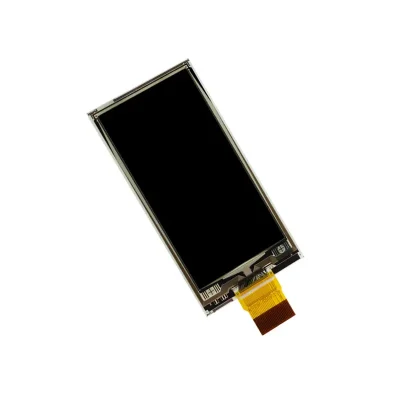
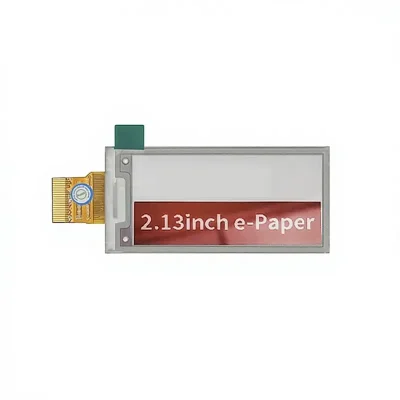
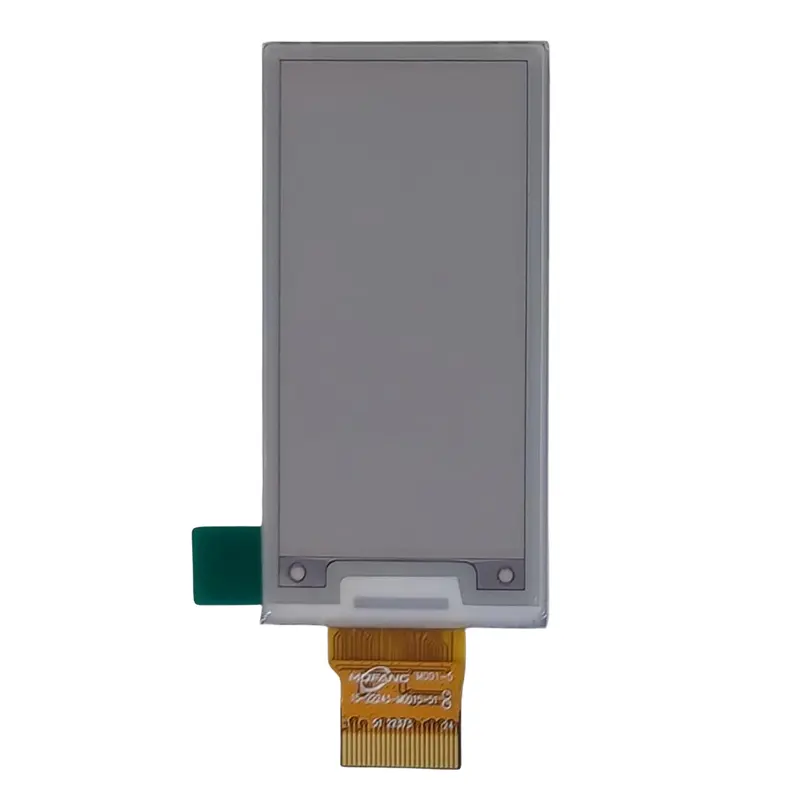
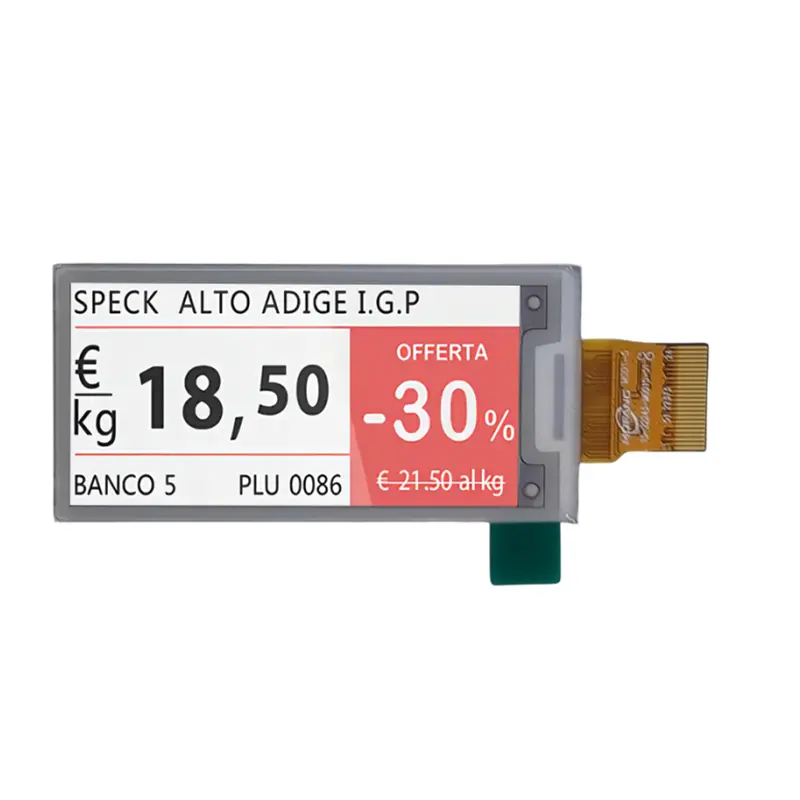
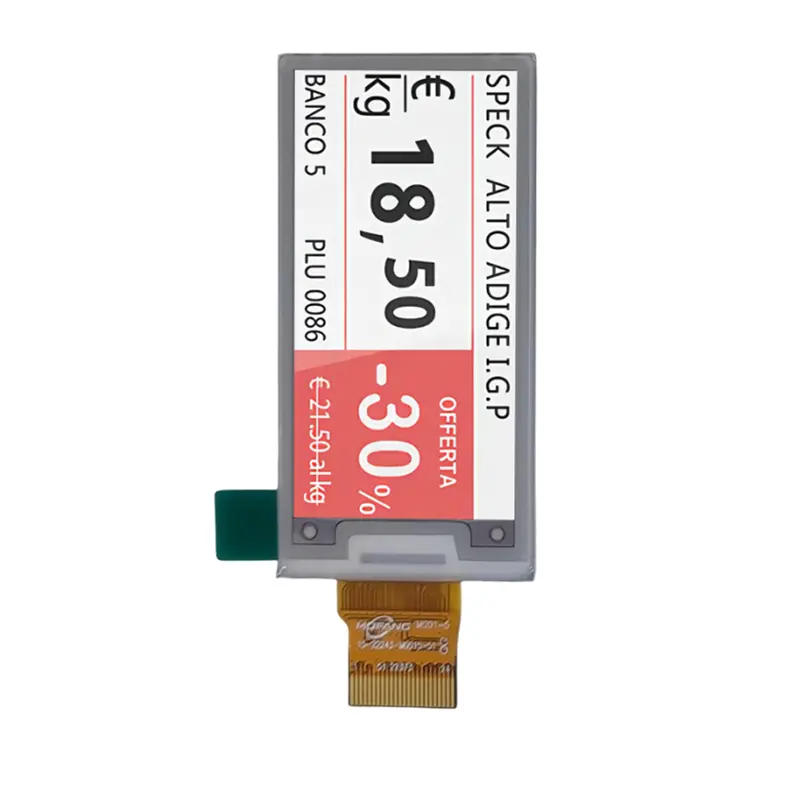
The Retail Price Tag E Paper Display is a 2.13-inch electronic-paper component for shelf labels and other low-update retail information products. Its portrait 122 × 250 raster supports prices, product names, barcodes, stock indicators and promotional accents within a compact label area.
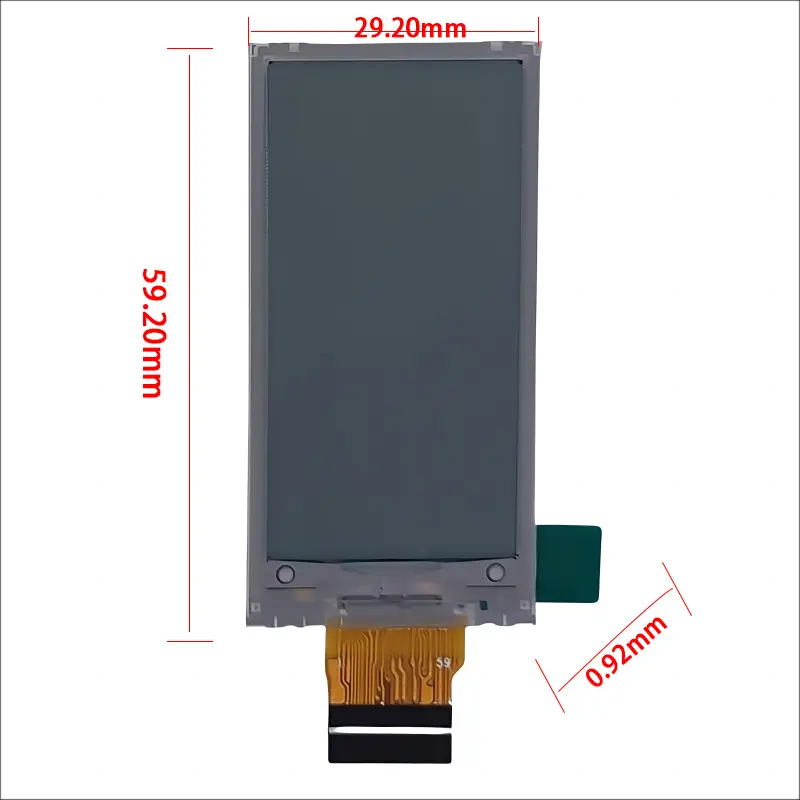
The panel provides black, white and red output through an MCU/SPI interface and a 24-pin FPC. It has a 23.70 × 48.55 mm visible area and a 29.20 × 59.20 × 0.92 mm outline. The standard configuration has no backlight and no touch panel.
Key Specifications
| Parameter | Confirmed value |
|---|---|
| Display size | 2.13 inches |
| Resolution | 122 × 250 pixels |
| Display colors | Black, white and red |
| Interface | MCU/SPI |
| FPC | 24 pins |
| Visible area | 23.70 × 48.55 mm |
| Module outline | 29.20 × 59.20 × 0.92 mm |
| Pixel pitch | 0.194 × 0.194 mm |
| Viewing | Listed 180° wide view |
| Backlight | None |
| Touch panel | None |
| Operating temperature | 0°C to +40°C |
| Storage temperature | −25°C to +60°C |
Black, White and Red Shelf-Label Artwork
Prepare the Native 122 × 250 Canvas
Create label artwork at the native 122 × 250 pixel resolution and confirm the installed orientation before releasing graphics. A portrait layout can reserve a large central price field, a smaller product-name zone and separate areas for unit pricing, promotion text or inventory status.
Small fonts, thin rules and barcodes should be validated on a physical sample. Final legibility depends on font weight, front-window reflections and the shopper’s viewing distance.
Use Red as a Controlled Accent Color
Treat red as a third display color rather than a continuous-tone graphic channel. It is well suited to promotional fields, discount marks and alert icons, while black should carry most text and barcode information.
Prepare artwork with explicit black, white and red layers and confirm the accepted bitmap or conversion workflow. Do not assume that artwork prepared for another 2.13-inch panel will produce identical results.
Retail Price Tag E Paper Display SPI Integration
Confirm the 24-Pin FPC Definition
The interface is identified as MCU/SPI with 24 pins, but the complete pin assignment, connector pitch, contact side, logic levels and timing are not defined. A matching pin count does not establish compatibility with another panel.
Before PCB release, confirm the SPI mode, clock limit, chip-select behavior, data/command control, reset, busy indication, supply requirements and generated drive voltages. The FPC drawing should also identify pin-one orientation and the permitted bend area.
Separate the Bare Panel from the ESL System
This item is a display component rather than a complete wireless electronic shelf label. A finished ESL also requires a controller, power subsystem, communications hardware, enclosure, front window and software for receiving and rendering pricing data.
Define whether the procurement scope is the raw EPD panel, a panel-plus-controller assembly or a finished tag. That decision changes firmware, power, mechanical and production responsibilities.
Approve the Controller and Waveform Package
Electronic-paper refresh behavior depends on the controller and waveform package used for the exact color version. The driver IC, LUT or waveform package, refresh time, partial-refresh capability and sleep sequence are not confirmed.
Request the approved datasheet and software package for the ordered revision before selecting a controller or reusing code from another 122 × 250 panel.
Mechanical and Optical Qualification
Use the Confirmed Module Envelope
The panel outline is 29.20 × 59.20 × 0.92 mm, with a 23.70 × 48.55 mm visible area. The enclosure drawing should define the front opening, support surface, FPC exit and tolerance stack without stressing the glass edge or flex connection.
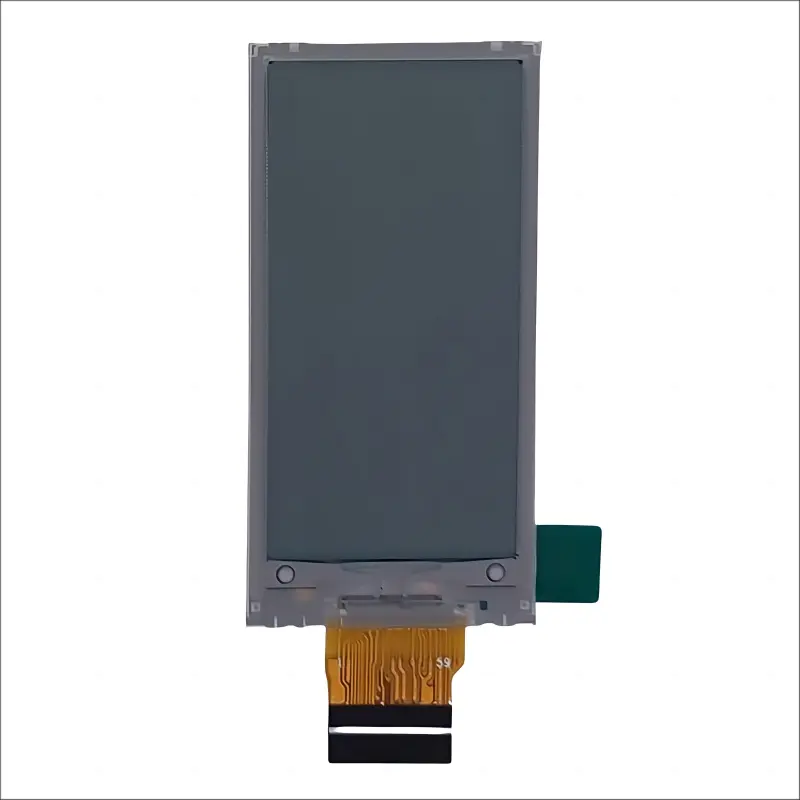
The product view shows the FPC exiting from the lower edge, so connector placement and bend clearance should be included in the first prototype.
Design for Ambient Light
The standard panel has no backlight. Its appearance depends on store lighting, front-window transmission, reflections and viewing geometry. The listed 180° wide-view statement should be validated in the intended housing rather than treated as a finished-system guarantee.
No front light, protective-glass grade or optical bonding is confirmed for the standard configuration.
Temperature and Refresh Boundaries
Apply the 0°C to +40°C Operating Range
The component operating range is 0°C to +40°C, and the storage range is −25°C to +60°C. These limits suit controlled commercial environments but do not establish freezer, refrigerated-case or outdoor operation.
Finished-product qualification should also include the controller, battery, adhesive, enclosure and front window.
Confirm Update Timing and Power Data
No refresh time, update-energy figure, sleep current or lifetime grade is confirmed. Battery-life calculations should use approved measurements from the selected controller, waveform, update frequency and wireless architecture.
Define the expected number of daily updates, full-screen refresh requirement, permitted flicker and recovery behavior after power interruption.
Applications and Selection Boundaries
The Retail Price Tag E Paper Display is suited to electronic shelf labels, promotional price cards, inventory tags, reusable logistics labels and compact low-update information panels after interface and environmental qualification.
It should not be presented as a complete wireless ESL, touch display, illuminated display or freezer-grade label. Projects requiring partial refresh, front lighting, touch or a broader temperature range need separate review.
Customization and Procurement
FPC orientation, connector definition, controller and waveform support, color version, front-window design, enclosure adaptation, artwork conversion, branding and packaging may be reviewed by project.
Custom configurations are generally reviewed from 500 pieces, subject to tooling requirements, material availability and the requested specification. Sample and standard-panel quantities are confirmed separately.
Procurement Checklist
Confirm the following before sample approval:
- Approved ordered revision and exact black, white and red color version
- Native 122 × 250 artwork and installed orientation
- Complete 24-pin assignment and FPC drawing
- SPI mode, timing, clock, reset and busy signals
- Logic supply and panel drive-voltage requirements
- Controller, LUT and waveform package
- Full-refresh and partial-refresh support
- Refresh time, update power and sleep-current data
- 23.70 × 48.55 mm visible area
- 29.20 × 59.20 × 0.92 mm mechanical fit
- Front-window material and ambient-light target
- 0°C to +40°C operating environment
- Sample criteria, order quantity and annual demand
FAQ
About 2.13 Inch Retail Price Tag E Paper Display
What must be checked before connecting the 24-pin SPI panel?
Is this panel a complete electronic shelf label?
How should black, white and red artwork be prepared?
Does the absence of a backlight guarantee visibility in every store?
Is partial refresh supported?
Freya Yang
+86 18318948097