Freya Yang
+86 18318948097
+852 62667476
43 Inch High Luminance Stretched Signage LCD Module for Transit
Model P/N
Size
Resolution
Brightness
Viewing Angle
Connector Type
Operating Temp
Overall(mm)
huisoar
HS430FBM-ND10
Brand
Panel Size (inch)
Model P/N
Resolution
Brightness (nits)
Viewing Angle
Contrast Ratio
Response Time
Overall (mm)
Active Area (mm)
Refresh Rate
Display Colors
Panel Type
Connector Type
Operating Temp
Touchscreen Type
Storage Temp
Work Mode
Control Type
Operating Environment
Designed For
43 Inch High Luminance Stretched Signage LCD Module for Transit
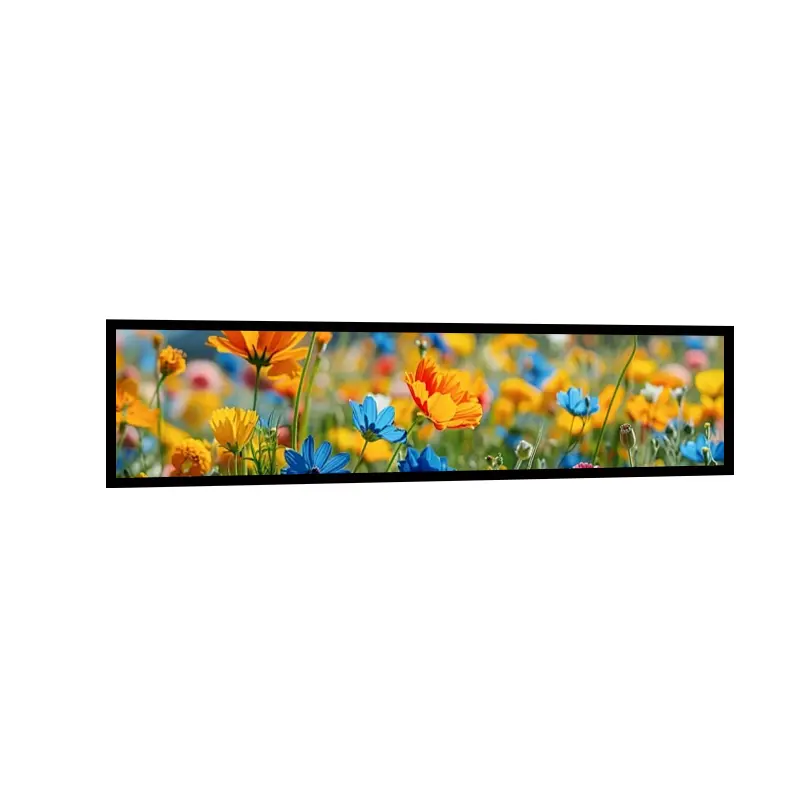
A High Luminance Stretched Signage LCD Module is designed for equipment that needs a long horizontal information area without the height of a conventional 16:9 screen. This 43-inch configuration combines a native 1920 × 360 canvas, 1000 cd/m² typical luminance, IPS viewing, a 51-pin LVDS signal interface and a non-touch architecture. Its 1073.78 × 201.336 mm active area is well suited to route information, departure messages, status bands and other passenger-information layouts where content must remain legible across a wide strip.
Product Summary
The 43-inch stretched format provides substantially more horizontal space than vertical space, making it useful for content such as station names, route sequences, departure times, service notices and scrolling information. The module uses an a-Si TFT-LCD structure with IPS technology and transmissive operation.
The optical specification combines 1000 cd/m² typical luminance with a 1200:1 typical contrast ratio. The viewing specification is 89°/89°/89°/89° typical for left, right, up and down at CR ≥10, supporting public-information layouts that may be viewed from several positions.
The standard configuration is non-touch. This keeps the display architecture focused on information output and allows the equipment designer to define the protective front, mounting structure and any separately engineered interaction system at finished-product level.
Key Specifications
| Parameter | Value |
|---|---|
| Screen size | 43 inches |
| Native resolution | 1920 × 360 pixels |
| Aspect ratio | Greater than 3:1 |
| Active area | 1073.78 × 201.336 mm |
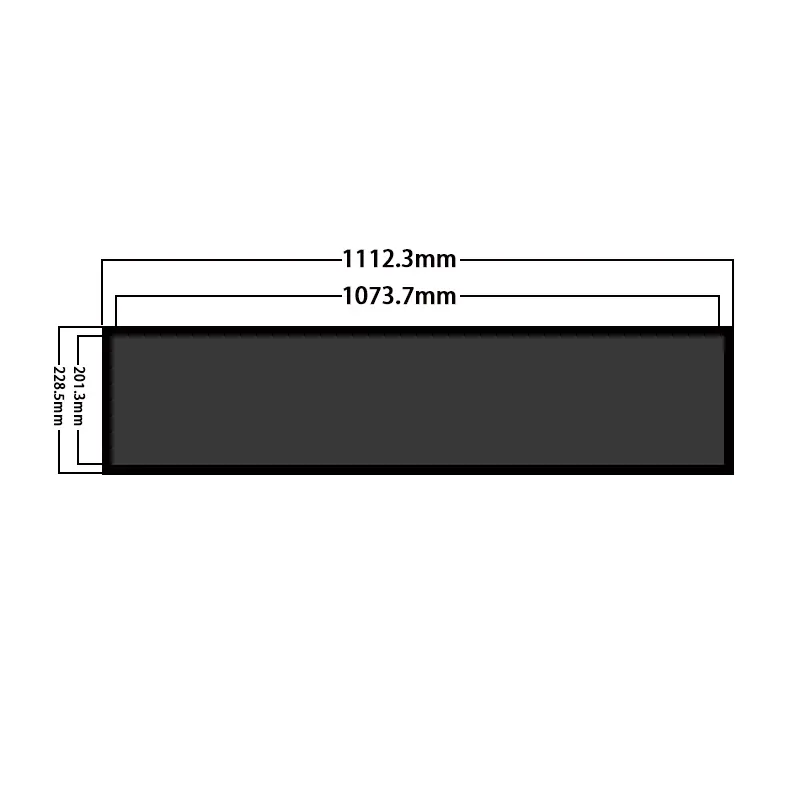
| Module outline | 1112.3 × 228.5 mm |
| Maximum thickness | 19.3 mm |
| Panel technology | a-Si TFT-LCD, IPS |
| Optical mode | Transmissive |
| Luminance | 1000 cd/m² typical |
| Contrast ratio | 1200:1 typical |
| Viewing angle | 89°/89°/89°/89° typical, L/R/U/D, CR ≥10 |
| Display colors | 16.7M colors |
| Signal interface | LVDS |
| Signal connection | 51 pins |
| Backlight type | WLED |
| Touch | Non-touch |
| Operating temperature | 0°C to +50°C |
| Storage temperature | −20°C to +60°C |
Bright-Ambient Optical Performance
Fixed 1000 cd/m² Luminance
The 1000 cd/m² typical output gives the panel a stronger optical baseline for stations, terminals and other high-ambient-light locations than a conventional low-luminance indoor module. It is particularly useful when route text, timetable information or warning messages need to remain visually distinct in brightly illuminated public spaces.
Finished-system readability still depends on the complete optical stack. Protective glass, reflection, screen angle and the distance between the LCD and front window can change perceived contrast. The 1000 cd/m² value should therefore be validated with the actual front structure and installation lighting before the finished equipment is approved for a specific outdoor or semi-outdoor environment.
IPS Viewing for Passenger Information
The IPS configuration supports wide-angle viewing, with 89° specified in each left, right, up and down direction. This matters for passenger-information hardware because viewers may approach the screen from different positions instead of standing directly in front of its centerline.
The 1200:1 typical contrast ratio and 16.7M-color capability provide a practical foundation for text, icons, route graphics and branded information. Content designers should still test font size, contrast and line density at the real viewing distance used in the installation.
51-Pin LVDS Integration
Host Timing and Pin Mapping Must Be Qualified
The display uses a 51-pin LVDS signal connection, but connector count alone does not establish controller compatibility. Before a controller board or cable is released, the project should confirm native 1920 × 360 timing, LVDS channel and bit mapping, complete pin assignment, connector orientation and required electrical levels.
A matching 51-pin connector does not guarantee timing, voltage, mapping or pin compatibility with another LCD module.
Using the approved interface drawing and electrical definition is essential when replacing an existing panel or adapting a new host platform.
WLED Backlight Requires Separate Electrical Confirmation
WLED is confirmed as the backlight type, but the available specification does not define backlight voltage, current, enable logic, dimming method or lifetime grade. Those values should be locked before the backlight driver and system power budget are finalized.
LVDS defines the image-data connection; it does not define the WLED electrical requirements.
High Luminance Stretched Signage LCD Module for Passenger Information
Native 1920 × 360 Content Planning
The 1920 × 360 raster should be treated as a purpose-built long-format canvas rather than as a cropped 16:9 screen. Route maps, destination names, platform messages, departure times and service alerts can be arranged horizontally without consuming unnecessary vertical space.
The native 1920 × 360 raster should be used for route and status layouts rather than scaling conventional 16:9 artwork.
For multilingual passenger information, the project should validate the longest station names and emergency messages at the target viewing distance before approving the final layout.
Mechanical Fit for Long Enclosures
The active area measures 1073.78 × 201.336 mm, while the module outline is 1112.3 × 228.5 mm with a maximum thickness of 19.3 mm. These dimensions serve different mechanical purposes: the active area defines the visible image region, while the outline and depth control enclosure fit, internal support and connector clearance.
The 1112.3 × 228.5 mm outline and 19.3 mm maximum thickness should be approved before enclosure tooling.
A long-format module should be supported according to the final mechanical drawing rather than treated like a compact panel fixed only at its ends.
Environmental and Front-Structure Planning
Temperature Boundaries
The confirmed operating range is 0°C to +50°C, and the storage range is −20°C to +60°C. These are component-level limits and should be used when evaluating enclosure temperature, ventilation and site conditions.
They do not establish a weatherproof or outdoor-enclosure rating. If the finished unit is installed where rain, dust, solar heating or condensation may occur, those risks need to be handled by the complete equipment design and separately qualified protection measures.
Standard Non-Touch Architecture
The standard configuration is non-touch.
For departure boards, route displays, platform information bands and message strips, this can simplify the front construction because direct user interaction is often unnecessary.
If a project requires touch, the sensor, controller, interface, cover lens, bonding method and combined mechanical dimensions must be evaluated separately. A touch overlay should not be assumed to fit without checking its effect on optical output, enclosure clearance and cable routing.
Application Fit
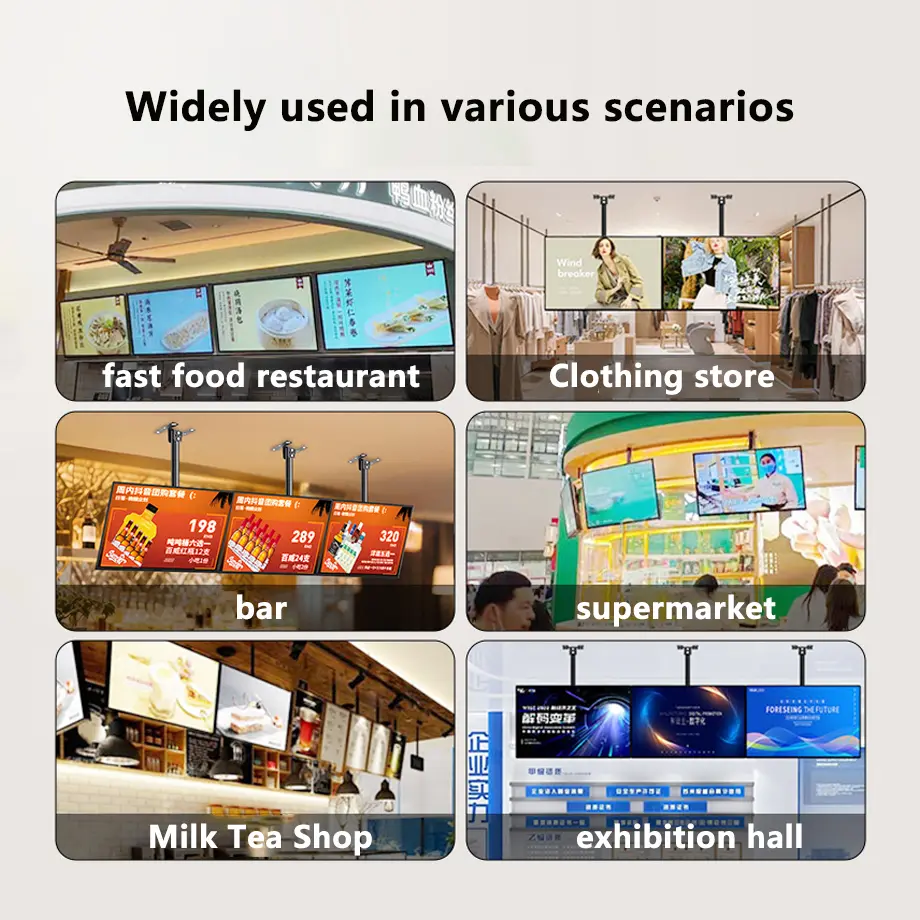
This High Luminance Stretched Signage LCD Module is particularly relevant to passenger-information displays, station and terminal guidance, route-message bands, departure boards and other long-format digital-signage equipment. The combination of a 43-inch format, 1920 × 360 native resolution, 1000 cd/m² typical luminance and wide IPS viewing supports installations where a standard-height display would occupy unnecessary vertical space.
It can also be considered for other protected high-ambient public-information installations after electrical, optical, mechanical and environmental conditions are qualified. The module should be selected as a component platform rather than treated as a finished weatherproof signage enclosure.
Customization and Procurement
Project review can cover LVDS controller and cable matching, front glass, anti-glare or anti-reflective treatment, optical bonding, enclosure adaptation, mounting support, cable routing and separate touch development.
Custom configurations are generally reviewed from 500 pieces, subject to tooling requirements, material availability and the requested specification. Sample and standard-module quantities are confirmed separately.
Procurement Checklist
Before sample or production approval, confirm native 1920 × 360 timing, complete 51-pin LVDS assignment, channel and bit mapping, electrical levels, connector orientation, WLED voltage/current/enable/dimming requirements, 1073.78 × 201.336 mm active area, 1112.3 × 228.5 mm outline, 19.3 mm maximum thickness, 1000 cd/m² luminance tolerance, 1200:1 contrast target, IPS viewing data, non-touch configuration, 0°C to +50°C operating range, −20°C to +60°C storage range, front-window optical stack, enclosure conditions, sample criteria, quantity and annual demand.
FAQ
About 43 Inch High Luminance Stretched Signage LCD Module
What must be checked before connecting a 51-pin LVDS controller?
How should passenger-information content be prepared for 1920 × 360?
Is 1000 cd/m² sufficient behind a protective front window?
Which dimensions control enclosure release?
When should the non-touch version be selected?
Freya Yang
+86 18318948097