~
~
~
~
~
~
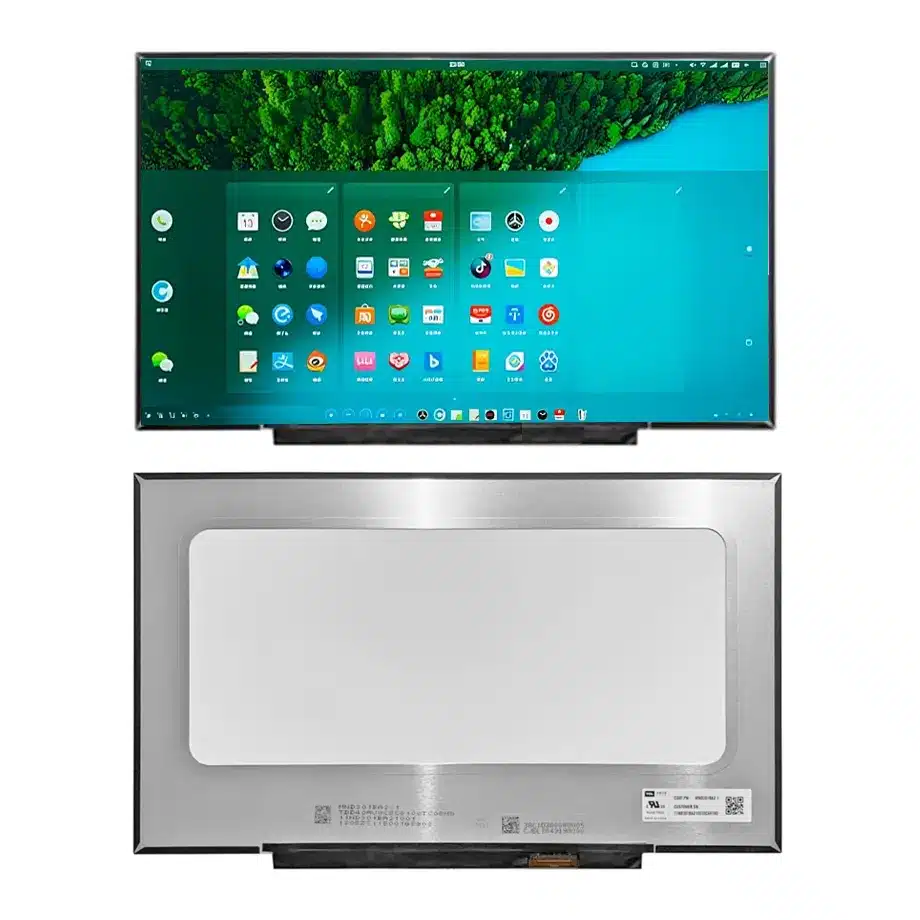
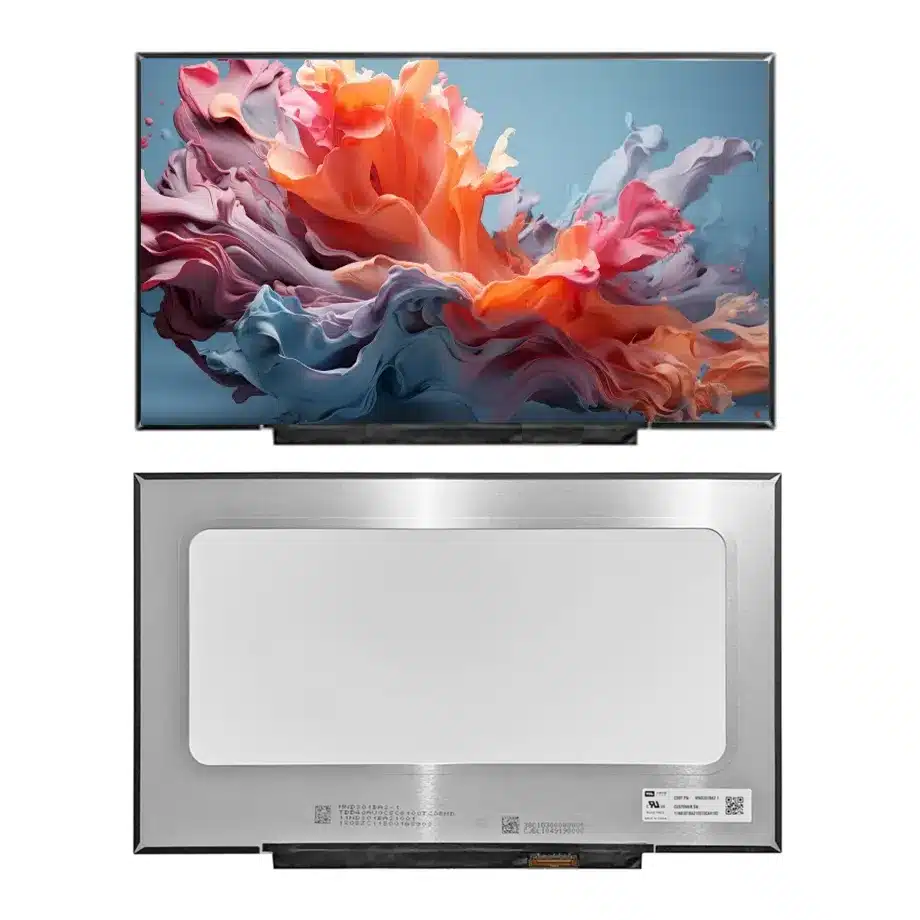
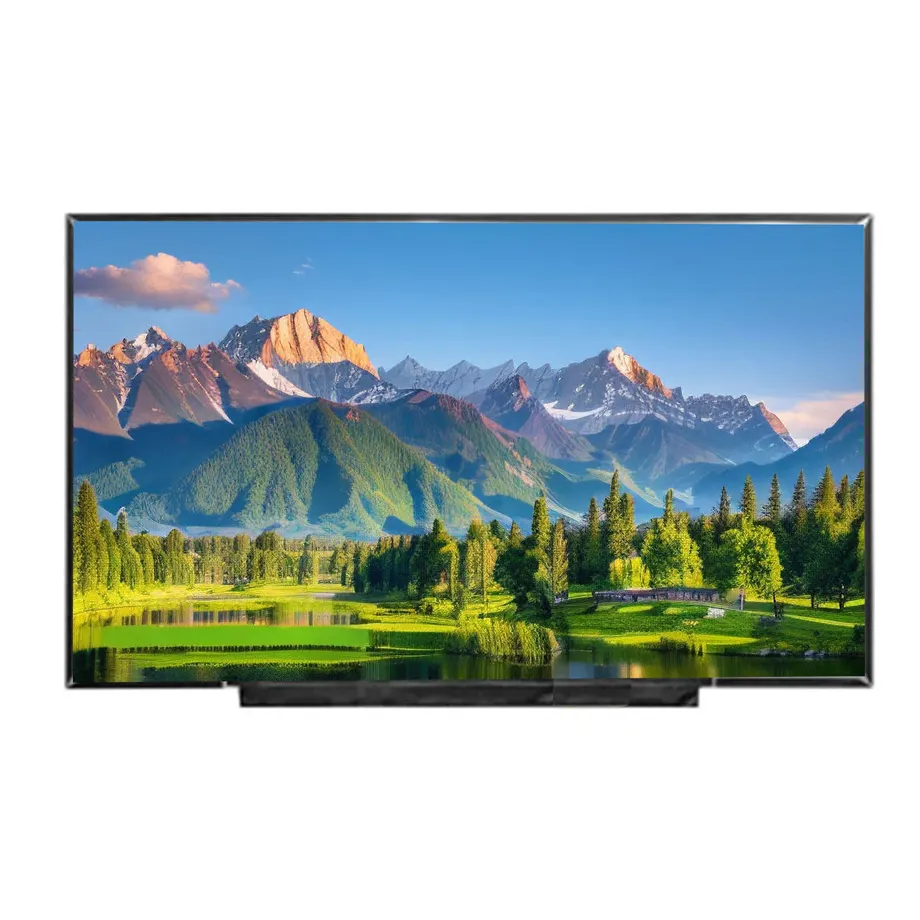
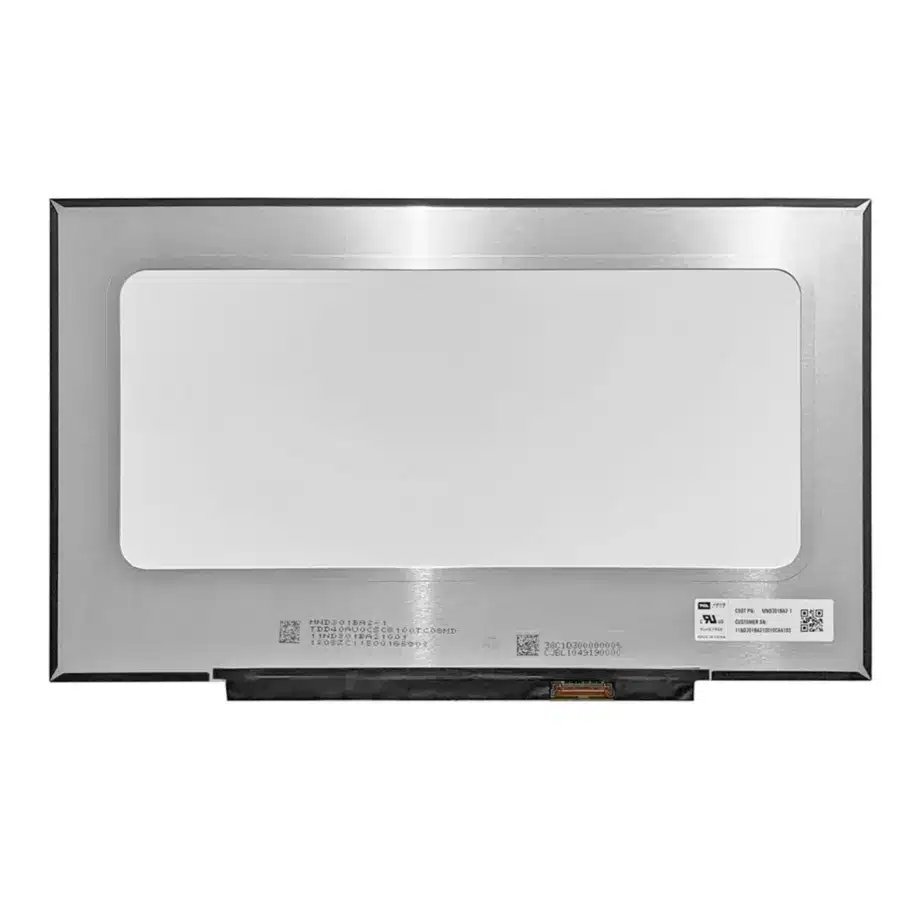
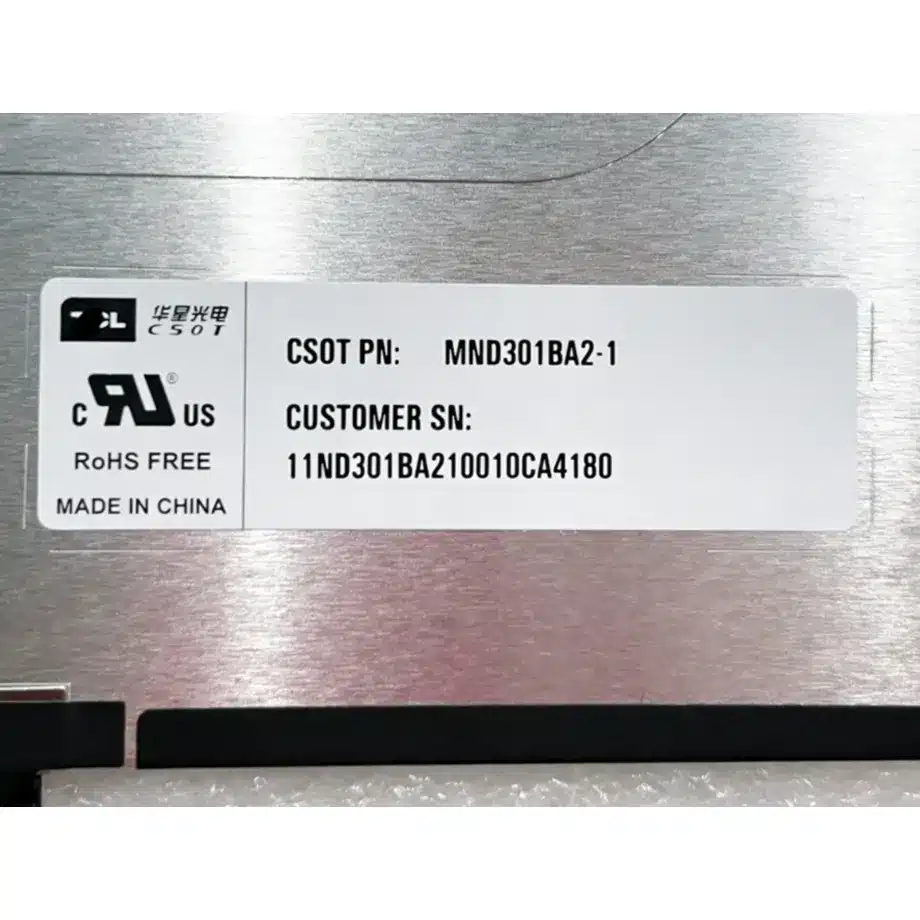
MND301BA2-1 FHD FFS Notebook Panel WLED CSOT
Model P/N
Size
Resolution
Brightness
Viewing Angle
Connector Type
Operating Temp
Overall(mm)
csot
MND301BA2-1
Brand
Panel Size (inch)
Model P/N
Resolution
Brightness (nits)
Viewing Angle
Contrast Ratio
Response Time
Overall (mm)
Active Area (mm)
Refresh Rate
Display Colors
Panel Type
Connector Type
Operating Temp
Touchscreen Type
Storage Temp
Work Mode
Pixel Format
Designed For
Product Details
Product Overview
MND301BA2-1 FHD FFS Notebook Panel is a 13.3-inch CSOT LTPS TFT-LCD module documented for laptop use. Its native resolution is 1920(RGB)×1080 FHD in a 16:9 format, with a 293.76 × 165.24 mm active area. The panel uses FFS normally-black transmissive operation, a 1000:1 typical contrast ratio and 89/89/89/89 viewing-angle values. A WLED backlight is documented. Operating temperature is 0 to 50 °C and storage is -20 to 60 °C.
Several integration fields remain intentionally unresolved for this exact model: available exact-model documentation does not establish outline dimensions, module mass, luminance, surface treatment, response time, color specification, refresh rate, touch configuration, display interface, connector geometry or panel input voltage. Those values should not be filled from another 13.3-inch CSOT notebook panel simply because size and resolution match. The exact product should therefore be treated as a defined FHD FFS optical platform whose final mechanical and electrical release depends on controlled model-specific documentation.
Three Core Buyer Value Propositions
1. 13.3-inch FHD geometry gives service and notebook teams a precise optical target
The combination of 1920×1080 resolution, 16:9 format and a 293.76 × 165.24 mm active area provides a concrete image-window definition for compact notebook projects. That is more useful than specifying “13-inch laptop screen” because diagonal labels alone do not establish native timing or aperture size. For replacement work, these confirmed values can be used as early screening criteria, while connector position, outline, mounting and cable requirements remain separate exact-model checks.
2. FFS normally-black optics and 1000:1 contrast establish a broad-view display baseline
The FFS mode, symmetric 89-degree viewing values and 1000:1 typical contrast define a practical notebook optical class for general productivity, education and portable-computing applications. These values can support sample inspection and system-level display evaluation without inventing unsupported brightness or gamut claims. Because luminance, surface finish and color coverage are unresolved, the panel should not be marketed as high-brightness, wide-gamut, color-calibrated or outdoor-readable without additional exact evidence.
3. Sparse exact-model electrical data makes documentation control a procurement advantage
When a panel's interface and connector are not confirmed, the safest procurement strategy is to preserve the exact model identity and make drawing/pinout verification a release requirement. That prevents a common replacement error in which another 13.3-inch FHD panel is accepted based only on visible image specifications. Cable mapping, input voltage, backlight control and mechanical fit can differ materially even when the active area and resolution appear similar. Treating unknowns explicitly reduces the risk of a superficially compatible but electrically incorrect substitute.
Key Specifications at a Glance
| Parameter | Confirmed value |
|---|---|
| Manufacturer / model | CSOT MND301BA2-1 |
| Display size | 13.3 inch |
| Panel type | LTPS TFT-LCD, LCM |
| Native resolution | 1920(RGB)×1080 FHD, 16:9 |
| Active area | 293.76 × 165.24 mm |
| Display mode | FFS, Normally Black, Transmissive |
| Contrast ratio | 1000:1 typical |
| Viewing-angle values | 89/89/89/89 |
| Backlight | WLED |
| Operating / storage | 0 to 50 °C / -20 to 60 °C |
| Documented application | Laptop |
| Unresolved exact-model fields | Outline, mass, luminance, surface, response, colors, refresh, touch, interface, connector and panel input |
Why unresolved interface data should stop a plug-and-play compatibility claim
A notebook panel cannot be qualified from resolution and diagonal alone. The motherboard needs the correct signaling standard, lane count or channel mapping, connector pinout, input voltage and power sequence. None of those values is sufficiently established for this exact model in the available exact-model documentation. The engineering response is not to guess a common notebook interface; it is to obtain the controlled specification or confirm the panel electrically on an approved production sample.
For MND301BA2-1 FHD FFS Notebook Panel, procurement should request the exact pinout and mechanical drawing before approving a replacement or new platform. A 30-pin or 40-pin connector assumption would create false certainty, and an interface borrowed from a family member could damage hardware if voltage or mapping differs. Treat interface confirmation as a gating design input, especially for service programs that encounter multiple visually similar 13.3-inch FHD panels.
What FFS normally-black operation contributes to notebook viewing
FFS is a wide-view LCD architecture, and the exact model's 89/89/89/89 viewing values are consistent with broad angular visibility. The normally-black mode also gives the product a defined dark-state orientation for optical evaluation. Those facts support general laptop applications in which the screen is viewed from changing angles, such as shared documents, classroom use or portable work. They should not be expanded into IPS branding or another manufacturer's trademarked technology description.
The 1000:1 typical contrast ratio is a panel-level value under specified test conditions. The final notebook's apparent contrast will also depend on surface treatment, cover layers, ambient light and backlight control. Because the surface finish and luminance are unresolved, no conclusion should be made about glare performance or bright-room readability until an exact sample or controlled specification supplies those parameters.
WLED backlight: what is known and what still needs confirmation
The exact model is documented with a WLED backlight, which distinguishes it from a bare LCD cell requiring a complete external optical light source. However, the available evidence does not establish the LED-string arrangement, integrated-driver status, backlight voltage, lifetime or dimming method. The notebook system should therefore verify the actual backlight electrical requirements before board or cable release rather than assigning a standard value from another CSOT panel.
TCL CSOT's laptop display overview describes a broader notebook portfolio spanning business, entertainment, touch and higher-performance products. That manufacturer context supports Laptop as an application class, but it does not add high-refresh, touch, brightness or gamut specifications to MND301BA2-1. The exact model remains defined only by the confirmed facts available for this suffix.
LTPS context without importing portfolio-level claims
The panel type is LTPS TFT-LCD, which identifies the backplane technology but does not by itself determine power consumption, refresh rate or pixel response. TCL CSOT's HFS and notebook technology overview discusses LTPS and other notebook display developments in the company's wider technology portfolio. Those examples explain why notebook panels can vary substantially in power, color and refresh even within one manufacturer.
For this model, no exact power figure or refresh rate is confirmed. A sourcing page should not transfer a portfolio claim such as 120 Hz, wide gamut or sub-one-watt operation onto MND301BA2-1. The correct practice is to keep those fields blank until model-specific evidence is available and to test the approved sample under the target notebook's timing and power conditions.
Mechanical integration when only active area is confirmed
The active image rectangle is 293.76 × 165.24 mm, which is useful for estimating the visible bezel aperture. It is not enough to design the lid cavity because the outer dimensions, thickness, mounting method, connector location and board geometry remain unresolved. Mechanical engineers should obtain the current drawing before tool release and avoid copying an outline from a similar 13.3-inch FHD display.
For service replacement, compare the original panel label and full suffix first, then verify cable reach, connector side, bracket or adhesive geometry and lid clearance. The missing mass also means hinge and weight calculations should use an approved sample measurement if they depend on exact panel weight. A family-level mechanical assumption can create fit problems even when the active image aligns perfectly.
Environmental limits and practical notebook qualification
The exact operating range is 0 to 50 °C with -20 to 60 °C storage. These component limits are appropriate inputs to a notebook thermal plan but do not establish rugged, industrial-wide-temperature or automotive qualification. Finished-system testing should consider heat from the processor, charging system and lid environment, especially at maximum backlight demand once the exact backlight electrical characteristics are known.
Cold boot, warm operation, sleep/resume and repeated lid cycles should be checked on the intended hardware. If a commercial product needs a wider environmental range, select or qualify a panel with supporting exact-model evidence rather than extending the MND301BA2-1 limits by assumption. The same principle applies to impact, vibration and lifecycle requirements that are not documented here.
Application fit for compact FHD notebook platforms
MND301BA2-1 FHD FFS Notebook Panel is documented for Laptop use. Its strongest supported scenario is a 13.3-inch FHD notebook or service program that values broad-view FFS operation, 1000:1 contrast and a WLED-lit module, while retaining model-specific interface and mechanical verification as release requirements. Business notebooks, education systems and general portable-computing products are reasonable application directions when the remaining electrical and optical parameters are confirmed for the target design.
No exact OEM notebook compatibility is asserted. A reseller may describe a model as suitable for a particular laptop family, but exact fit requires the original panel identity, connector, cable, lid mechanics and firmware timing to agree. Replacement approval should therefore use the full suffix and controlled documentation rather than a generic “13.3-inch 1080p” search description.
Procurement and validation checklist
- Lock CSOT MND301BA2-1 and the complete suffix in purchasing records.
- Verify native 1920×1080 timing and the 293.76 × 165.24 mm active area.
- Obtain the exact interface, connector pinout and panel input requirements before motherboard or cable release.
- Obtain the mechanical drawing for outline, depth, connector position and mounting details.
- Confirm the WLED backlight electrical arrangement, driver method and dimming behavior.
- Verify 1000:1 typical contrast and broad-view FFS behavior on an approved sample.
- Keep luminance, surface, response time, colors, refresh rate and touch status unresolved until exact evidence is available.
- Use the documented 0 to 50 °C operating and -20 to 60 °C storage limits as component boundaries.
- Do not infer named-device compatibility, certification, lifecycle, price, MOQ or lead time from incomplete market references.
For MND301BA2-1 FHD FFS Notebook Panel qualification, provide the target notebook motherboard, original panel identity if this is a replacement, cable and lid drawings, backlight-control requirements, environmental limits and required quantity. Exact-model interface and mechanical documentation should be closed before production approval so that a similar 13.3-inch FHD notebook panel is not treated as interchangeable without proof.
Recommended: Same Size
(13.3")
Applications & Value of LCD Panel

- Fast sourcing with in-stock panels & cross-reference alternatives
- Stable supply chain with long-term availability
- Engineering-level support from panel to integration
- Custom solutions: cable, touch & optical bonding
- Strict quality control with IQC / OQC / aging test
- Full traceability system for quality assurance
- Complete technical documentation & drawings
- Compliance support: RoHS & certification files