Freya Yang
+86 18318948097
+852 62667476
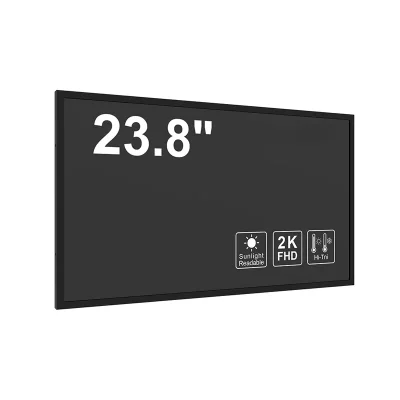
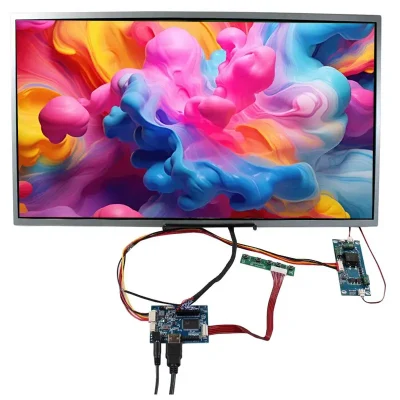
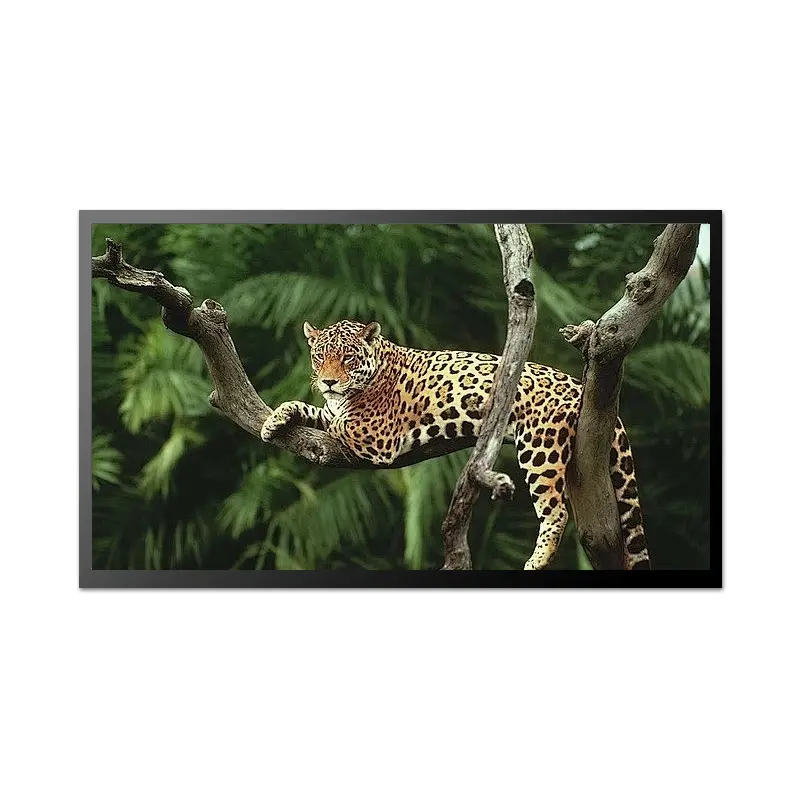
23.8 Inch Wide Viewing FHD LCD Module for Outdoor Signage
Model P/N
Size
Resolution
Brightness
Viewing Angle
Connector Type
Operating Temp
Overall(mm)
huisoar
HS0238GA01-C150
Brand
Panel Size (inch)
Model P/N
Resolution
Brightness (nits)
Viewing Angle
Contrast Ratio
Response Time
Overall (mm)
Active Area (mm)
Refresh Rate
Display Colors
Panel Type
Connector Type
Operating Temp
Touchscreen Type
Storage Temp
Work Mode
Pixel Format
Operating Environment
Designed For
23.8 Inch Wide Viewing FHD LCD Module for Outdoor Signage
Built for protected signage enclosures, this 23.8-inch IPS module combines native Full HD graphics with 1500 cd/m² typical luminance and a 30-pin LVDS connection.
Product Summary
The Wide Viewing FHD LCD Module is a 23.8-inch a-Si TFT-LCD component for industrial information systems, public displays, and outdoor-facing signage assemblies that need a native 1920 × 1080 image. Its IPS hard-screen construction provides 89° viewing from the left, right, top, and bottom, while the 3000:1 typical contrast ratio supports clear differentiation between bright and dark interface elements.
The standard configuration is non-touch and uses a 30-pin LVDS connection. A matching connector count does not establish timing, voltage, channel mapping, bit width, or cable compatibility.
The 1500 cd/m² panel rating must be validated behind the final front window before finished-system outdoor readability is approved.
Key Specifications at a Glance
| Parameter | Confirmed value |
|---|---|
| Display size | 23.8 inches |
| Resolution | 1920 × 1080 pixels |
| Aspect ratio | 16:9 |
| Panel technology | a-Si TFT-LCD, IPS hard screen |
| Operating mode | Transmissive |
| Luminance | 1500 cd/m² typical |
| Contrast ratio | 3000:1 typical |
| Viewing angles | 89°/89°/89°/89° left/right/up/down |
| Display colors | 16.7M colors |
| Interface | LVDS |
| Connection | 30 pins |
| Active area | 527.04 × 296.46 mm |
| Module outline | 557.2 × 326.6 × 17.5 mm |
| Backlight | WLED |
| Touch | No touch |
| Operating temperature | 0°C to +50°C |
| Storage temperature | −20°C to +60°C |
Native Full HD Content and 16:9 Layout
Preserve the 1920 × 1080 Raster
The native 16:9 raster matches standard Full HD advertising, public-information, and industrial visualization content. Prepare graphics directly at 1920 × 1080 to avoid unnecessary scaling, soft text, or distorted aspect ratios.
Confirm landscape orientation, scan direction, refresh timing, and pixel mapping before software release. Small text and dense data should also be evaluated at the final viewing distance.
IPS Viewing Geometry
The confirmed viewing sequence is 89° left, 89° right, 89° up, and 89° down. This supports off-axis observation, but mounting height, panel tilt, front-window reflections, and ambient illumination still influence perceived contrast.
Test the display with the intended enclosure and viewing positions rather than relying only on the panel-angle values.
Wide Viewing FHD LCD Module LVDS Integration
30-Pin Host Compatibility
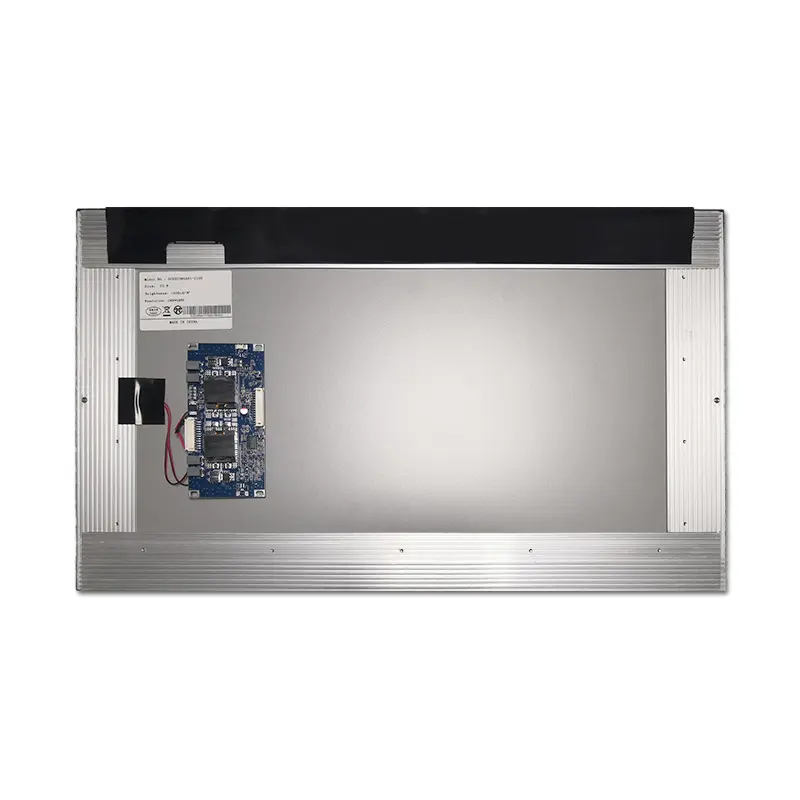
The module uses a 30-pin LVDS connection. Compatibility requires the complete pin assignment, connector geometry, contact side, cable orientation, voltage rails, channel count, bit width, clock arrangement, and color mapping.
Another 23.8-inch Full HD panel can use the same connector count while requiring a different cable, controller configuration, or electrical definition.
LVDS Timing and Mapping
Approve the native pixel clock, horizontal and vertical timing, polarity, channel mapping, and VESA or JEIDA convention for the ordered revision. Do not infer dual-channel, eight-bit, or a particular panel voltage from the interface name alone.
Hosts providing HDMI, DisplayPort, eDP, MIPI DSI, or another video standard require a matched controller or bridge that outputs the approved LVDS signal.
1500 cd/m² Optical Performance
Panel Luminance Versus Finished Readability
For the Wide Viewing FHD LCD Module, 1500 cd/m² provides substantial optical headroom for bright interiors, window-facing installations, shaded outdoor equipment, and protected signage enclosures. It does not independently establish direct-sun readability.
Cover glass, touch layers, adhesive, air gaps, decorative printing, contamination, enclosure shadows, and ambient reflections can reduce front-of-screen luminance and contrast. Qualify the display with the actual optical stack and installation lighting.
3000:1 Contrast and Reflection Control
The 3000:1 typical contrast ratio supports dark-field separation and legible interface elements under controlled conditions. High panel contrast cannot cancel strong surface reflections, so front-window transmission and reflectance remain critical.
Optical bonding, anti-reflective treatment, anti-glare treatment, enclosure shading, and automatic brightness control may be evaluated as separate system options. None should be assumed in the standard module.
WLED Backlight and Thermal Planning
Electrical Documentation Before Driver Selection
The module uses a WLED backlight, but the voltage, current, string arrangement, driver topology, enable logic, dimming method, and maximum power are not confirmed. Obtain the approved electrical data before selecting a driver or power supply.
Panel logic and WLED power should be treated as separate design domains unless approved documentation states otherwise.
Dimming, Heat, and Service Conditions
Higher luminance increases electrical and thermal demand. Confirm PWM or analog dimming, startup behavior, inrush current, cable requirements, thermal limits, and expected operating duty.
Backlight lifetime must be tied to a defined current, temperature, duty cycle, and luminance-decay criterion before it is used as a procurement requirement.
Mechanical Fit for 23.8-Inch Enclosures
Active Area Versus Module Outline
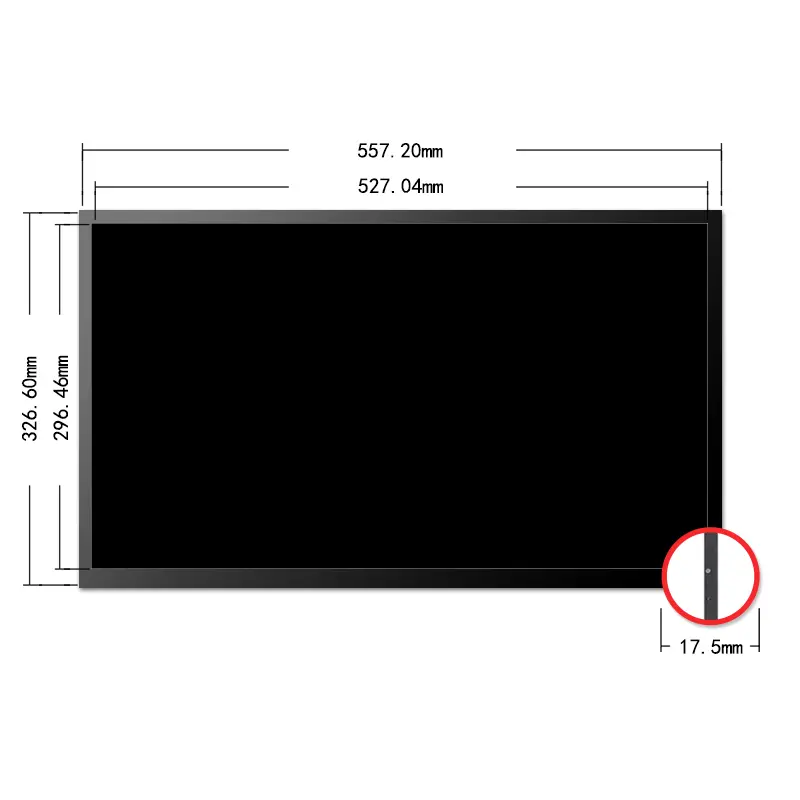
The 527.04 × 296.46 mm active area controls the visible image opening. The 557.2 × 326.6 mm outer dimensions control the enclosure cavity, support structure, and bezel clearance.
The design must also allow for connector access, cable routing, manufacturing tolerances, service clearance, and the non-active border. Diagonal size alone is insufficient for tooling release.
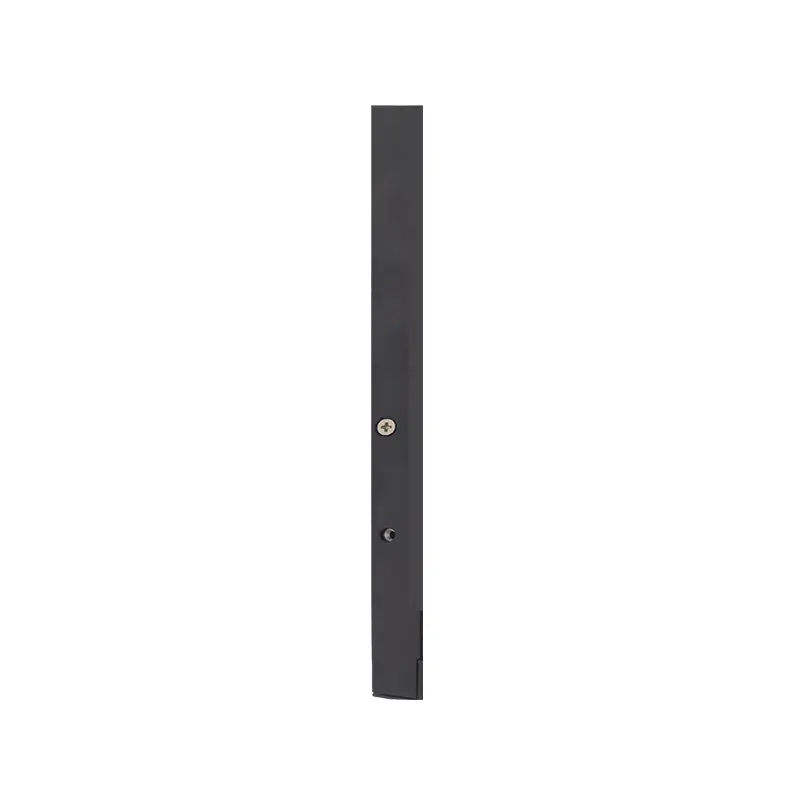
17.5 mm Maximum Thickness
The confirmed maximum thickness is 17.5 mm. This value does not include a project-specific touch sensor, cover glass, bonding layer, gasket, protective housing, controller board, or cooling hardware.
Mechanical supports should distribute force without twisting the panel or pressing against the active image area.
Environmental and Application Boundaries
The operating range is 0°C to +50°C, while the storage range is −20°C to +60°C. Storage limits do not expand the qualified operating range.
The Wide Viewing FHD LCD Module can be evaluated for protected outdoor digital signage, industrial control panels, public-information displays, transportation information systems, retail promotional enclosures, and bright-ambient kiosk equipment. Outdoor use requires a suitable enclosure, thermal path, moisture control, front-window design, and project-specific environmental qualification.
The module does not establish waterproofing, dust protection, vibration resistance, ultraviolet durability, continuous-duty grade, or an IP rating.
Customization and Procurement
Brightness review, LVDS cable and controller matching, front-window design, optical bonding, touch integration, WLED control, enclosure mechanics, thermal management, branding, and packaging may be evaluated by project.
Custom configurations are generally reviewed from 500 pieces, subject to tooling requirements, material availability, and the requested specification. Sample and standard-module quantities are confirmed separately.
Procurement Checklist
Confirm before sample approval:
- Assigned product revision and matching supplier revision.
- Native 1920 × 1080 timing and required refresh rate.
- Complete 30-pin assignment, connector orientation, and cable drawing.
- LVDS channel count, bit width, mapping, clocking, and VESA or JEIDA convention.
- Panel input voltage, current, inrush, and power-sequence requirements.
- WLED voltage, current, topology, enable, dimming, and thermal limits.
- 527.04 × 296.46 mm active opening.
- 557.2 × 326.6 × 17.5 mm module fit and tolerances.
- Front-window transmission, reflectance, and required front-of-screen luminance.
- Standard non-touch configuration or separately specified touch assembly.
- Operating environment, enclosure protection, sample criteria, quantity, and annual demand.

FAQ
About 23.8 Inch Wide Viewing FHD LCD Module
What must be checked before replacing another 30-pin LVDS panel?
Is 1500 cd/m² sufficient behind an outdoor-signage front window?
Does the 3000:1 contrast ratio remove the need for reflection control?
What changes when capacitive touch is added?
Which dimensions should control enclosure release?
Freya Yang
+86 18318948097