Freya Yang
+86 18318948097
+852 62667476
55 Inch 3000 Nits Sunlight Viewable LCD Panel for Outdoor Signage
Model P/N
Size
Resolution
Brightness
Viewing Angle
Connector Type
Operating Temp
Overall(mm)
huisoar
HS550ENT-N30
Brand
Panel Size (inch)
Model P/N
Resolution
Brightness (nits)
Viewing Angle
Contrast Ratio
Response Time
Overall (mm)
Active Area (mm)
Refresh Rate
Bezel Opening
Display Colors
Panel Type
Connector Type
Surface Treatment
Operating Temp
Touchscreen Type
Storage Temp
Work Mode
Pixel Format
Maximum Power
Operating Environment
Designed For
55 Inch 3000 Nits Sunlight Viewable LCD Panel for Outdoor Signage
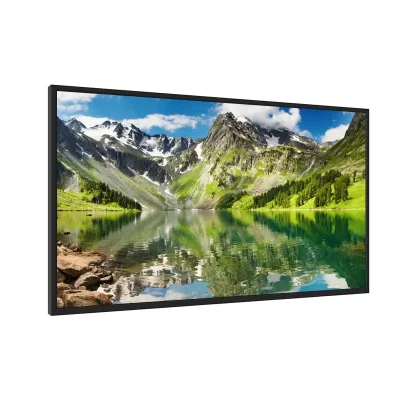
This 3000 Nits Sunlight Viewable LCD Panel pairs 4K UHD detail with anti-glare 3H treatment, ambient-light sensing and QWP support for bright display systems.
Product Summary
A 55-inch sunlight-viewable LCD panel needs more than high luminance when it is integrated into public-facing equipment. This configuration combines native 3840 × 2160 UHD resolution with a fixed 3000 cd/m² output, a 1209.6 × 680.4 mm display area and a slim 40.0 mm outline depth.
The optical structure is designed for bright environments, with an anti-glare 3H surface, wide ±89° horizontal and vertical viewing, a built-in light sensor and quarter-wave-plate support for viewing through polarized sunglasses. Portrait and landscape orientation support also gives equipment designers more freedom when planning outdoor signage, transport information displays and other high-ambient-light installations.
Key Specifications
| Item | Confirmed configuration |
|---|---|
| Nominal size | 55 inches |
| Native resolution | 3840 × 2160 pixels |
| Brightness | 3000 cd/m² |
| Display area | 1209.6 × 680.4 mm |
| Pixel pitch | 0.5593 × 0.5593 mm |
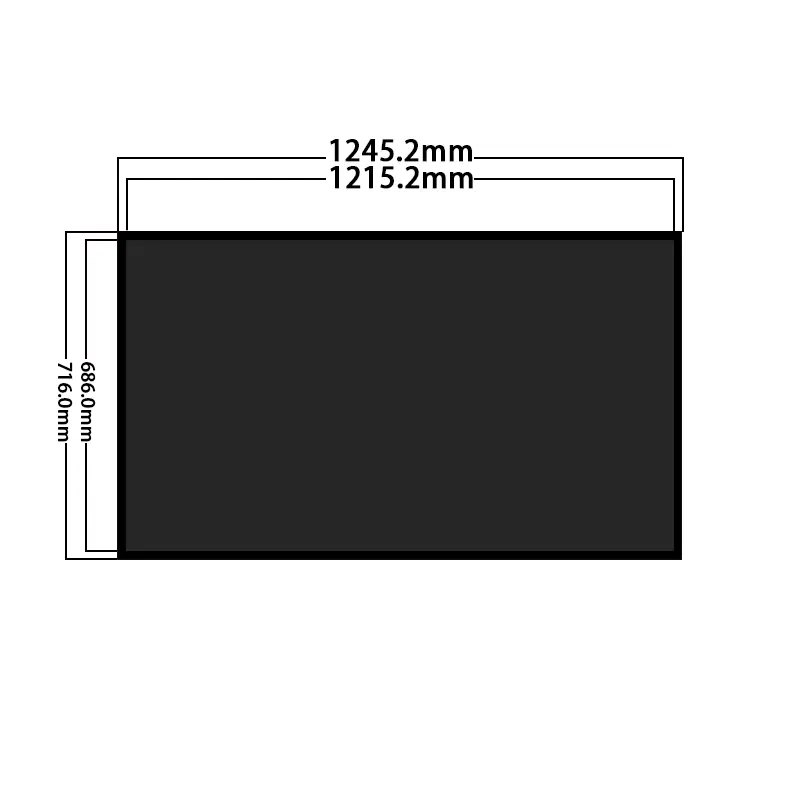
| Bezel opening | 1215.2 × 686.0 mm |
| Outline | 1245.2 × 716 × 40.0 mm |
| Display colors | 8-bit, 16.7M colors |
| Pixel arrangement | RGB vertical stripe |
| Operation mode | Normally Black |
| Surface | Anti-glare, 3H |
| Viewing | ±89° horizontal / ±89° vertical |
| Total power | 361.2 W typical |
| Orientation | Portrait or landscape |
| Ambient control | Built-in light sensor |
| Polarized-sunglasses support | Quarter-wave optical structure |
3000 cd/m² Optical Performance
A fixed 3000 cd/m² luminance level gives the panel substantial optical output for outdoor-facing and strong ambient-light applications. This is especially relevant when large 4K content must remain visually clear in transport systems, public information structures or charging equipment.
Brightness, however, is only one part of finished-system readability. The final cover glass, reflections, screen setback, ambient-light direction and thermal behavior can materially change perceived contrast. Optical qualification should therefore be performed using the actual front structure rather than approving the system from the luminance number alone.
Anti-Glare 3H Surface
The anti-glare 3H surface helps manage reflections at the panel level and adds a defined hard-coating grade. This creates a stronger starting point for high-ambient-light integration than an untreated front surface.
The finished optical stack still matters. If an enclosure adds ordinary glass several millimeters in front of the panel, reflections from that additional surface can become the dominant limitation. Cover-glass transmission, reflectance and spacing should therefore be included in the engineering review.
QWP and Polarized-Sunglasses Viewing
Quarter-wave-plate support is particularly relevant to outdoor and transport-facing systems because users may view the display while wearing polarized sunglasses.
The QWP feature should be validated after the final cover structure is chosen. Additional films, touch layers, laminated glass or polarizing materials can affect the finished viewing result, so polarized-sunglasses performance should be checked on the completed optical stack rather than only at panel level.
4K Content and Mechanical Integration
Native 3840 × 2160 resolution gives a 55-inch screen enough pixel capacity for detailed advertising, route information, charging instructions, maps, public notices and mixed text-and-image layouts.
For integrators, the mechanical references are equally important because three different dimensions serve different design purposes.
Active Area, Bezel Opening and Outline
The 1209.6 × 680.4 mm display area defines the visible image region. The 1215.2 × 686.0 mm bezel opening provides a separate reference for the front window, while the complete outline is 1245.2 × 716 × 40.0 mm.
Those values should not be treated as interchangeable. The active area controls content and viewing-window alignment, the bezel opening helps define the front aperture, and the complete outline determines physical fit inside the cabinet. An approved mechanical drawing should control final enclosure release.
Portrait and Landscape Deployment
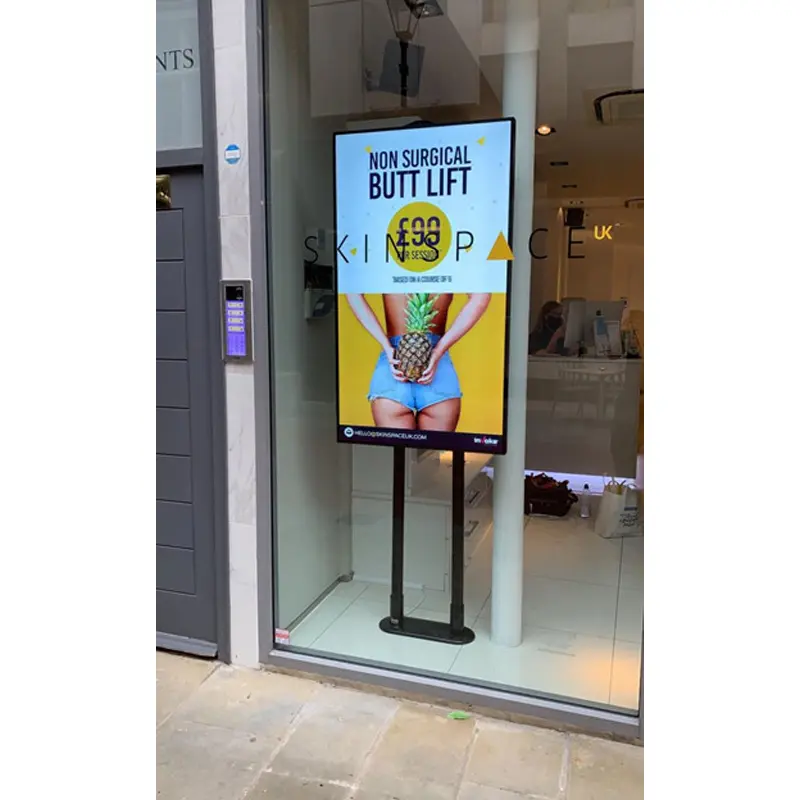
Portrait and landscape support gives the same panel platform more application flexibility. Landscape orientation is well suited to transport information, wide advertising layouts and multi-column public content. Portrait orientation can support freestanding information structures, charging equipment and vertical advertising.
Mounting hardware, cooling and cable routing must be designed around the final orientation. Orientation should therefore be locked before the cabinet and thermal path are approved.
3000 Nits Sunlight Viewable LCD Panel Integration
The 55-inch configuration combines optical features with system-level functions, but several important electrical integration parameters still require project confirmation.
Light-Sensor Control
The built-in light sensor provides a foundation for ambient-light-responsive brightness control. This is useful because an outdoor display does not necessarily need maximum luminance during every hour of operation.
The control curve, sensor position, minimum brightness, maximum brightness and response behavior should be commissioned for the actual installation. A sensor hidden behind dark glass or positioned where it sees internal rather than external light can produce inappropriate brightness decisions.
Power and Electrical Planning
The confirmed total power figure is 361.2 W typical.
That number does not define the required input voltage, connector or power architecture. A system designer should not reverse-engineer an assumed supply rail from the wattage value alone. The approved electrical document needs to specify input voltage, current demand, connector definition, grounding, panel/backlight power architecture and any separate controller requirements.
This distinction is especially important for an outdoor cabinet where display power, cooling hardware, control electronics and auxiliary devices may all share the system power budget.
Outdoor Signage Application Boundaries
The 3000 Nits Sunlight Viewable LCD Panel is relevant to outdoor digital signage, transport and bus information equipment, EV charging systems, outdoor information columns and security-monitoring displays.
These applications share a need for bright visual output, large-format 4K content and flexible mechanical integration. The 40.0 mm panel depth can also help equipment designers control cabinet thickness compared with deeper finished signage systems.
Weather Protection and Final Enclosure Qualification
Outdoor optical positioning must not be confused with a confirmed waterproof product grade.
A product-specific IP rating is not part of the confirmed technical specification set used for this panel. Any required protection against rain, dust, water jets, condensation or vandalism must therefore be qualified at the final enclosure level.
Generic IP-rated housings, sealed connectors and weather-resistant system options may be evaluated as separate customization routes, but they should not be presented as standard panel specifications without an approved project configuration.
Customization Options
Project engineering may review front glass, reflection control, optical bonding, additional coatings, enclosure adaptation, environmental sealing, ambient-light calibration, controller and interface selection, cabling, mounting architecture, branding and finished-system integration.
Generic IP-rated enclosures, wide-voltage power systems, industrial connectors, embedded operating systems and wireless communication packages are separate project routes rather than automatic standard features of this panel.
Custom configurations are generally reviewed from 500 pieces, subject to tooling requirements, material availability and the requested specification. Sample and standard-panel quantities are confirmed separately.
Procurement Checklist
- Confirm the assigned product revision and resolve the supplier reference-model conflict.
- Lock the fixed 3000 cd/m² output, tolerance and measurement method.
- Approve native 3840 × 2160 timing and intended content format.
- Confirm the 1209.6 × 680.4 mm display area.
- Confirm the 1215.2 × 686.0 mm bezel opening.
- Approve the 1245.2 × 716 × 40.0 mm mechanical outline in the documented axis order.
- Confirm the 0.5593 × 0.5593 mm pixel pitch.
- Verify the final cover glass, optical coatings and panel-to-glass spacing.
- Confirm whether polarized-sunglasses viewing is a project requirement.
- Define the light-sensor position and brightness-control behavior.
- Verify the 361.2 W typical total-power figure for the ordered revision.
- Obtain the actual input voltage, current and complete power architecture.
- Obtain the exact signal interface, connector and controller requirements.
- Lock portrait or landscape installation.
- Obtain the approved operating and storage temperature limits.
- Obtain panel/system weight and mounting requirements.
- Obtain the standard refresh rate.
- Confirm backlight lifetime grade if required.
- Confirm touch status and any separate touch-stack requirements.
- Define the required weather/IP protection at system level.
- Submit the enclosure drawing, site-light conditions, sample criteria, quantity and annual demand.

FAQ
About 55 Inch 3000 Nits Sunlight Viewable LCD Panel
What must be checked before using 3000 cd/m² behind protective glass?
Which dimensions should control the enclosure design?
How should the 361.2 W power figure be interpreted when input voltage is not listed?
What should be validated for portrait use and polarized-sunglasses viewing?
Does outdoor positioning mean the standard panel is waterproof?
Freya Yang
+86 18318948097