Freya Yang
+86 18318948097
+852 62667476
17 Inch Desktop WXGA LCD Module for Monitor Integration
Model P/N
Size
Resolution
Brightness
Viewing Angle
Connector Type
Operating Temp
Overall(mm)
huisoar
HS170WXGA01
Brand
Panel Size (inch)
Model P/N
Resolution
Brightness (nits)
Viewing Angle
Contrast Ratio
Response Time
Overall (mm)
Active Area (mm)
Refresh Rate
Bezel Opening
Display Colors
Panel Type
Connector Type
Surface Treatment
Operating Temp
Touchscreen Type
Storage Temp
Work Mode
Pixel Format
Input Voltage (V)
Control Type
Operating Environment
I/O Interface
Designed For
17 Inch Desktop WXGA LCD Module for Monitor Integration
This 16:10 TN display component combines 1440 × 900 resolution, dual-channel LVDS and a single-CCFL backlight for controlled-light monitor assemblies.
Product Summary
The Desktop WXGA LCD Module is a 17-inch display component for compact monitor assemblies that need a native 1440 × 900 workspace and a panel-level integration path. Its 16:10 format provides more horizontal room than older square layouts while retaining a manageable enclosure size.
The standard configuration uses TN, normally white, transmissive operation with 200 cd/m² typical luminance, 262K colors and a 60 Hz refresh rate. It is a non-touch module intended for indoor or otherwise controlled-light equipment.
Key Specifications
| Parameter | Confirmed value |
|---|---|
| Display size | 17 inches |
| Resolution | 1440 × 900 pixels, WXGA+ |
| Aspect ratio | 16:10 |
| Active area | 367.2 × 229.5 mm |
| Bezel opening | 371.2 × 233.5 mm |
| Outline | 382.2 × 244.5 × 6.8 mm |
| Luminance | 200 cd/m² typical |
| Contrast ratio | 300:1 typical |
| Viewing data | 45/45/20/35° typical, CR ≥ 10 |
| Preferred view | 6 o’clock |
| Response time | 12/4 ms typical, Tr/Td |
| Display colors | 262K, 6-bit |
| Surface | Glare, haze 0% |
| Refresh rate | 60 Hz |
| Native interface | 30-pin LVDS, two-channel, 6-bit |
| Panel input | 3.3 V typical |
| Backlight | One CCFL, listed 10,000-hour life, with driver |
| Touch | Non-touch |
| Operating temperature | 0°C to +50°C |
| Storage temperature | −20°C to +60°C |
WXGA+ Workspace for Compact Monitor Systems
Use the Native 1440 × 900 Raster
The host should output 1440 × 900 using the approved timing. Native operation preserves text shape, menu spacing and image geometry without scaling softness.
The 16:10 canvas works well for document windows, utility software, service menus and general monitor interfaces. Content should be prepared for the actual 17-inch viewing distance rather than copied directly from a larger Full HD screen.
Plan Around TN Viewing Behavior
The module uses TN, normally white, transmissive operation. Its raw viewing-angle sequence is 45/45/20/35° typical, and the preferred view is identified at 6 o’clock.
The enclosure should place the panel close to the expected viewer position. Applications requiring broad off-axis viewing, portrait rotation or several simultaneous viewing positions should be evaluated with an approved sample before release.
Optical Limits in Controlled Indoor Lighting
Treat 200 cd/m² as a Standard Indoor Level
The 200 cd/m² panel is intended for controlled indoor lighting.
The glare surface with 0% haze can produce stronger reflections than an anti-glare finish. Front glass, ambient light and viewing position should therefore be evaluated as a complete optical stack.
The standard specification does not establish sunlight-readable, outdoor-advertising or window-facing performance.
Match Color Expectations to the 6-Bit Panel
The module supports 262K colors through a 6-bit display path. It is suitable for standard desktop graphics, menus, office-style content and utility interfaces, but it should not be positioned as a wide-gamut or color-critical panel.
The 300:1 typical contrast ratio and traditional TN architecture place it in a straightforward monitor-integration category rather than a premium imaging category.
LVDS Integration for the Desktop WXGA LCD Module
Confirm the Complete 30-Pin Definition
The panel uses two-channel, 6-bit LVDS through a 30-pin connector.
A matching 30-pin connector does not prove LVDS compatibility.
The controller must match native timing, pixel clock, channel count, bit mapping, connector orientation, signal voltage and the complete pin assignment. Another 17-inch panel may use the same connector count while requiring a different cable or 8-bit mapping.
Separate Panel Power from Controller-Board Power
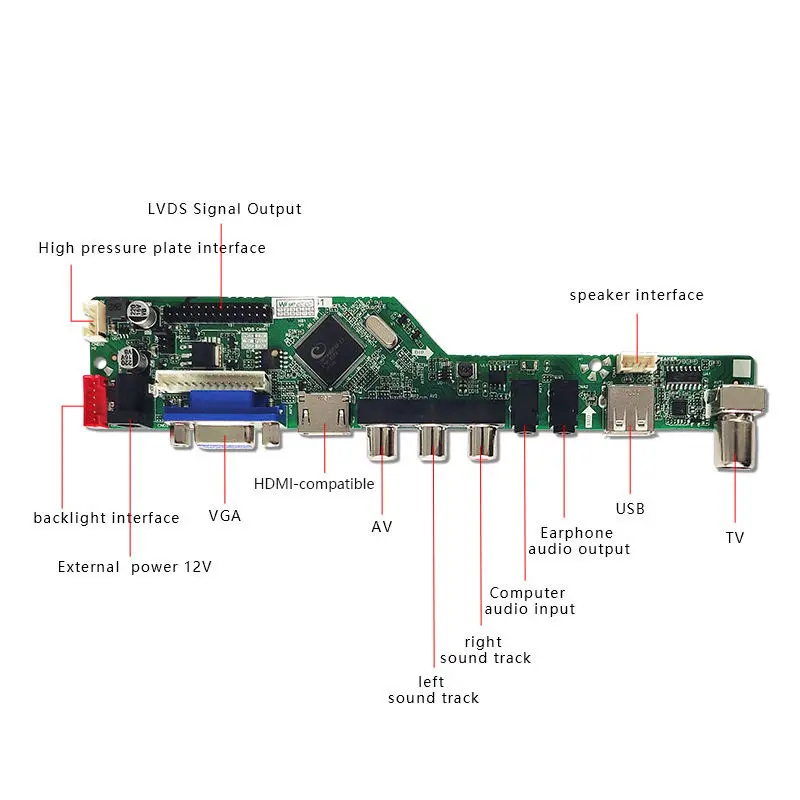
The panel input is 3.3 V typical. A controller-board illustration shows a separate 12 V external input, but that board-level supply must not be treated as the panel input.
The 3.3 V panel rail must not be confused with a 12 V controller-board supply.
Confirm the controller output, LVDS cable, panel rail, enable controls and backlight path as one matched system before power-up.
CCFL Backlight and Service Planning
Qualify the Single-CCFL Configuration
The module is specified with one CCFL lamp, a listed 10,000-hour life and a driver. This backlight architecture differs from current WLED modules and requires the correct high-voltage connection.
Do not substitute an LED-driver output or generic inverter without matching the lamp, connector and electrical requirements. The approved backlight documentation should control replacement and service decisions.
Keep the Controller Board as a Separate Scope
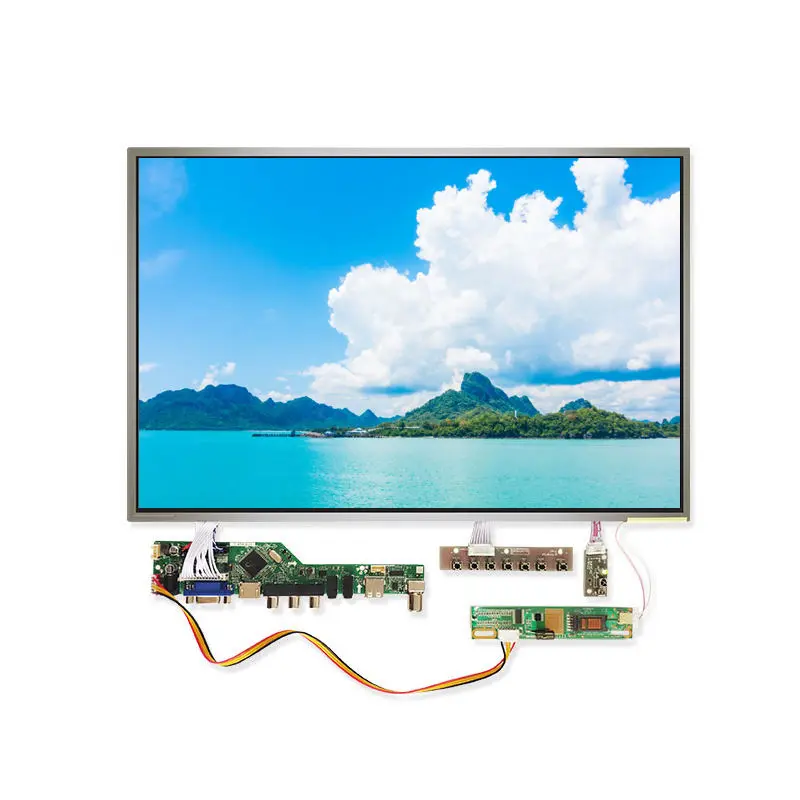
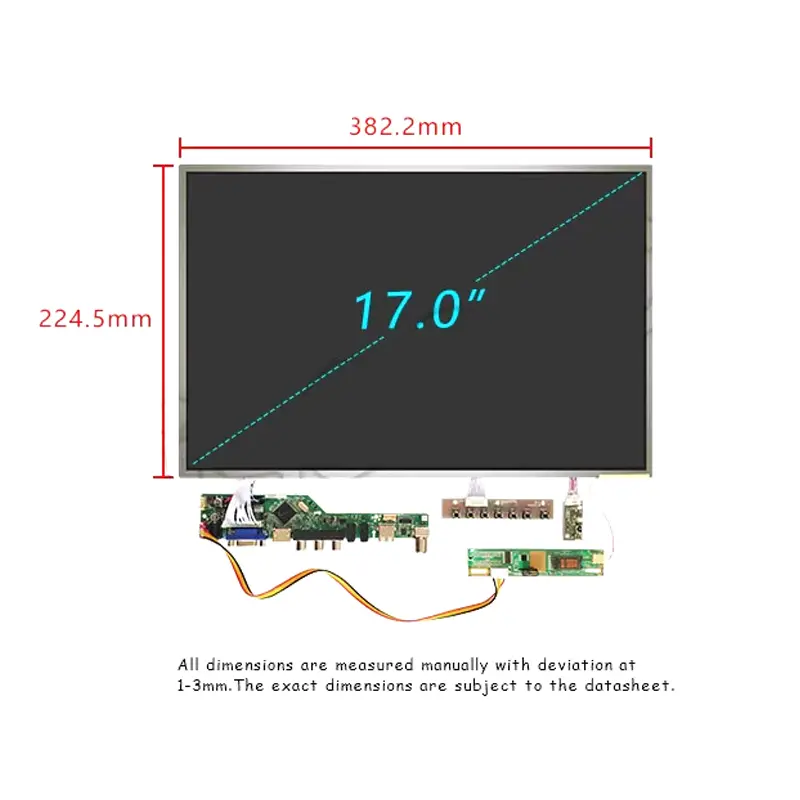
A controller-board image shows HDMI-compatible, VGA, AV, USB, TV and audio functions. These are external board functions, not native panel interfaces.
A controller-board image does not establish that the board, cable, speakers or ports are included.
The order should identify whether the requirement is for the raw LCD module, a matched controller kit or a complete monitor assembly.
Mechanical Fit for Monitor Assemblies
Use the Three Mechanical Boundaries Correctly
The active image area is 367.2 × 229.5 mm. The bezel opening is 371.2 × 233.5 mm, and the complete panel outline is 382.2 × 244.5 × 6.8 mm.
The enclosure opening should use the approved bezel and active-area drawing, while the internal frame must accommodate the complete outline, connector, CCFL wiring and cable bend radius.
Account for the Wedge Profile
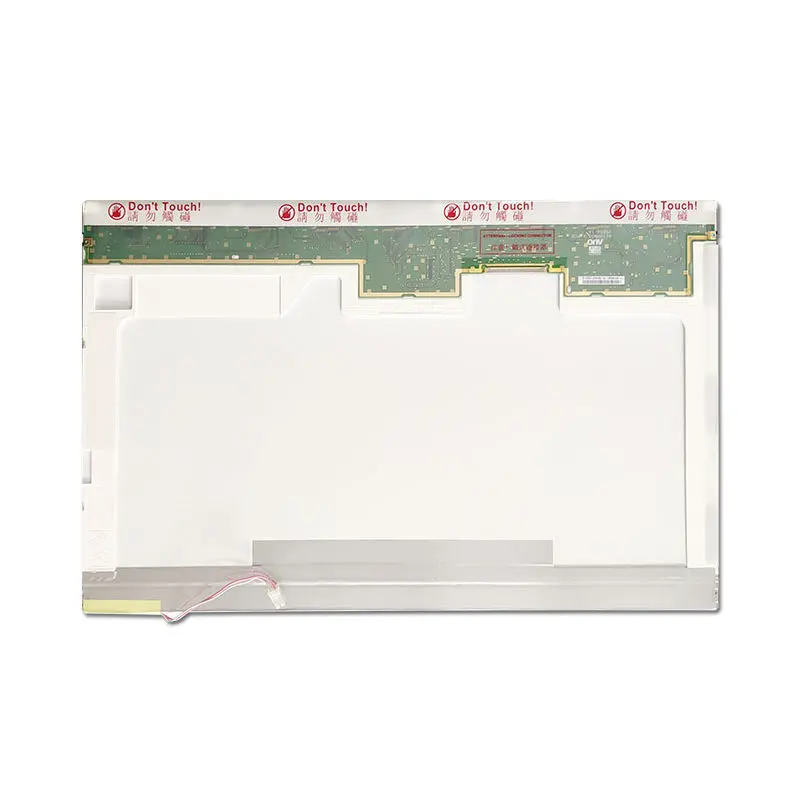
The module is described as a wedge structure with a bent PCBA and a depth reference of at least 5.2 mm. The 6.8 mm outline depth should not be treated as a uniform flat thickness across every rear area.
Keep-out zones, rear-board clearance and cable routing should be confirmed before tooling.
Application Fit
The Desktop WXGA LCD Module is best suited to compact desktop monitor assemblies, utility displays, service consoles and controlled-light indoor equipment that can use a fixed viewing position.
Indoor elevator media or wall-mounted information displays may also be evaluated where 200 cd/m² and the glare surface meet the actual lighting conditions. Outdoor, direct-sun and weather-exposed installations require a different optical and environmental specification.
Configuration Options
Project review can cover:
- Matched LVDS cable
- Controller board
- CCFL backlight connection
- Keypad and audio functions
- Enclosure adaptation
- Front cover
- Surface-treatment alternatives
- Branding
- Packaging
Logo, packaging and graphic customization are listed from 1,000 pieces.
Technical custom configurations are generally reviewed from 500 pieces, subject to tooling requirements, material availability and the requested specification. Sample and standard-module quantities are confirmed separately.
Procurement Checklist
Confirm these items before sample approval:
- Approved panel label and model-specific datasheet
- Native 1440 × 900 timing at 60 Hz
- Pixel clock and synchronization
- Two-channel, 6-bit LVDS mapping
- Complete 30-pin assignment
- Connector pitch, contact side and orientation
- 3.3 V panel input
- CCFL lamp and driver electrical requirements
- Whether the controller board and LVDS cable are included
- Required HDMI-compatible, VGA, AV, USB, TV or audio functions
- 367.2 × 229.5 mm active area
- 371.2 × 233.5 mm bezel opening
- 382.2 × 244.5 × 6.8 mm outline
- Wedge and rear-PCBA keep-out zones
- Glare-surface reflection under project lighting
- Fixed viewing position and 6-o’clock preferred view
- Non-touch requirement
- Operating and storage temperatures
- Sample quantity and annual demand

FAQ
About 17 Inch Desktop WXGA LCD Module
What must be checked before replacing another 30-pin LVDS panel?
Is the 200 cd/m² panel suitable behind protective glass?
Can a 12 V HDMI-compatible controller board power the panel directly?
What must be confirmed for the CCFL backlight?
When should a different panel technology be selected?
Freya Yang
+86 18318948097